
Tarnplanen: The Honest Health Case for a Camouflage Tarp
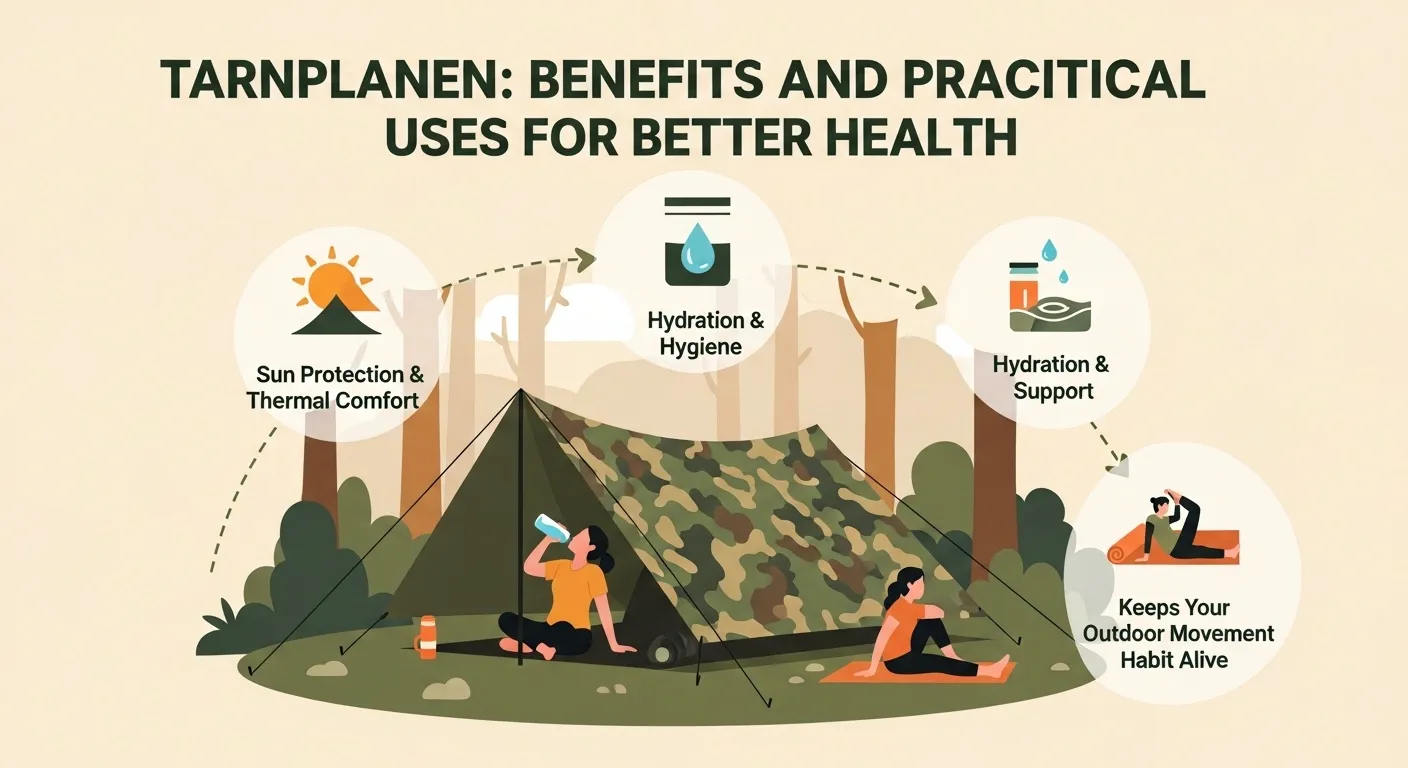
a Tarnplane doesn’t lower your cortisol, doesn’t boost your immune system, doesn’t do anything to your body at all. The forest does that. What the tarp does is keep you out there long enough, and dry enough, for the forest to land and the forest part is measured, not hand-waved. A 2026 Brazilian study clocked salivary cortisol falling from 0.29 to 0.16 μg/dL after a single forest-bathing session, with systolic blood pressure dropping from 119.5 to 108 mmHg, and one hour under the trees raises circulating levels of a tree compound called pinene about sixfold. The tarp is kit. The trees are the medicine. Worth being honest about which is which before anyone sells you a tarp as a wellness device.
The Forest Does The Work, The Tarp Removes The Excuse
You see, every number worth quoting belongs to the place, not the fabric. A systematic review and meta-analysis in the International Journal of Biometeorology pooled 22 studies and found cortisol significantly lower after forest exposure in nearly every trial, whether measured against an urban control group or as a before-and-after drop within the forest group itself. The Brazilian work went further on the psychological end the share of participants classed as low-stress jumped from 17.4% to 52.2% after one session.
None of that came from a sheet of coated nylon. It came from sitting under trees and staying put.
And "staying put" is the entire problem a tarp solves. A squall blows in, or a cold wind comes off the ridge, and most people are back at the car inside forty minutes - well before the parasympathetic shift the studies describe has had time to settle. You leave right as it's starting to work. A shelter you can rig in two minutes is the difference between a rained-off afternoon and the long, unbroken sit that actually moves the numbers, which is the only role Tarnplanen play in any of this.
What Forest Air is Actually Doing to You
This is the part the wellness blogs skip, and it’s the most interesting bit. Trees release aromatic compounds called phytoncides essential oils they produce to fend off insects and fungus. Pinene is the common one, and it doesn’t just sit in your nose. After an hour in the woods, circulating pinene rises roughly sixfold through your system.
Once it’s in you, it does something. A Japanese team led by Qing Li ran the cleanest test of this: they had twelve healthy men, aged 37 to 60, sleep three nights in an urban hotel room while cypress stem oil was vaporised into the air, then measured their blood and urine. Phytoncide exposure significantly raised natural killer cell activity and the proportion of NK cells expressing perforin, granulysin, and granzyme the proteins those cells use to kill while adrenaline and noradrenaline in the urine dropped. Natural killer cells are part of the immune front line against virus-infected and tumour cells.
The effect isn’t a flash in the pan either. Earlier work from the same group found the boost to NK activity lasted more than seven days after a forest trip, in both men and women. So a weekend under the trees is buying you a week of carryover, not an afternoon’s good mood.
A fair caveat, because this is health content and overclaiming is the commodity move. A 2024 systematic review on phytoncides and immunity graded the overall quality of evidence as low, noting the true effect could differ substantially from the estimate, partly because few studies exist and they vary in design. The direction is consistent and the mechanism is plausible. The magnitude in any one person is not nailed down. Treat it as a real, researched reason to spend hours in a forest not a prescription.
Microclimate, Framed Honestly
The pitch you’ll see everywhere is half-right, and the wrong half is worth correcting. A tarp won’t prevent illness. What it manages is your immediate exposure UV overhead, rain, and wind-chill carrying heat off your skin faster than your body replaces it. Cut the wind and the rain and you’ve removed the two biggest reasons a long sit outdoors slides from pleasant into miserable, or in cold conditions, into genuinely risky.
That’s enough on its own. It’s exposure management, not a cure, and saying so plainly is exactly what separates this from the identical “boost your wellness with a tarp” pages that hand the fabric credit for the forest’s work.
The Pitches that Actually Get Used
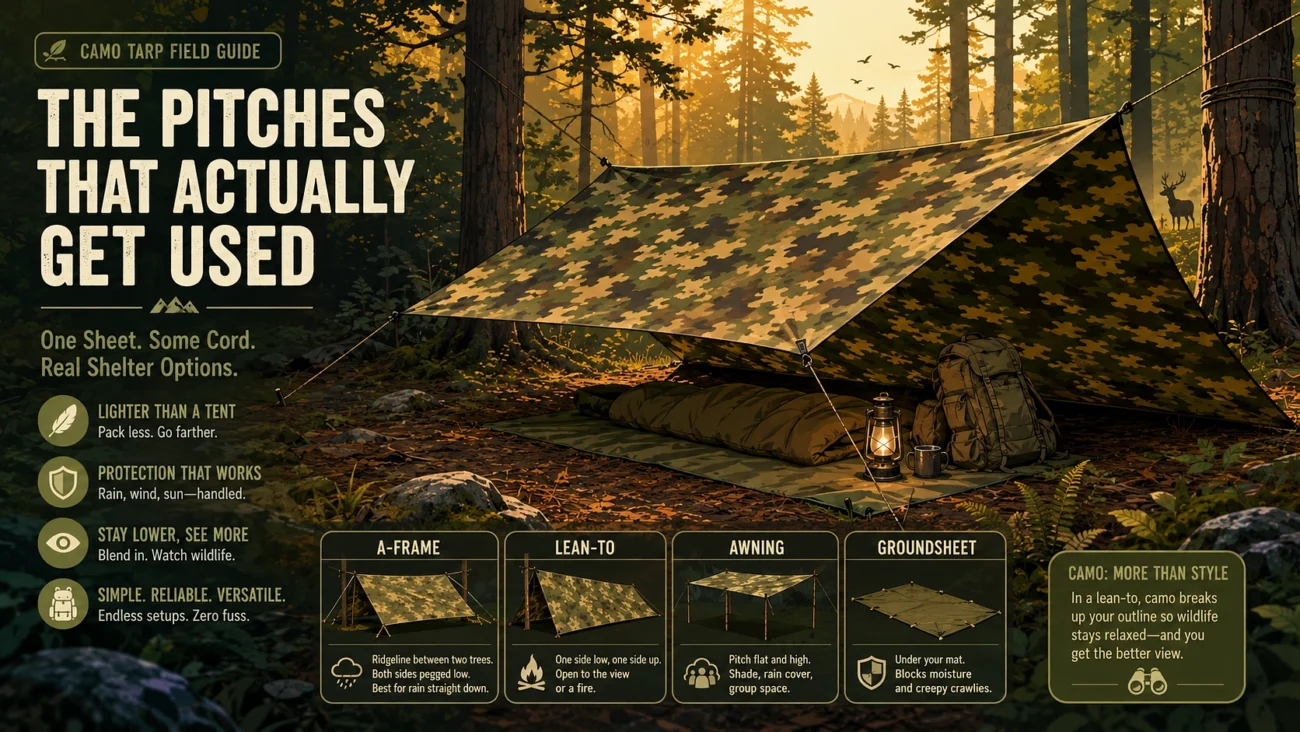
There’s a middle ground between hauling a full tent and roughing it under the open sky, and almost no casual walker touches it. One sheet, some cord, a couple of trees or trekking poles, and you’ve got real options:
- A-frame – ridgeline strung between two trees, both sides pegged low. Your default for rain coming straight down.
- Lean-to – one edge staked to the ground, the other lifted, open face toward a view or a fire.
- Sun-and-rain awning – pitched flat and high over a spot so a group can eat off the damp ground.
- Improvised groundsheet – laid under a sleeping mat against moisture creeping up and insects coming through.
Camo earns its keep most in the lean-to. A muted, broken-up pattern softens your outline enough to sit dead still while birds and deer carry on as if you weren’t there a far better window onto wildlife than blundering around trying to close the gap. That’s the one situation where the camouflage on Tarnplanen is function rather than marketing.
The Fabric is The Whole Decision, So Read it Properly
Here’s where a tarp that shrugs off ten seasons separates from one that wets through in its second autumn. Three specs carry it.
- Material and the trade-off nobody explains. You’ll see siliconised nylon, siliconised polyester, or PU-coated versions of either. Not interchangeable. Nylon is hydrophilic it absorbs water over time, which is why a nylon tarp sags in the rain and needs re-tensioning; polyester barely absorbs and holds its shape wet. Silnylon is lighter and stretchier; silpoly resists UV better and won’t go slack mid-storm. For something you’ll leave pitched for hours, that no-sag behaviour beats the gram or two you’d save.
- Hydrostatic head the number quietly doing everything. It measures how tall a column of water the fabric holds back before leaking, in millimetres. Ratings run from about 800 mm to 10,000 mm, and anything from 1,500 mm up generally counts as “waterproof.” Real tarps spread across that range a budget 10-denier nylon tarp might sit at 2,000 mm, a tough 75-denier ripstop polyester can hit 5,000 mm. A practical floor for sustained rain is around 2,000 mm in PU-coated nylon or polyester; 3,000 mm-plus buys margin for a long wet weekend. The tarp sold with no hydrostatic-head figure at all is the one to distrust that number gets dropped when it isn’t flattering.
- Denier, because it trades against weight. Denier is the thickness of the individual threads; higher denier is thicker, stronger, more durable, so 40D nylon outlasts 15D. The cost is weight. A 30-denier siliconised ripstop tarp can weigh as little as 300g and pack to hand-size, while a 70-denier survival tarp runs closer to 1.8 pounds but takes three days of rain and sun without failing. Hiking far, go low. Basecamp you’ll abuse, go heavy.
- Attachment points. At least 14 reinforced tie-outs plus a few ridgeline loops gives you the freedom to pitch low in a storm or high as a sunshade, and the better ones combine nylon webbing loops with rustproof grommets. Check the reinforcement, not the count a grommet punched through bare fabric tears out the first time wind really leans on it.
References
- Antonelli et al. Effects of forest bathing (shinrin-yoku) on levels of cortisol as a stress biomarker: a systematic review and meta-analysis. International Journal of Biometeorology, 2019.
- Forest bathing as an integrative strategy for mental and cardiovascular health: a quasi-experimental study in Brazil. Frontiers in Public Health, 2026.
- Li Q. et al. Effect of phytoncide from trees on human natural killer cell function. Int. J. Immunopathol. Pharmacol., 2009.
- Li Q. et al. Phytoncides (wood essential oils) induce human natural killer cell activity. Immunopharmacol. Immunotoxicol., 2006.
- Phytoncides and immunity from forest to facility: a systematic review and meta-analysis. ScienceDirect, 2024.
- What are Tent Fabric Specifications and Coatings? – hydrostatic head and denier reference.
- Silpoly vs Silnylon for Tents and Tarps – fabric trade-offs and per-square-metre costs.
- Best camping tarps, tested – Live for the Outdoors, denier/HH/weight figures.