
The Supportive Wellness Framework: Why Your Health Depends on Who’s Around You

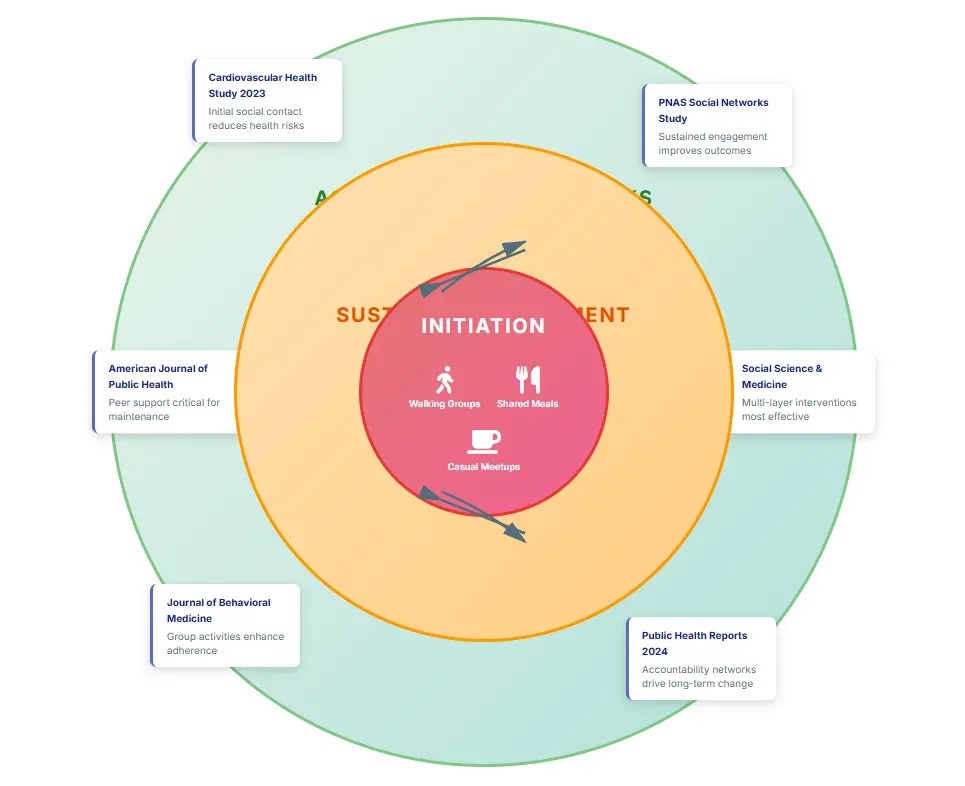
Most wellness advice treats you like an isolated unit. Eat this. Exercise that. Sleep better. Track your steps.
Missing from all that? The people.
Turns out your social connections might matter more than your gym membership. Not in some feel-good, inspirational quote way. In a “this affects how long you live” way.
What the Research Actually Shows
A 25-year study tracked 5,749 adults over 65. The Cardiovascular Health Study measured everything – disease markers, disability rates, who died when. Social networks mattered more than anyone expected. People with stronger social ties lived longer AND stayed functional longer. Not just alive – actually able to do things.
The effect size? Comparable to quitting smoking.
Social isolation increases mortality risk by 50-91%, depending on how you measure it. That puts loneliness in the same category as obesity and physical inactivity for predicting early death.
We’re not talking about feeling happy or having emotional support (though those matter). This is about physiological changes. Blood pressure. Inflammation markers. Stress hormones. Your body responds to social connection at a cellular level.
The Problem With Individual Wellness Plans
Standard health interventions focus on personal behavior change. Set a goal. Track progress. Use willpower.
Which works… until it doesn’t.
Peer support groups in weight loss programs show 22-28% of participants hitting clinically significant results. Individual programs? Much lower. The difference isn’t motivation or knowledge. It’s accountability and shared struggle.
When you’re trying to change health behaviors alone, you’re fighting your entire environment. When you’re doing it with others, the environment shifts.
The Framework: Three Layers That Build On Each Other
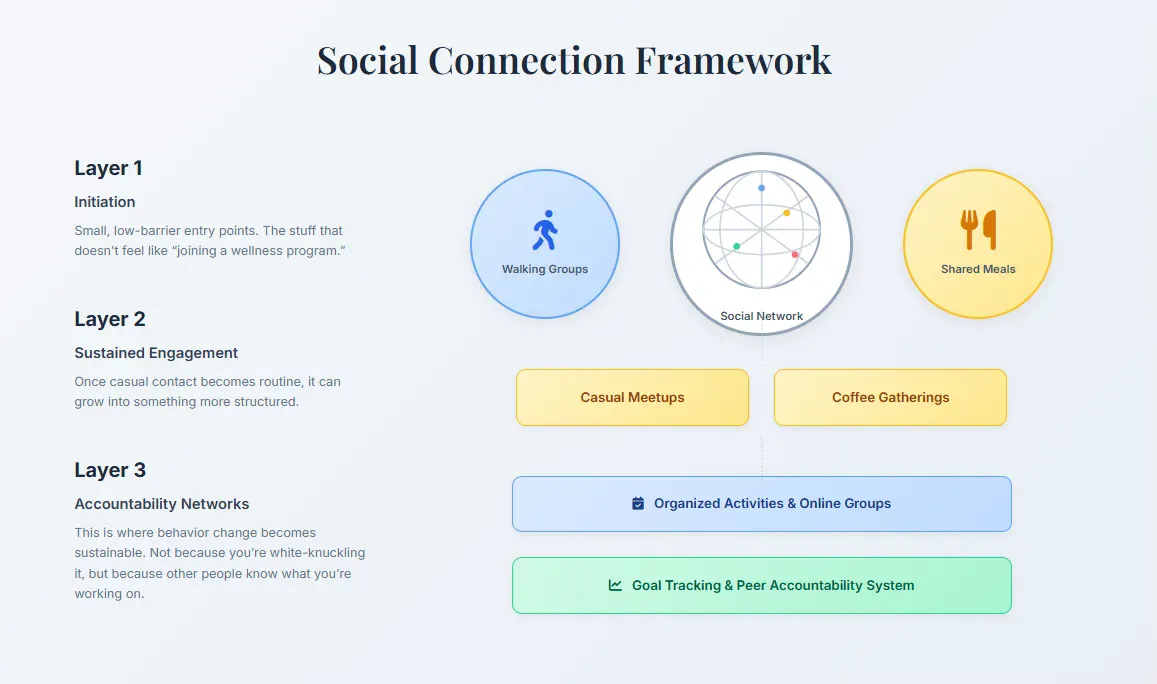
This isn’t a program someone designed. It’s a synthesis of what actually works based on multiple research streams.
Layer 1: Initiation
Small, low-barrier entry points. The stuff that doesn’t feel like “joining a wellness program.”
What this looks like:
- Weekly walks with one or two people
- Meal-sharing days where someone cooks, others show up
- Casual meetups with no agenda
- Shared grocery runs
- Coffee before work with coworkers
The research on collective efficacy shows something interesting. Communities with higher collective efficacy (basically, “we can do things together”) have lower obesity rates, less depression, better health outcomes overall. It’s not about formal programs. It’s about neighbors watching out for each other’s kids, small acts of cooperation, trust building.
You start here because it’s easy to say yes. No commitment. No pressure. Just regular contact with people who aren’t actively undermining your health goals.
Layer 2: Sustained Engagement
Once casual contact becomes routine, it can grow into something more structured.
What this looks like:
- Online groups sharing recipes and meal plans
- Organized activities (group hikes, cooking classes, sports leagues)
- Shared resources (meal prep tips, workout routines, local wellness spots)
- Regular check-ins about progress or setbacks
- Community events focused on health topics
Peer-led lifestyle interventions use “experiential and collaborative learning” instead of lectures. Participants work together to solve real-world challenges. The group becomes a laboratory for testing what actually works in daily life.
The PeerFIT program for adults with mental illness showed this approach working even in populations where individual interventions typically fail. Participants used smartphones to track activity, connected on Facebook between sessions, attended group exercise classes. The peer support network extended beyond formal meeting times.
Structure matters, but not rigidity. Groups that let participants shape activities based on their actual lives see better adherence than prescriptive programs.
Layer 3: Accountability Networks
This is where behavior change becomes sustainable. Not because you’re white-knuckling it, but because other people know what you’re working on.
What this looks like:
- Shared goal setting with specific, measurable targets
- Public progress tracking (group chats, shared docs, apps)
- Celebration of wins, no matter how small
- Honest conversations about setbacks without judgment
- Team-based challenges or competitions
- Mutual commitment to showing up
The MAN v FAT football program in the UK targets men with BMI over 27.5 through team-based weight loss. Players get incentives to lose weight as a team. It’s competition, but friendly. The coach provides support, but the accountability comes from not wanting to let your teammates down.
One participant quote from a different study: “You feel that somebody’s batting for you.”
Another: “You don’t want to let the team down.”
That’s accountability. Not guilt or shame. Knowing someone notices if you don’t show up.
Research on adherence in weight loss programs found attendance at group sessions and self-monitoring were the strongest predictors of success. But attendance isn’t about discipline. It’s about not wanting to ghost people who are counting on you.
Why This Works (The Mechanisms)
Three research-backed reasons:
1. Observational Learning When you see someone like you succeeding, you believe it’s possible for you too. Social cognitive theory calls this “modeling.” Peer support formats let less advanced members learn from those ahead of them.
2. Stress Buffering Social support dampens physiological stress responses. Lower cortisol. Reduced inflammation. Better immune function. The mechanism isn’t mysterious – it’s hormonal. Oxytocin, dopamine, serotonin get released during positive social interactions.
3. Environmental Modification Your social network shapes available choices. If everyone around you orders takeout every night, cooking feels abnormal. If half your friends meal prep on Sundays, it becomes the default option.
You’re not fighting your environment. You’re changing it.
How to Actually Build This
Start with one person. Not a group. One. Find someone also interested in making changes. Set a recurring time to walk, cook, or try something new together.
Let it grow organically. After a few weeks, invite others. Don’t overthink the structure. “We’re trying to eat better, want to join?” beats a formal wellness initiative.
Use what’s already there. Got coworkers? Start a lunch walking group. Neighbors? Organize a weekly potluck. Online communities? Join ones specific to your interests (runners, plant-based eating, weightlifting).
Create small rituals. Weekly check-ins. Monthly group activities. Shared tracking systems. The specifics matter less than consistency.
Celebrate everything. Someone showed up three weeks straight? That’s worth noting. Progress, not perfection.
Make it mutual. This only works if it’s not one person dragging everyone else along. Shared ownership means shared commitment.
What Doesn’t Work
- Forced participation. If it feels like homework, people bail.
- Perfectionism. The community that demands perfect adherence loses members fast.
- Comparison culture. “She lost 10 pounds, why haven’t you?” kills motivation.
- No room for failure. Life happens. Support means showing up even when someone’s struggling.
- Leader-dependent structures. If the whole thing collapses when one person gets busy, it wasn’t sustainable.
The Evidence Base
This framework synthesizes findings from:
- Cardiovascular Health Study (5,749 participants, 25-year follow-up) on social networks and longevity.
- Meta-analyses on social support and mortality showing 50-91% increased risk from isolation.
- Peer support weight loss interventions achieving 22-28% clinically significant results.
- Collective efficacy research linking community cohesion to health outcomes.
- PeerFIT program demonstrating peer-led lifestyle interventions for mental health populations.
- Studies on accountability and adherence in behavior change programs.
None of this research says “start a supportive wellness network.” That’s the synthesis. But every component has backing.
What Success Looks Like
Not everyone losing 30 pounds. Not perfect attendance. Not Instagram-worthy transformation photos.
Success is simpler:
- People showing up regularly.
- Behaviors changing gradually.
- Support when things get hard.
- Sustainable habits replacing temporary fixes.
- Health improvements that last.
The framework works because it aligns with how humans actually operate. We’re social animals. We change in groups. Individual willpower has limits.
Build the network. The wellness follows.
References
- Bhatia R, Hirsch C, Arnold AM, Newman AB, Mukamal KJ. Social networks, social support, and life expectancy in older adults: the Cardiovascular Health Study. Archives of Gerontology and Geriatrics. 2023;111:104981
- Frontiers in Psychology. Social Support and Longevity: Meta-Analysis-Based Evidence and Psychobiological Mechanisms. Published August 17, 2021
- Yang YC, Boen C, Gerken K, Li T, Schorpp K, Harris KM. Social relationships and physiological determinants of longevity across the human life span. Proceedings of the National Academy of Sciences. 2016;113(3):578-583
- Ufholz KE. Peer Support Groups for Weight Loss. Current Cardiovascular Risk Reports. 2020;14(11)
- Aschbrenner KA, Naslund JA, Shevenell M, Kinney E, Bartels SJ. A pilot study of a peer-group lifestyle intervention enhanced with mHealth technology and social media for adults with serious mental illness. Journal of Nervous and Mental Disease. 2016
- Sampson RJ, Raudenbush SW, Earls F. Neighborhoods and violent crime: A multilevel study of collective efficacy. Science. 1997;277(5328):918-924
- Befort CA, Donnelly JE, Sullivan DK, Ellerbeck EF, Perri MG. Group versus individual phone-based obesity treatment for rural women. Eating Behaviors. 2010;11(1):11-17