
How Smart Kiosks Improve Retail & Healthcare Experience
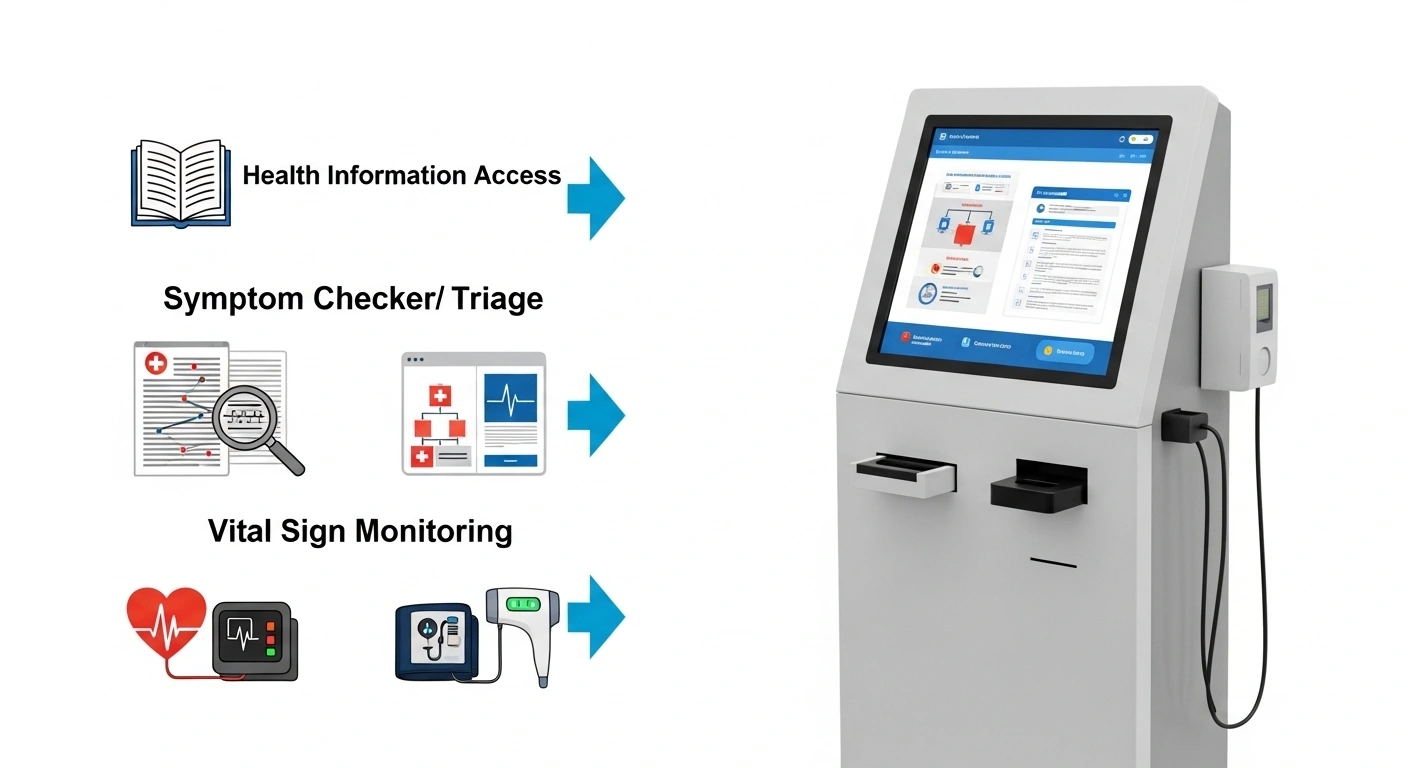
Retail and healthcare may seem like entirely different industries, but they share a growing need for faster service, improved user experience, and operational efficiency. In both environments, long queues, manual processes, and limited staff resources can lead to frustration for customers and patients alike. To address these challenges, businesses and medical facilities are increasingly adopting smart kiosk solutions.
These systems enable self-service interactions, streamline workflows, and provide instant access to information. From retail stores enhancing shopping convenience to hospitals improving patient check-in processes, kiosks are bridging the gap between service expectations and real-world delivery. As digital transformation accelerates, the integration of kiosk technology is becoming a key strategy for both sectors.
Converging Needs in Retail and Healthcare Environments
Although retail and healthcare experience to be very different industries, their user needs are increasingly converging, especially in terms of efficiency and experience. Both sectors require faster service and reduced waiting times. Long queues not only negatively impact user satisfaction but can also lead to lost sales in retail or lower patient satisfaction in healthcare. As a result, improving service speed has become a shared priority.
At the same time, there is a growing demand for self-service and contactless interactions. Consumers prefer using self-service kiosks for browsing and payment, while patients increasingly rely on kiosks for registration and check-in. This reduces physical contact, enhances convenience, and improves overall efficiency especially in the post-pandemic era where safety and hygiene remain important considerations.
In addition, expectations for convenience continue to rise. Whether it is quick checkout and product lookup in retail, or clear navigation and information access in hospitals, users expect seamless, intuitive, and efficient experiences.
Against this backdrop, smart kiosk solutions are emerging as a key technology, helping both industries deliver faster, more user-centered services and driving the shift toward digital transformation.
Key Smart Kiosk Application Across Retail and Healthcare
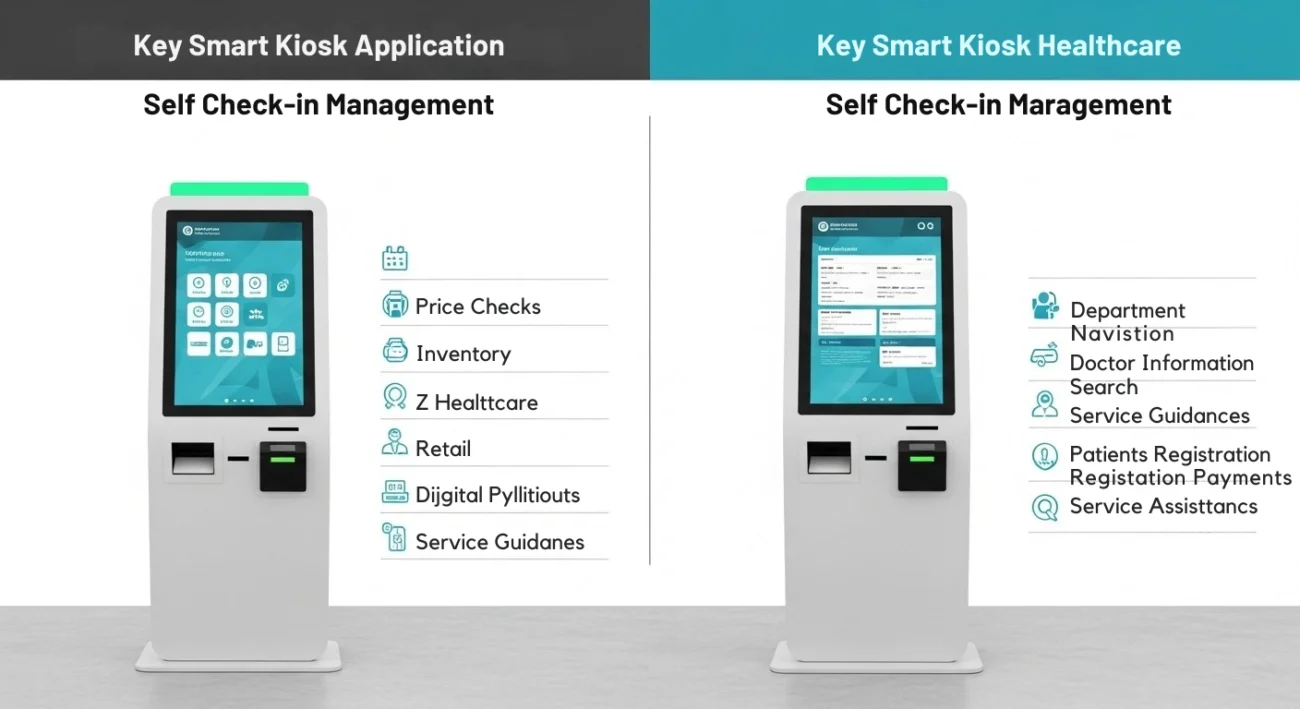
Across both retail and healthcare environments, smart kiosks have become essential tools for improving efficiency and user experience. One of the most important applications is self check-in and queue management. Users can quickly register, receive queue numbers, and track their status, significantly reducing pressure on front desk staff. In hospitals, this helps streamline patient flow and reduce congestion, while in retail settings it improves the customer experience, especially during peak hours.
- In terms of functionality, retail and healthcare share similar digital logic despite different use cases. In retail, kiosks enable product browsing, price checks, and inventory lookup. In healthcare, they are used for department navigation, doctor information search, and service guidance, helping patients move more efficiently through complex facilities.
- Digital payments and transaction processing are another key function. Retail kiosks support multiple payment methods for fast checkout, while healthcare kiosks allow patients to complete registration payments and billing processes, reducing manual workload and minimizing errors.
- Additionally, kiosks provide convenient access to information and customer support. They can display FAQs, service instructions, and even connect users to remote assistance when needed. This is also why many businesses are adopting interactive kiosk solutions for retail environments and healthcare, as they help create more efficient, intelligent, and user-centered service experiences.
Enhance Experience Through Automation and Personalization
- Automation and personalization are transforming how both retail and healthcare environments deliver user experiences.
- By introducing smart kiosk systems and digital signage, organizations can significantly reduce wait times and improve service speed.
- Automated check-in, queue management, and guided workflows allow users to complete tasks quickly without relying on staff, resulting in smoother operations and higher satisfaction.
- Kiosks can provide tailored recommendations or guidance based on user input, whether it’s suggesting products in a retail store or directing patients to the correct department in a hospital.
- This targeted interaction reduces confusion and enhances overall efficiency.
- Multilingual and user-friendly interfaces further improve accessibility.
- In diverse regions, offering localized language options ensures that users can easily understand and interact with the system.
- A hospital in Peru partnered with Ikinor to implement a hospital digital signage solution combined with customized Spanish-language interfaces.
- As a result, patient navigation became significantly easier, and communication barriers were reduced.
- A consistent omnichannel experience is becoming increasingly important.
- Users can begin their journey online, continue via mobile devices, and complete interactions at on-site kiosks.
- This seamless integration across platforms ensures convenience and continuity, ultimately creating a more intuitive and satisfying user experience.
Future Outlook: Unified Smart Service
The future of retail and healthcare is moving toward unified smart service ecosystems, where different systems and technologies work seamlessly together. One of the most important developments is the integration of kiosks with POS, CRM, and HIS systems. This allows real-time data sharing, enabling businesses and medical facilities to streamline operations, reduce duplication, and deliver more coordinated services.
AI-driven insights are also playing a growing role. By analyzing user behavior and operational data, smart kiosk systems can predict demand, optimize workflows, and provide personalized recommendations. In retail, this may mean suggesting relevant products based on browsing history, while in healthcare, it can help guide patients more efficiently through departments and reduce waiting times.
Another key trend is the increasing demand for scalable and flexible solutions. Different industries and scenarios require customized hardware, software, and interface designs. This is where interactive kiosk OEM/ODM solutions become especially valuable. They allow businesses to tailor kiosk systems based on specific operational needs, branding requirements, and local market conditions.
As these technologies continue to evolve, unified ecosystems will enable more intelligent, connected, and user-centric service environments across industries.