
Daycare Babies Get 12 to 15 Infections in Their First Year and Most of It Is Normal
If your daycare baby has been sick basically nonstop, you are not imagining it and you are not doing anything wrong. Here is the quick version before we get into the details:
- 12 to 15 respiratory infections in the first year is normal.
- 2 GI bugs with diarrhoea and vomiting in the first year is normal.
- 1 or 2 rash-related illnesses in the first year is normal.
- The first six months at daycare are the worst, then it eases up.
- By school age, daycare kids actually get sick less than home-care kids.
Those numbers come from a 2026 review in Clinical Microbiology Reviews run by parent-scientists at UCL and Cambridge, and they basically confirm that the lived parent experience of “my baby is sick every other week” is exactly what the data says should be happening.
So when you are dragging your second-week-back-to-work self to the pediatrician for the fourth time in two months, what you are actually seeing is your baby’s immune system going through what one of those researchers literally called immune system boot camp. It feels horrible because it kind of is, but it is also doing exactly what it is supposed to do.
Why Daycare Babies Get Sick Way More Than Home-Care Babies
It comes down to exposure. A baby at home interacts with maybe four or five people regularly. A baby in daycare is sharing a room with eight to twelve other babies who are all chewing on the same toys, sneezing on each other, and passing around viruses their immune systems have also never seen before. Multiply that across two hundred-plus cold viruses circulating at any given time and you get the math behind 12 to 15 infections a year.
The American Academy of Pediatrics estimates infants in child care may get 10 to 12 upper respiratory infections per year, with the rate dropping as kids get older. A separate Danish study tracking 138,000 hospital admissions found that for babies under one, the first six months of daycare enrollment increases the risk of being hospitalized for a respiratory infection by about 70%. The absolute risk is still pretty low, but the relative jump is real and that is what you are feeling when it seems like every single bug your baby catches turns into something serious.
Here is the part that actually matters though. A 2002 JAMA Pediatrics paper from a long-running Arizona study found that daycare kids are about twice as likely to have frequent colds before age three, but by school age that pattern flips. Children who attended daycare as babies tend to get sick less often than their stay-at-home peers once they hit elementary school, because their immune systems already built memory against a huge chunk of the common viruses by then.
So the trade-off is real. You are paying upfront in sick days now to bank fewer sick days later. It does not feel like a great deal in the middle of a 3am ear infection visit, but the data is fairly clear that it actually is.
What Is Your Baby Actually Catching All The Time?
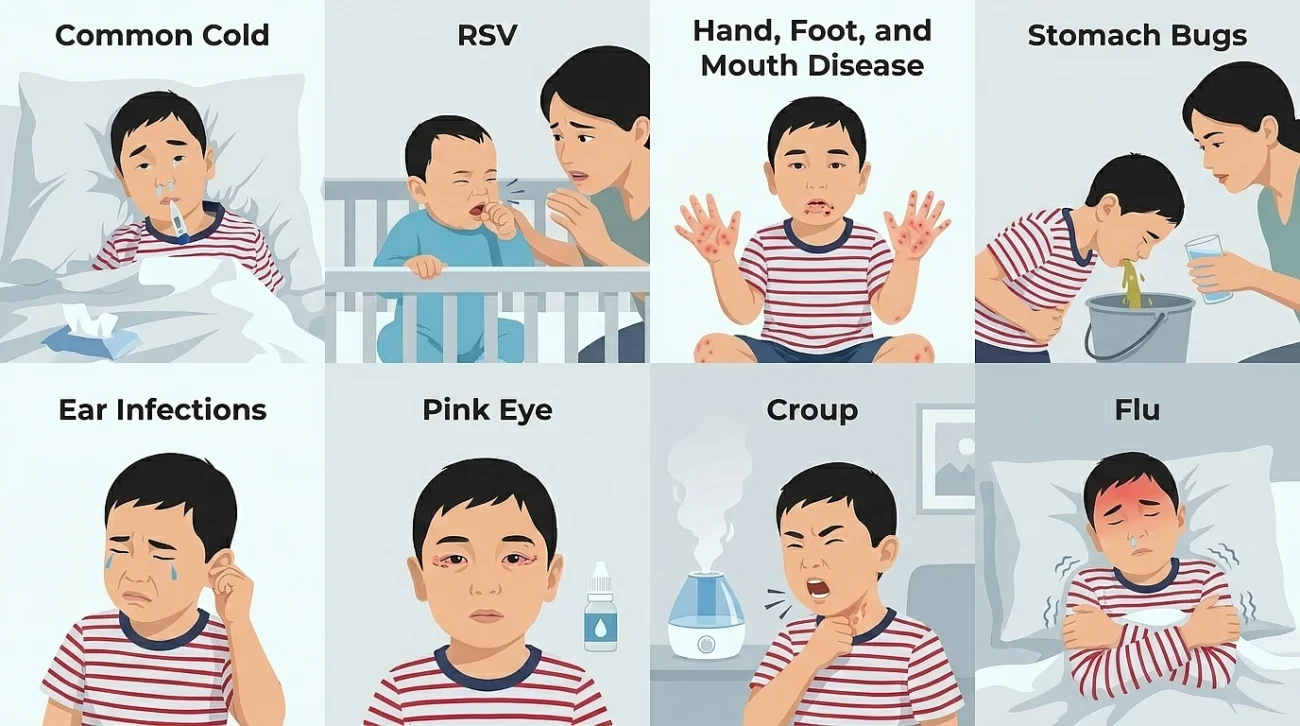
Mostly the same handful of things, on repeat, with slightly different viruses each round.
- Common cold viruses – there are over 200 of them, your baby will work through a lot of these.
- RSV – respiratory syncytial virus, looks like a bad cold but can be serious in babies under one.
- Hand, foot, and mouth disease – usually mild, rash on hands and feet plus mouth sores.
- Stomach bugs – rotavirus, norovirus, the usual GI culprits, usually 1 to 3 days of vomiting and diarrhoea.
- Ear infections – often follow a cold because of fluid buildup behind the eardrum.
- Pink eye – usually viral, contagious, daycares often send kids home but it is rarely serious.
- Croup – that barking cough you can hear from another room, mostly viral.
Most of these are viral, which means antibiotics do nothing for them. This matters because the most common parent reflex when a daycare baby gets sick is wanting an antibiotic, and pediatricians spending half their visits explaining why that is not the answer for the millionth time.
When Do You Actually Keep Them Home And When Is The Daycare Being Annoying?
Both things can be true at once. Some daycare exclusion policies are way stricter than what pediatricians actually recommend, and some parents send kids in who clearly should be at home.
The list of stay-home situations from the AAP:
- Fever above 101°F (38.3°C) with a behaviour change or other symptoms.
- Diarrhoea that is not contained in the diaper, or more than 2 stools above normal in 24 hours.
- Stool with blood or mucus.
- Vomiting 2 or more times in 24 hours.
- Rash with fever or behavioural changes.
- Mouth sores with uncontrollable drooling.
- Persistent uncontrollable cough.
- Anything that prevents the child from participating in normal activities.
Pinkeye on its own without fever is not on the AAP list, even though most daycares send kids home for it. Mild cold symptoms without fever are also not on the list. A 2017 NPR investigation into the gap between AAP guidance and actual daycare policies found that even in states that officially endorse AAP guidelines, individual daycare exclusion policies often did not match them. So if your daycare is sending your baby home for things that do not appear on this list, that is not necessarily because your baby needs to be home, it is because the daycare has its own policy.
When Does Fever Become An Actual Emergency In A Baby?
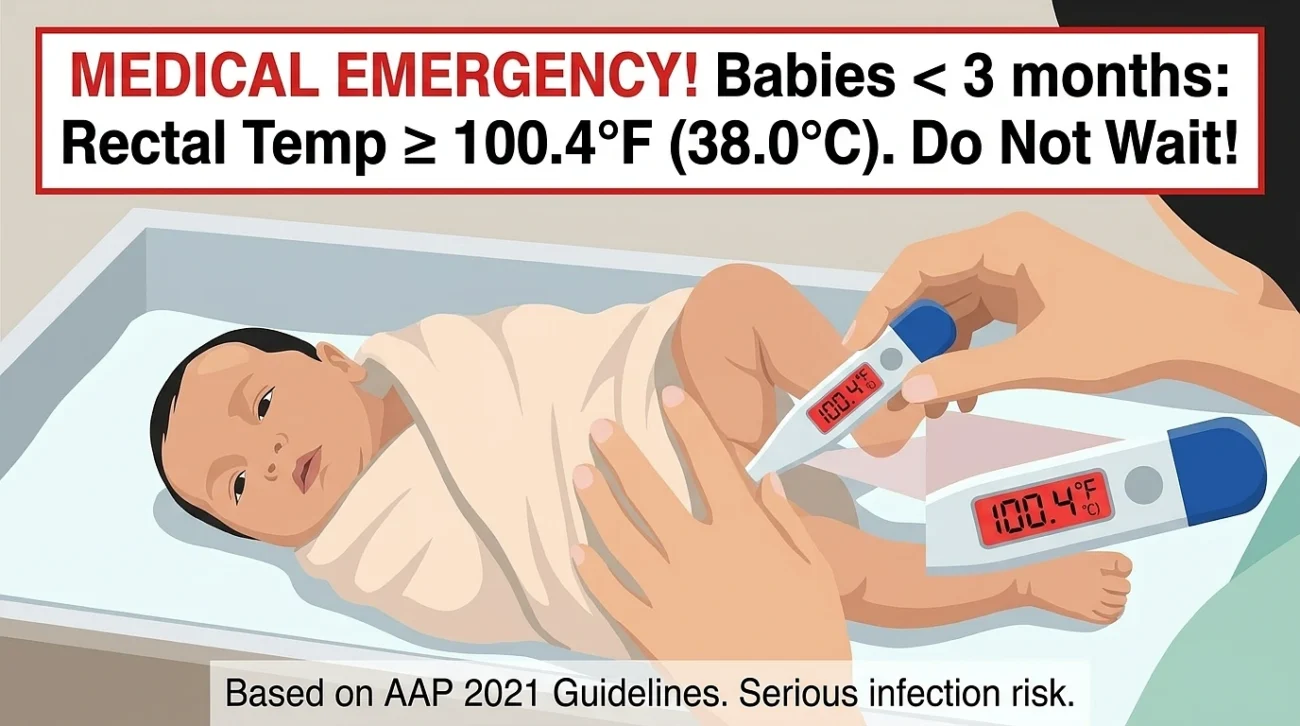
This is where the rules change based on age, and getting this wrong is the thing that scares pediatricians the most.
For babies under 3 months, any rectal temperature of 100.4°F (38.0°C) or higher is a medical emergency. Not a wait-and-watch situation. The AAP clinical practice guideline for febrile infants 8 to 60 days old, published in Pediatrics in August 2021, lays out the evaluation pathway, and at this age fever usually triggers urinalysis, blood culture, and sometimes CSF testing to rule out serious bacterial infection. More than 10% of febrile young infant fever turn out to have a urinary tract infection.
For babies between 3 and 6 months, fever is still taken seriously but the threshold for panic is a bit higher. Persistent fever, fever above 102°F, or fever combined with any of these symptoms is when you call the pediatrician right away:
- Difficulty breathing or breathing fast.
- Refusing to eat or drink for hours.
- Signs of dehydration like fewer wet diapers, no tears when crying, dry mouth.
- Unusual lethargy or hard to wake.
- Inconsolable crying that does not stop.
- A new rash that looks like bruising or small red or purple spots, which can signal a serious infection and warrants a 911 call.
For babies over 6 months, most fevers from common viruses can be managed at home with monitoring, fluids, age-appropriate fever reducers, and rest. You still want to call the pediatrician if the fever sticks around more than 2 to 3 days or if the baby seems worse rather than better, but the threshold for emergency intervention loosens up a lot once they are past the very young infant window.
The rule that catches most problems early is the twice-a-day temperature check during any active illness, plus paying close attention to behaviour. Fever is the warning signal but how the baby is acting is just as important. A baby with a 101°F fever who is still smiling, taking fluids, and behaving relatively normally is usually fine to watch. A baby with the same fever who is floppy, refusing to drink, or unusually quiet needs a phone call to the doctor.
What Actually Helps Reduce Daycare Illness, And What Does Not
Now this is the part where most parents waste a lot of money and effort on things that do basically nothing, while skipping the cheap things that actually work.
What the research actually supports:
- Hand washing – for the baby, for you, for everyone in the house, before eating, after the bathroom, after coming home from daycare. This is by far the highest-impact thing you can do.
- Sleep – adequate sleep supports immune function, and overtired daycare babies get sick more.
- Breastfeeding if it works for your family – antibodies in breast milk help during the first year specifically.
- Up-to-date vaccinations – the UCL review specifically calls vaccination one of the most effective things parents can do, and the newer MMRV vaccine covers measles, mumps, rubella, and chickenpox.
- Keeping sick visitors and siblings away from the baby during the worst of their illness when possible.
What Does Not Really Help Despite Being Heavily Marketed
- Most infant immune-boosting supplements have very little evidence behind them for healthy term babies.
- Heavy hand sanitizer use throughout the day at home, soap and water does the job and is less drying on baby skin.
- Requesting antibiotics for severity infections, which is most daycare illness, this does not help and contributes to antibiotic resistance.
- Most over-the-counter cold medications are not recommended for babies under 6 and have safety concerns for kids under 4.
- Probiotics are a mixed bag, some evidence for specific strains in specific situations but nothing close to a general daycare illness prevention.
The boring honest answer is that you cannot really prevent the illness cycle, you can only manage it. The exposures are coming whether you like it or not because that is what daycare is.
How Do You Actually Evaluate A Daycare’s Hygiene Before Signing Up?
A clean-looking facility and a clean-running facility are not always the same thing. The questions to ask that actually surface real differences:
- What is the sick child exclusion policy and is it written down somewhere.
- How often do staff wash their hands, and is there a documented protocol for handwashing between diaper changes and feedings.
- How are toys cleaned and how often, especially in the infant room where everything goes in the mouth.
- What is the staff-to-infant ratio, the AAP recommends no more than 3 infants per adult under 12 months.
- How is feeding handled, especially bottle prep and labelling for parent-supplied milk.
- What happens when a child gets sick at the facility, where do they wait and how are parents notified.
- Are diaper changing surfaces separated from food prep and play areas.
- What vaccinations are required for kids and staff.
The answers tell you whether the facility has actual operating protocols or just generally tidy vibes. If you are still in the search stage and looking for daycare infant near me options, walking through these questions in person during a tour is the best way to separate the marketing from the reality. The facilities that have real protocols will answer specifically and confidently. The ones that do not will give general reassurance.
When Does The Constant Illness Actually Stop?
For most kids, the first six months at daycare are the worst. Things start easing up after that as the immune system builds memory against the most common viruses circulating in your specific daycare.
By the end of year one, the rate usually drops noticeably. By year two it is closer to normal, although still higher than home-care kids. By year three the difference is much smaller, and by school age the pattern flips entirely.
The Dutch study tracking 1,626 children for six years found that daycare kids had higher gastroenteritis rates only in year one, similar rates in years two and three, and lower rates than home-care kids from year three through year six. The protection holds.
So yes, you are going through it now. And yes, it will actually get better. The first six months are the hardest part of the whole arrangement, and most parents who push through that window find the second year of daycare looks completely different from the first.
The middle of an ear infection visit at 11pm is not the moment to feel reassured by long-term immune data. But when you are deciding whether to pull your baby out because it feels like this will never end, the data says it will end, and probably sooner than it feels like.