
What Is CIRS Disease? Symptoms, Causes and Treatment
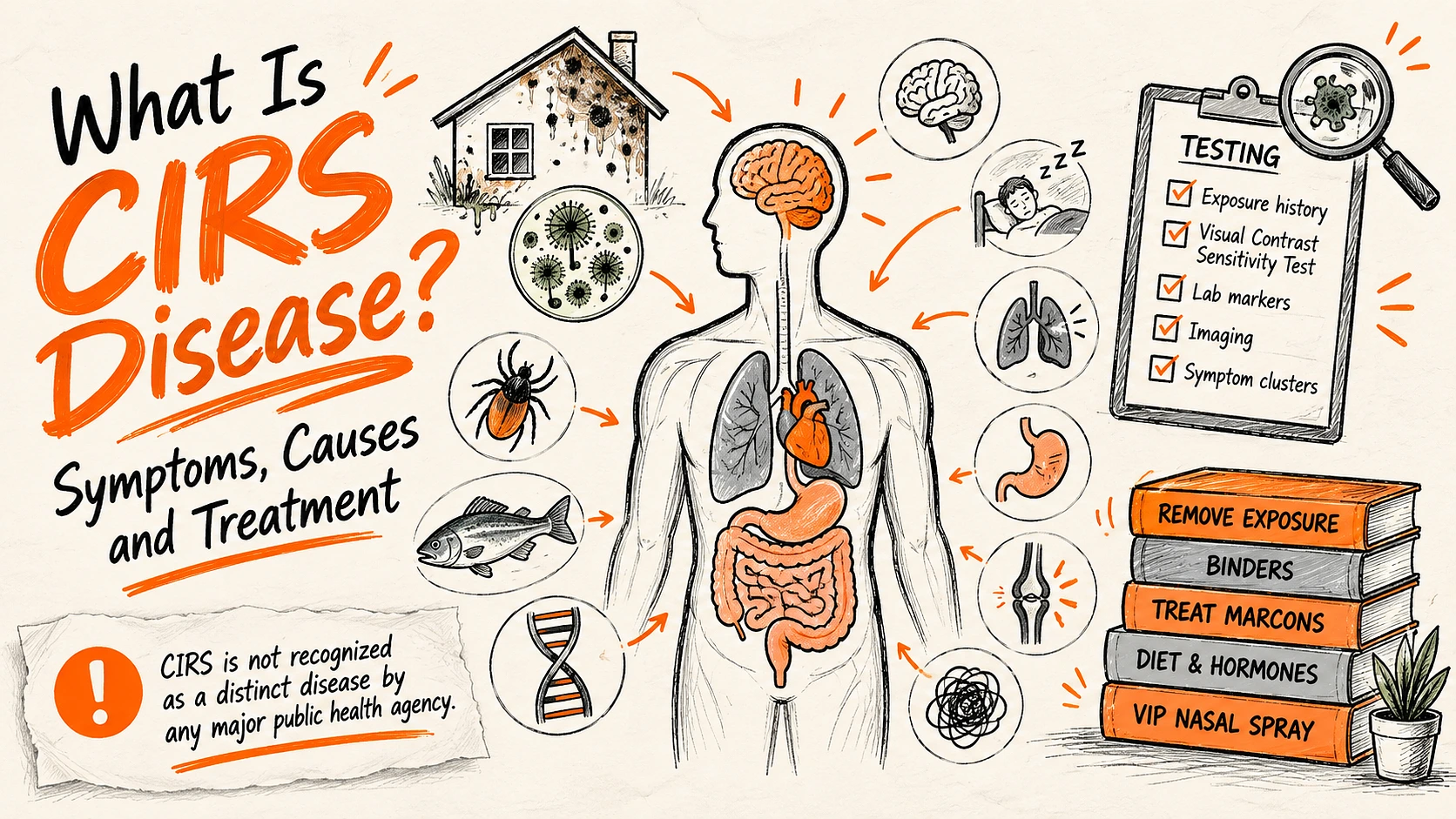
CIRS stands for Chronic Inflammatory Response Syndrome, and the plain version of it is an immune system that starts reacting to something in the environment and then never stops reacting, long after the person has left whatever set it off. The trigger is usually mold and bacteria inside a water damaged building. Symptoms show up across almost every system in the body at once, which is the reason people carry this for years while collecting one partial diagnosis after another.
One thing belongs at the top, because it changes how the rest of this should be read. CIRS is not recognized as a distinct disease by any major public health agency. It has a published case definition, a lab panel, a treatment protocol and a research base behind it, and it lives almost entirely inside functional and environmental medicine. Conventional medicine has mostly not come along.
What Is CIRS Disease
CIRS is a multi system illness driven by an innate immune response to biotoxins that the body cannot clear. It is not an allergy. Allergy runs on IgE and adaptive hypersensitivity, and this does not, which is why antihistamines do nothing for it and why allergy testing comes back unremarkable in people who are genuinely unwell.
The illness was first described by Dr Ritchie Shoemaker, a family physician in Pocomoke, Maryland, who in 1997 linked an undefined illness in local patients to a toxin from a fish killing dinoflagellate called Pfiesteria. He later connected the same pattern of illness to water damaged buildings and to tick borne infections.
How Biotoxins Cause the Inflammation
In most people the sequence is boring and it works. A biotoxin comes in, the immune system tags it, the liver secretes it into bile, and it leaves the body in stool. Nothing lingers.
In a susceptible person the tagging step fails. The antigen presenting cells start the reaction and never finish it, so the toxin keeps recirculating while the immune response stays switched on. Think of a smoke alarm that keeps sounding because whatever tripped it was never found, so there is nothing to switch off.
That stuck response produces a measurable pattern. Inflammatory markers like TGF-beta1, C4a and MMP-9 run high, while regulatory ones like MSH and VIP run low. MSH under 35 pg/mL is reported in roughly 95% of confirmed cases, and low MSH wrecks sleep architecture, pain modulation and mucosal immunity, which is why so many people with this end up being worked up for sleep apnea first.
Around 24% of the population is said to carry an HLA-DR/DQ haplotype that makes them mold susceptible, with 21% carrying a Lyme susceptible version. Both figures come from Shoemaker’s own comparison of his patient data against international gene registries, not from independent replication, and that distinction matters when you see the number quoted flatly on clinic websites. Carrying the haplotype also does not give you the illness. You still need the exposure.
Where the Diagnosis Currently Stands

Supporters point to real material. There are randomized trials, a published case definition, transcriptomic work, volumetric brain imaging, and a biomarker panel you can order through LabCorp rather than some proprietary boutique lab.
The problems are also real. TGF-beta1 rises in pulmonary fibrosis, chronic kidney disease, active autoimmune flares, long covid and malignancy, so an elevated result on its own means very little. C4a has to be run on the specific assay used in the research, mostly through National Jewish Health in Denver, and a standard hospital complement panel is not interchangeable with it. UCLA Health has published that CIRS is not an established diagnosis and named the concern that matters most here, which is that a CIRS workup can delay a different diagnosis that would have been found by a conventional path.
My own read, for what it is worth: the exposure science is solid, the symptoms are real, and the specific framework built on top of them is contested in ways the clinic pages tend to skip past. If you are pursuing this, pursue the ordinary differentials at the same time rather than after.
Symptoms of CIRS
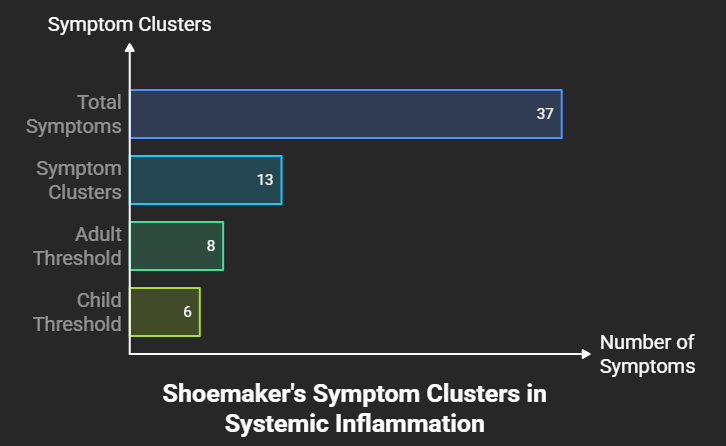
Because the inflammation is systemic, the symptom list is long and scattered, and it overlaps heavily with ME/CFS and fibromyalgia. Shoemaker’s research organised 37 symptoms into 13 clusters, and the preliminary bar is 8 or more of those 13 clusters being present in one person, or 6 in a child under 11.
That clustering is the point. One or two of these on their own means nothing at all.
- Cognitive: brain fog, short term memory loss, trouble finding words, difficulty concentrating, disorientation.
- Fatigue: heavy unrelenting exhaustion that rest does not fix, plus post exertional crashes.
- Pain: joint pain that moves around, morning stiffness, muscle cramps, ice pick and sharp stabbing pains, muscle weakness.
- Neurological: vertigo, static shocks, numbness, tingling, tremors, light headedness.
- Eyes, sinus and throat: blurred or hazy vision, light sensitivity, tearing, red eyes, chronic sinus congestion, sensitivity to odors, sore or burning throat.
- Respiratory and cardiac: cough, wheezing, shortness of breath on exertion, air hunger, heart palpitations.
- Digestive: abdominal pain, diarrhea, bloating, nausea, appetite swings, new food intolerances.
- Regulatory: temperature dysregulation, night sweats, excessive thirst with frequent urination, mood swings, anxiety, irritability.
The excessive thirst with frequent urination is one of the more telling ones, because it points at the hormonal side rather than at anything psychological. People get told for years that they are stressed. Thirst does not come from stress.
Causes of CIRS
There are three requirements, and all three have to be present.
- A water damaged building. Mold, bacteria, endotoxins, actinomycetes and volatile organic compounds together, what the literature calls a biochemical stew rather than any single organism. Shoemaker’s estimate is that about 80% of cases come from this route.
- Other biotoxin sources. Tick borne pathogens including Lyme, ciguatera from reef fish, and cyanobacteria from harmful algal blooms.
- Genetic susceptibility. The HLA-DR/DQ haplotypes that impair toxin clearance.
- Do you know that out of the roughly 500,000 people who get acute ciguatera poisoning each year from eating toxic fish, only about 5% go on to develop the chronic version? The rest clear it in weeks. That 5% is the group CIRS is trying to explain.
Treatment and Management
Testing Before Treatment Begins
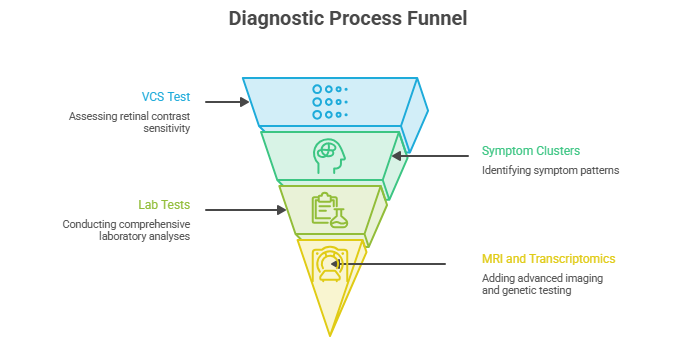
Nothing starts until the diagnosis is worked through, and the sequence is deliberate.
The clinical entry point is three things together: a documented history of exposure to a water damaged building, an abnormal Visual Contrast Sensitivity test, and 8 or more of the 13 symptom clusters. The VCS is a cheap screening test of how well the retina detects contrast, and it carries around 92% accuracy in the published data. Failed VCS plus 8 clusters puts the probability near 98.5%.
Then the labs. A VCS fail alone proves nothing and is not a diagnosis, which is a distinction worth holding onto given how many sites sell it as one. The full panel covers TGF-beta1, C4a, MMP-9, MSH, VEGF and VIP, alongside HLA-DR/DQ typing, with NeuroQuant volumetric MRI and GENIE transcriptomic testing added in some cases.
The Shoemaker Protocol Steps
The protocol runs in a fixed order because several of the abnormalities feed each other, and treating them out of sequence tends to fail.
- Remove the exposure. This is the step everything else depends on, and it is also the step people fail, because remediating or leaving a house costs real money.
- Binders. Cholestyramine or Welchol taken to bind biotoxins in the gut so they leave in stool instead of being reabsorbed.
- Treat MARCoNS. A resistant staph colonisation in the deep nasal passages that cleaves MSH, usually treated with a compounded nasal spray. MSH will not recover while it persists.
- Gluten removal where anti gliadin antibodies are positive, typically for at least 3 months.
- Correct the hormonal and vascular abnormalities, including ADH and androgens, with losartan used specifically to bring down TGF-beta1.
- VIP nasal spray, last, once everything upstream has been corrected and exposure is genuinely gone.
The no amylose diet sits alongside these, cutting starchy root vegetables and grains to reduce inflammatory load. All of this is off label prescribing, which is worth understanding before you start, because your insurance will treat it as such.
What Recovery Usually Looks Like
Slow, and dependent on the environment more than on any drug. Re-exposure undoes progress, so a person who treats successfully and then moves into another damp building goes back to the start, sometimes faster and harder than the first time.
The practical advice, whatever you conclude about the framework itself, is to get the building tested before you get yourself tested. A damp home with visible growth and a musty smell is a fixable problem with an obvious cost attached, and fixing it helps a great many people who never needed a syndrome name at all.