
Ayurvedic Tonics vs Modern Medicine: Better Work for Health

Your grandmother swears by that dark brown paste in the kitchen. Instagram wellness influencers are mixing powders into smoothies. Meanwhile, pharmaceutical companies spend decades isolating single compounds to target specific pathways.
General tonics in Ayurveda Rasayanas, technically claim to work on multiple body systems simultaneously. Chyawanprash for immunity and digestion and skin and stamina. Triphala for gut health and detox and eye function. Ashwagandha for stress and strength and sleep and hormones. The Western medical mind recoils. One substance, multiple targets, Sounds like snake oil with better marketing.
Except the mechanism isn’t actually mysterious once you stop thinking in pharmaceutical terms.
Adaptogens Don’t “Fix” Anything
Pharmaceutical drugs work like precision strikes. Beta-blockers block beta receptors. SSRIs selective serotonin reuptake. One lock, one key, predictable outcome.
Adaptogenic herbs operate differently. They modulate. Think thermostat, not sledgehammer.
Take Ashwagandha (Withania somnifera). Research published in the Journal of Ethnopharmacology shows it doesn’t simply “lower cortisol” or “raise cortisol” it normalizes the HPA axis response. High stress Cortisol drops. Chronic fatigue with blunted cortisol Levels improve. Same plant, opposite effects depending on what your body needs.
This isn’t magic. It’s biochemical flexibility through multiple active compounds working on feedback loops rather than forcing one pathway.
Giloy (Tinospora cordifolia) demonstrates similar patterns. A 2021 study in Phytomedicine documented its immunomodulatory properties it can stimulate immune response when needed but also shows anti-inflammatory action when the immune system overreacts. Autoimmune flare versus infection, different responses from the same herb.
The Polypharmacy Problem (Or Why One Herb Contains Dozens of Compounds)
Triphala means “three fruits” Amalaki, Bibhitaki, Haritaki. Sounds simple until you realize each fruit contains tannins, flavonoids, glycosides, phenolic compounds, and alkaloids in varying concentrations.
You’re not taking one drug. You’re taking a cocktail of 50+ bioactive molecules that interact with each other and with your existing biochemistry.
Modern pharmacology calls this “dirty” because it complicates research. How do you run a double-blind study when the active compound isn’t singular? Which molecule does what?
Ayurvedic physicians call it synergy. The compounds don’t work in isolation they potentiate, buffer, and balance each other.
Consider Amla (Phyllanthus emblica), the richest natural source of vitamin C. But fresh Amla juice loses its vitamin C content within hours of extraction. Yet dried Amla powder retains therapeutic properties for months. The tannins and flavonoids protect and stabilize the ascorbic acid, plus they contribute their own antioxidant effects.
Remove the vitamin C in a lab and isolate it? You lose 60% of the fruit’s actual benefit.
This drives reductionist researchers insane because they can’t identify the “active ingredient.” There isn’t one. The activity emerges from the combination.
System Level Changes Versus Symptom Suppression
| System Level Changes | Symptom Suppression |
|---|---|
| Focuses on: Underlying physiological functions, building resilience in the body’s systems | Focuses on: Masking or temporarily relieving symptoms without addressing the root cause |
| Mechanism: Gradually improves overall health and function of body systems, leading to symptom reduction over time | Mechanism: Directly blocks or numbs symptoms for quick relief, without correcting the root imbalance |
| Example: Chyawanprash supporting respiratory mucosal integrity and immune function to reduce frequency of infections | Example: A lozenge providing temporary relief from a sore throat |
| Timeframe: Requires consistent, long-term use to create measurable improvements | Timeframe: Offers fast relief but effects fade once discontinued |
| Approach: Holistic — treats the body as an interconnected system | Approach: Isolated — targets one symptom or organ |
| Example: Ashwagandha reducing cortisol and improving sleep quality after several weeks of regular use | Example: Over-the-counter painkillers easing discomfort without addressing the underlying inflammation |
The Detox Delusion and What Actually Happens
Every wellness brand slaps “detoxifying” on everything. Your liver and kidneys already detox perfectly well if they’re functional.
What Triphala actually does according to research in Phytotherapy Research is improve gut motility, support beneficial bacterial populations, and reduce intestinal inflammation. That’s not “detox.” That’s supporting the organs that eliminate waste products more efficiently.
Giloy doesn’t “flush toxins.” It upregulates hepatic enzyme activity and protects liver cells from oxidative damage. Your liver detoxifies better because the cells work better, not because some mystical cleansing happened.
The terminology matters because “detox” implies your body is full of unnamed poisons that need emergency extraction. That’s marketing fiction. What’s actually occurring is optimization of existing elimination pathways through cellular support.
Amla’s high tannin content acts as a mild astringent in the digestive tract. Tightens up leaky gut junctions, reduces inflammatory permeability. Over time, this means better nutrient absorption and less systemic inflammation from gut-derived endotoxins.
Call it what it is: structural maintenance of intestinal barriers. Decidedly less sexy than “ancient detox formula.”
Why General Tonics Fail (And It’s Usually User Error)
Tonics fail most often because people take them like prescription drugs randomly, inconsistently, without considering baseline health.
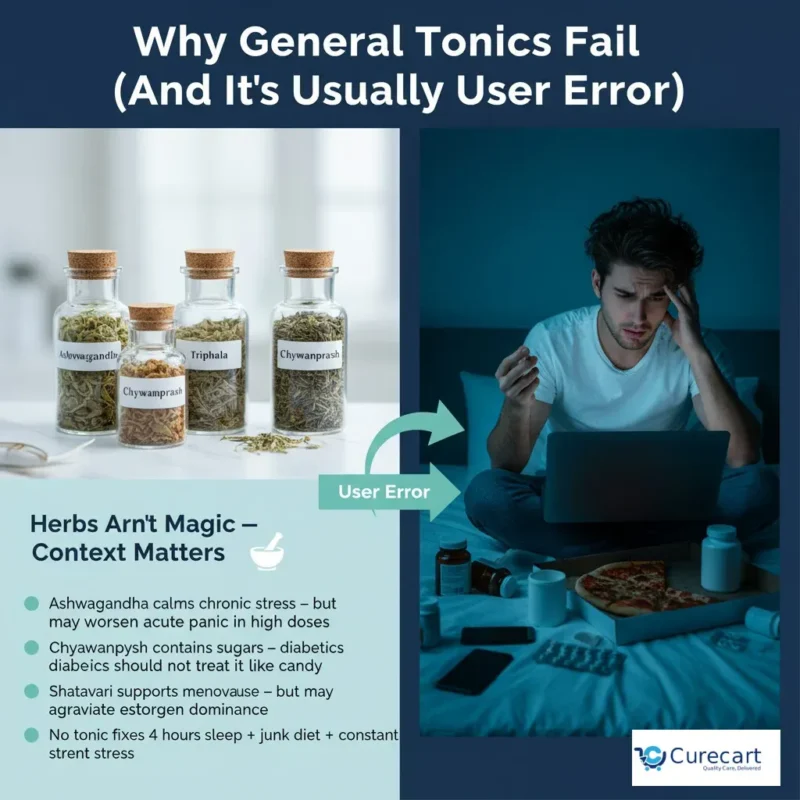
Ashwagandha works brilliantly for chronic stress and cortisol dysregulation. Give it to someone with acute anxiety from an active panic disorder? Might help, might do nothing, might occasionally worsen agitation in high doses. Wrong tool for the job.
Chyawanprash contains honey and jaggery—simple sugars. Diabetics dosing it like candy wonder why blood glucose spikes. The formula was designed for healthy individuals or those with deficiency conditions, not metabolic disease requiring carbohydrate restriction.
Shatavari is a phytoestrogen. Useful for postmenopausal hormone support. Less useful potentially problematic in estrogen-dominant conditions like certain fibroids or endometriosis types. Context matters enormously.
Expecting tonic results from tonic-unfriendly lifestyles. Sleep 4 hours, eat processed garbage, never move, chronically stressed, then wonder why Triphala isn’t transforming your health. No herb compensates for systematic self-destruction.
Quality Control Remains the Elephant in the Room
The supplement industry is barely regulated. Heavy metal contamination, adulteration with cheaper herbs, completely wrong species labeled as the correct botanical name all documented problems.
A 2019 analysis published in Frontiers in Pharmacology tested 50 Ashwagandha supplements. Twelve contained zero detectable withanolides (the active compounds). Five had significant lead contamination. You were buying expensive dust and toxins.
Buying Amla powder from random Amazon sellers? Could be actual Phyllanthus emblica. Could be mixed with cheaper fillers. Could be irradiated to the point of destroying bioactive compounds. No way to know without third-party testing most companies don’t bother with.
Ayurvedic physicians traditionally sourced herbs from known regions during specific harvest times, processed them in specific ways. Modern bulk manufacturing shortcuts all of this for profit margins.
This isn’t an Ayurveda problem. It’s a capitalism problem.
Effective tonics require legitimate herbs properly prepared. Most people never get that far because they’re taking something that barely resembles the traditional preparation.
The Mechanism Nobody Talk Time and Consistency
Tonics accumulate effects. That’s not how we think about medicine anymore, but it’s how most traditional systems worked.
Chyawanprash taken daily for 90 days shows cumulative immune enhancement in clinical studies. Take it sporadically for 2 weeks? Minimal effect. The compounds need sustained presence to shift cellular function and microbiome composition.
Triphala’s benefits on gut microbiota diversity appear after 6-8 weeks of consistent use. One week doesn’t establish bacterial population changes. You’re just experiencing the laxative effect from the tannins.
Modern medicine wants instant results because that’s what drugs provide. Tonics function on biological time the speed at which cells regenerate, microbiomes rebalance, and metabolic pathways shift.
Impatience kills more tonic protocols than inefficacy.
General tonics work through systemic modulation rather than targeted intervention. Multiple compounds affecting multiple pathways, supporting baseline function rather than forcing specific outcomes. They require time, consistency, quality sourcing, and appropriate matching to individual constitution.
None of this is mystical. It’s just complex pharmacology that doesn’t fit into the one drug one target model that dominates modern medicine.
Whether that complexity is worth navigating depends entirely on whether you need restoration or just want a quick fix. Tonics provide the former. They were never designed for the latter.
References:
- Chandrasekhar K, Kapoor J, Anishetty S. A prospective, randomized double-blind, placebo-controlled study of safety and efficacy of a high-concentration full-spectrum extract of ashwagandha root in reducing stress and anxiety in adults. Indian Journal of Psychological Medicine. 2012;34(3):255-262.
- Saha S, Ghosh S. Tinospora cordifolia: One plant, many roles. Ancient Science of Life. 2012;31(4):151-159.
- Chaphalkar R, Apte KG, Talekar Y, Ojha SK, Nandave M. Antioxidants of Phyllanthus emblica L. bark extract provide hepatoprotection against ethanol-induced hepatic damage. Phytotherapy Research. 2017;31(4):531-539.
- Lopresti AL, Smith SJ, Malvi H, Kodgule R. An investigation into the stress-relieving and pharmacological actions of an ashwagandha extract. Medicine. 2019;98(37).
- Alok S, Jain SK, Verma A, Kumar M, Mahor A, Sabharwal M. Plant profile, phytochemistry and pharmacology of Asparagus racemosus. Asian Pacific Journal of Tropical Disease. 2013;3(3):242-251.
- Peterson CT, Denniston K, Chopra D. Therapeutic uses of Triphala in Ayurvedic medicine. Journal of Alternative and Complementary Medicine. 2017;23(8):607-614.
- Sharma V, Pandey D. Beneficial effects of Tinospora cordifolia on blood profiles in male mice treated with arsenic. Toxicology International. 2010;17(1):8-11.
- Gul M, Liu ZW, Iahtisham-Ul-Haq, Rabail R, Faheem F, Walayat N, Nawaz A, Shabbir MA, Munekata PES, Lorenzo JM, Aadil RM. Functional and nutraceutical significance of Amla: A review. PeerJ. 2022;10:e13513.
- Speers AB, Cabey KA, Soumyanath A, Wright KM. Effects of Withania somnifera supplementation on markers of mitochondrial biogenesis. Nutrients. 2021;13(2):348. https://www.mdpi.com/2072-6643/13/2/348
- Sharma R, Martins N, Kuca K, Chaudhary A, Kabra A, Rao MM, Prajapati PK. Chyawanprash: A traditional Indian bioactive health supplement. Biomolecules. 2019;9(5):161.
- Peterson CT, Pourang A, Dhaliwal S, Kohn JN, Uchitel S, Singh H, Mills PJ, Peterson SN, Sivamani RK. Modulatory effects of Triphala and Manjistha dietary supplementation on human gut microbiota. Journal of Clinical Medicine. 2020;9(8):2545.