
Heartfelt Prayers for Mental Health Inspire by Scripture

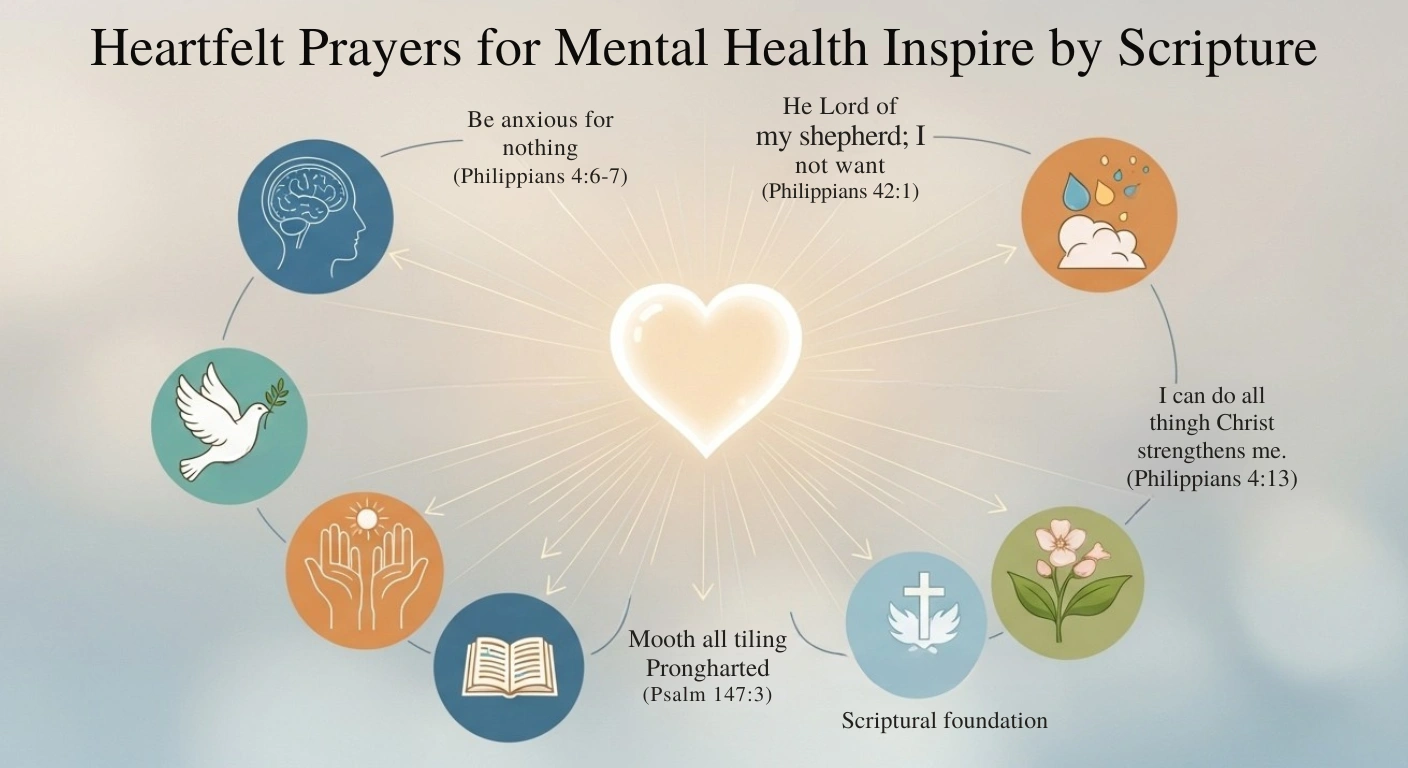
Let’s be honest. There are days when your mind feels like a runaway train. Anxiety creeps in at 2 a.m., depression settles over you like fog on a winter morning, and somewhere in all that noise, you wonder if God even hears you anymore.
If you’ve ever sat in silence wanting to pray but couldn’t find the words, you’re not alone. Millions of believers wrestle with this exact tension. They love God deeply but struggle mentally at the same time.
Scripture doesn’t shy away from mental anguish. The Bible is packed with raw, honest prayers from people who felt anxious, depressed, and overwhelmed. Those ancient words can become your lifeline today.
God right in the mess. It’s about using heartfelt prayers for mental health inspired by Scripture to anchor your soul when everything else feels unstable.
Whether you’re battling anxiety, walking through depression, supporting a loved one, or looking for spiritual tools to protect your peace of mind, you’ll find something here for you.
Why Prayer and Mental Health Belong in the Same Conversation
For a long time, many faith communities treated mental health like a forbidden topic. If you were anxious, you just needed more faith. If you were depressed, you weren’t praying hard enough.
That kind of thinking has caused real harm. Thankfully, more churches and believers are pushing back against it now.
Here’s the truth. Your brain is part of your body, and your body was made by God. Mental health sits right at the center of His concern. Just look at these biblical examples:
- David wrote the Psalms with raw honesty about his fear, his sleepless nights, and the heaviness in his chest.
- Elijah fled into the wilderness and told God he wanted to die (1 Kings 19:4).
- Jesus himself went through anguish so intense in Gethsemane that his sweat became like drops of blood (Luke 22:44).
These weren’t people with weak faith. They were some of the strongest believers who ever lived, and they still struggled mentally and emotionally.
Prayer doesn’t replace therapy or medication. But it does something no therapist’s office or prescription can do alone. It connects your suffering to someone who understands it perfectly.
When you bring your mental health struggles into your prayer life, you’re not being weak. You’re telling God, “I can’t do this alone, and I’m not going to pretend I can.”
A Prayer for When Anxiety Won’t Let Go
Anxiety makes everything feel urgent and nothing feel safe. Your heart races, your thoughts spiral, and the worst part is you often can’t even identify what you’re afraid of.
Philippians 4:6-7 speaks directly into this. “Do not be anxious about anything, but in every situation, by prayer and petition, with thanksgiving, present your requests to God. And the peace of God, which transcends all understanding, will guard your hearts and your minds in Christ Jesus.”
Father, my anxiety feels bigger than me right now. My thoughts are racing, my body is tense, and I can’t calm down. But Your Word tells me I can bring everything to You. Not just the big stuff, but all of it. So here it is, Lord. I’m handing You the worry I can name and the worry I can’t. I’m asking You for peace that doesn’t make logical sense, the kind that settles over me even when nothing has changed. Guard my heart. Guard my mind. Remind me that You’re not surprised by anything I’m facing today. I don’t need to have it all figured out. I just need You. Amen.
What makes this prayer work isn’t fancy language. It’s honesty. God isn’t looking for polished words. He’s looking for an open heart.
A Prayer for Walking Through Depression
Depression is a thief. It steals your energy, your motivation, and your ability to enjoy things you used to love. It whispers lies that sound like truth. “Nobody cares. Nothing will get better. You’re a burden.”
Psalm 34:17-18 pushes back hard against those lies. “The righteous cry out, and the Lord hears them; he delivers them from all their troubles. The Lord is close to the brokenhearted and saves those who are crushed in spirit.”
God doesn’t stand at a distance when you’re crushed. He moves closer.
Lord Jesus, I feel so heavy today. Getting out of bed took everything I had, and I’m not sure I have anything left. Depression has stolen my joy, and I barely recognize myself. But You say You’re close to the brokenhearted. So be close to me now. I need You to sit with me in this darkness because I can’t find my way out on my own. Restore my hope, even if it comes back slowly. Help me take the next small step. And Lord, give me the courage to reach out for help, whether that’s a friend, a counselor, or a doctor. Whoever You put in my path. I trust that healing can come through many hands, and all of them are Yours. Amen.
This prayer intentionally includes asking for courage to seek professional help. Faith and professional mental healthcare aren’t enemies. They work best together.
A Prayer for Dependence on God in Your Weakness
One of the hardest things about mental illness is feeling like you should handle it alone. You push through. You paste on a smile. You tell people you’re fine when you’re falling apart inside.
2 Corinthians 12:9-10 flips our understanding of weakness upside down. “My grace is sufficient for you, for my power is made perfect in weakness.”
Paul didn’t say weakness was something to overcome. He said it was the very place where God’s power shows up the most.
Lord, I’ve been pretending I can handle this on my own, and I can’t. My mind feels broken. My relationships feel strained. Some days even my body carries the weight of this mental pain. But You say Your power shows up best in weakness, and I’ve never felt weaker than right now. So instead of hiding, I’m coming to You with all of it. My exhaustion, my confusion, my shame. I’m laying down my crumbling foundation of self-sufficiency and asking You to be my firm foundation instead. When I feel mentally weak, let me be spiritually strong. I don’t need to be strong today. I just need to let You be strong for me. Amen.
This prayer matters because so many of us have built our identity around being the strong one, the capable one, the person everyone else leans on. When mental illness strips that away, it feels like losing yourself. But God says your weakness isn’t a failure. It’s an invitation for Him to step in.
A Prayer for a Mind That Won’t Stop Racing
Some of us don’t struggle with one identifiable worry. We struggle with a mind that simply won’t shut off. It jumps from thought to thought, replays conversations, imagines worst-case scenarios, and manufactures problems that haven’t happened yet.
Isaiah 26:3 offers a beautiful anchor. “You will keep in perfect peace those whose minds are steadfast, because they trust in you.”
“Steadfast” doesn’t mean you’ll never have a wandering thought again. It means you keep returning your focus to God, over and over. It’s a practice, not a one-time achievement.
God, my mind won’t stop. Thoughts keep piling on top of thoughts, and I feel mentally exhausted. I can’t focus on anything for more than a few seconds. Lord, I want the perfect peace You promise. But I’m struggling to hold my attention on anything right now. So meet me in this chaos. When my thoughts spiral, interrupt them with Your truth. When I imagine the worst, remind me that You hold my future. I choose to trust You, even though my mind keeps fighting me. Still my thoughts, Father. Give me just enough quiet inside to hear Your voice. Amen.
Here’s something interesting. Navy SEALs use positive self-talk in their training to build mental resilience. As a believer, your self-talk can go even deeper because it’s rooted in eternal truth. Try repeating phrases like these:
- “God is with me.”
- “I am not alone.”
- “Christ lives in me.”
- “I have a spirit of power, love, and a sound mind.”
These simple declarations can actually calm the part of your brain that controls anxiety. Science and Scripture line up on this one.
A Prayer for Sleepless Nights and Mental Exhaustion
Nighttime can be especially brutal when your mental health is suffering. The house gets quiet, the lights go off, and suddenly your mind turns up the volume on every fear, regret, and worry it saved all day.
Psalm 4:8 speaks gently into this. “In peace I will lie down and sleep, for you alone, Lord, make me dwell in safety.” And Psalm 3:5 adds, “I lie down and sleep; I wake again, because the Lord sustains me.”
Lord of Rest, I bring You my sleepless nights and my restless mind. My body is exhausted, but my brain won’t cooperate. The moment my head hits the pillow, every worry rushes in like a flood. Father, I ask You to be my covering tonight. Quiet the anxious thoughts. Silence the lies that grow louder in the dark. I release the stress of today and refuse to borrow tomorrow’s troubles. Surround my bed with Your peace. Let me lie down in safety, not because my circumstances are safe, but because You are. Protect my sleep. And when I wake, let me feel renewed because You carried me through the night. Amen.
If sleepless nights are a regular struggle for you, it’s worth talking to your doctor about it. Prayer covers the spiritual side, but your body may need practical support too. There’s zero shame in that.
A Prayer for Combating Feelings of Worthlessness
Mental illness has a way of attacking your sense of identity. You start comparing yourself to everyone who seems fine. You feel like a failure. In your worst moments, you feel completely worthless.
Psalm 147:10-11 reframes that conversation. “His pleasure is not in the strength of the horse, nor his delight in the legs of the warrior; the Lord delights in those who fear him, who put their hope in his unfailing love.”
God’s delight in you doesn’t depend on your output. It doesn’t change based on your mental stability.
Father, I feel like I’m falling behind. Everyone around me seems to function normally while I can barely get through the day. I feel like a burden to the people I love. But Your Word tells me something different. You don’t measure my value by productivity or mental health. You delight in me, not because of what I do, but because I’m Yours. Lord, help me see myself the way You see me. Uproot the lies of worthlessness and plant the truth of my identity in Christ deep in my heart. I am loved. I am valued. I am Yours. Amen.
Speaking God’s names over yourself adds real weight to this prayer:
- Jehovah Rapha — The God who heals
- Jehovah Shalom — The God of peace
- El Roi — The God who sees me
- Jehovah Nissi — The Lord is my banner
When you call on these names, you’re not just reciting words. You’re inviting His character into the broken places of your mind.
A Prayer for Someone You Love Who’s Struggling
Sometimes the hardest thing isn’t fighting your own battle. It’s watching someone you love fight theirs. You want to fix it, and you can’t.
Proverbs 11:14 reminds us “there is safety in having many advisers,” and James 5:16 tells us to “pray for each other so that you may be healed.”
Heavenly Father, someone I love is hurting right now, and I feel helpless. I can’t crawl inside their mind and make the pain stop. But You can reach the places I can’t. Wrap Your arms around them today. Bring the right people into their life. Compassionate doctors, wise counselors, faithful friends who won’t give up on them. Give me wisdom to know when to speak and when to simply be present. Protect me from burning out. And Lord, help them accept the help that’s available. Break through the shame that keeps them from getting care. I trust You with this person I love. Amen.
Praying for someone else’s mental health keeps your heart soft toward them on the hard days. Those days when their illness makes them difficult to be around. Those days when they push you away. Those days when progress feels painfully slow.
A Prayer for Healing from Past Trauma
Trauma doesn’t just live in the past. It echoes through your present in unexpected ways. A sound, a smell, a situation that suddenly throws you right back into the worst moment of your life.
Psalm 147:3 says, “He heals the brokenhearted and binds up their wounds.” And Psalm 73:26 adds, “My flesh and my heart may fail, but God is the strength of my heart and my portion forever.”
Lord, what happened to me left scars I carry every day. Some are visible, and some are buried so deep I’ve barely let myself look at them. But You see them all. I ask You to begin the long, slow work of healing. Help me be patient with myself the way You’re patient with me. Show me how to process what I’ve been through without being defined by it. Give me the courage to face hard memories with a counselor or trusted friend. And when flashbacks come, anchor me in the present. Remind me I’m safe now, that You are my protector, and that my story doesn’t end with what happened to me. Amen.
Trauma-informed prayer acknowledges the complexity of healing. It doesn’t rush the process or demand you “just forgive and move on.” It holds space for pain while pointing toward hope.
A Prayer for When You Feel Disconnected from God
Mental health struggles can make you feel spiritually distant too. You might not have energy to pray. Quiet time feels impossible. You start wondering if God has forgotten about you.
Romans 8:38-39 destroys that lie. “Neither death nor life, neither angels nor demons, neither the present nor the future, nor any powers, neither height nor depth, nor anything else in all creation, will be able to separate us from the love of God.”
Nothing separates you from His love. Not anxiety. Not depression. Not your worst day.
Jesus, I feel so far from You, and I hate it. My prayers feel like they’re bouncing off the ceiling. My Bible feels like just words on a page. But even if I can’t feel Your presence, I choose to believe You’re here. I choose to trust that my feelings aren’t the final word on reality. Your promises are. Keep me anchored to You even when I can’t sense the anchor. And when the fog lifts, help me remember that You never once let go. Amen.
Seasons of spiritual dryness are normal. They don’t mean God abandoned you. Sometimes faith isn’t a feeling. It’s a decision you make in the dark.
A Prayer for When Mental Health Is Damaging Your Relationships
Here’s a topic that rarely comes up in faith-based mental health spaces. Mental illness doesn’t just affect you. It ripples into every relationship you have.
- Depression can make you withdraw from the people who love you most.
- Anxiety can make you irritable, controlling, or emotionally unavailable.
- The guilt of knowing you’re hurting others just makes everything worse.
Colossians 3:13-14 offers grace in the middle of that strain. “Bear with each other and forgive one another. And over all these virtues put on love, which binds them all together in perfect unity.”
Father, my mental health isn’t just hurting me anymore. It’s hurting the people I love. I’ve been short-tempered with my spouse. I’ve pulled away from friends. I’ve missed moments with my kids because I felt too overwhelmed to show up. The guilt is eating me alive. Lord, help me repair what my illness has strained. Give my loved ones grace to bear with me. Give me humility to apologize and courage to explain what I’m going through instead of shutting down. Help me stop isolating and start letting people in. Teach me that needing help isn’t the same as being a burden. Heal the wounds my struggles have caused in the people around me. Bind us together with love that’s stronger than anything we’re facing. Amen.
Most mental health prayer resources completely ignore the relational fallout of mental illness. But it’s real, and pretending it doesn’t exist doesn’t help anyone.
The Power of the Psalms of Lament: Your Mental Health Prayer Book
If you’ve ever felt like the Bible is too polished for your messy emotions, you haven’t spent enough time in the Psalms of Lament.
Psalm 13:1-2 is a perfect example. “How long, Lord? Will you forget me forever? How long must I wrestle with my thoughts and day after day have sorrow in my heart?”
That doesn’t sound like someone who has it all together. That sounds like someone in a mental health crisis. And it’s right there in the Bible.
Here are some Psalms of Lament you can pray through when you don’t have words of your own:
- Psalm 22 — Feeling abandoned by God
- Psalm 42 — Deep sadness and spiritual longing
- Psalm 55 — Betrayal, fear, and the desire to escape
- Psalm 77 — Sleepless nights and questioning God
- Psalm 86 — Crying out in distress
- Psalm 142 — Feeling trapped and alone
Each one gives voice to a different kind of pain. Read them slowly. Let the words become your own.
The beautiful thing about lament psalms is they almost always end with a turn toward hope. The psalmist cries out in agony, then chooses to trust God anyway. That’s not denial. That’s faith at its most honest.
How to Create Your Own Scripture-Based Mental Health Prayer
Reading other people’s prayers is a great starting point. But writing your own takes things to a whole different level. Here’s a simple five-step process anyone can follow.
Identify What You’re Feeling. Before you open your Bible, honestly name what’s going on inside you. Are you anxious? Exhausted? Numb? Angry? Don’t filter it. God can handle your raw emotions.
Find a Scripture That Speaks to That Feeling. The Psalms are your best friend here. Some starting points:
- Anxious? Try Psalm 55:22 or Philippians 4:6-7
- Feeling abandoned? Read Psalm 22
- Exhausted? Turn to Matthew 11:28-29
- Afraid? Go to Isaiah 41:10
- Hopeless? Look at Romans 15:13
Write Your Prayer in Three Parts. First, tell God honestly how you feel. Then, speak the Scripture back to Him and claim that promise over your situation. Finally, ask Him for what you need. It might be peace, courage, patience, healing, or just strength to get through the next hour.
Memorize the Scripture You Used. When you memorize a verse, it stays accessible to you anytime. In a panic attack, during a sleepless night, or on a day when you can’t bring yourself to open your Bible. Hiding God’s Word in your heart means it’s always there when you need it.
Turn It into a Daily Affirmation. Reshape your Scripture into a first-person declaration. For example, Deuteronomy 31:8 says, “The Lord himself goes before you and will be with you; he will never leave you nor forsake you.” Your affirmation becomes: “God goes before me today. He is with me. He will never leave me.” Say it out loud every morning. It rewires how your brain processes fear and doubt over time.
This process turns Scripture from words on a page into a living, breathing tool for your mental health.
Practical Ways to Build Prayer into Your Mental Health Routine
Prayers for mental health work best when they become part of your daily rhythm. Here are some practical ideas that actually stick:
- Start your morning with one verse and one honest sentence to God. Even “Lord, I need You today” counts.
- Write your prayers down. Pen on paper slows your thoughts and helps you process feelings. Keep a journal by your bed.
- Pray Scripture out loud. Hearing God’s promises in your own voice does something real to your brain and your spirit.
- Take holy pauses. Three times a day, morning, noon, and night, stop for sixty seconds. Close your eyes, breathe deep, and whisper a short prayer. Psalm 131:2 says, “I have calmed and quieted myself.”
- Limit the noise. Cut back on doom-scrolling and negative inputs. Fill your space with worship music and God’s Word (Philippians 4:8).
- Invite people in. Text a trusted friend or pastor for prayer. Healing often comes through fellowship (James 5:16).
- Pair prayers with professional help. See a therapist. Take your medication. Join a support group. Prayer and professional care aren’t competing. They work toward the same goal.
Be patient with yourself. Healing isn’t linear. Some days feel like breakthroughs, and others feel like setbacks. Both are part of the journey.
You are Not Alone in This
Your mental health struggles don’t disqualify you from God’s love. They don’t make you less of a believer. And they don’t mean you’re broken beyond repair.
The Bible is full of people who wrestled with darkness. David, Elijah, Jeremiah, even Jesus himself. They prayed through it, sometimes with tears and sometimes with barely a whisper. God met every single one of them.
He’ll meet you too. Right where you are. Right in the middle of the mess.
So take a deep breath. Pick one of these prayers. And talk to the God who already knows what you need but loves hearing your voice anyway.
Final Thought
Prayer won’t erase your mental health struggles overnight, and that’s okay. What it will do is remind you that you never face those struggles alone. Every Scripture you speak, every honest word you bring before God, and every moment you choose faith over fear builds something inside you that the darkness can’t take away. Hope. Keep praying. Keep reaching out. And keep believing that the God who holds the universe together is more than able to hold you too.