
Monis 20mg Tablet: Uses, Side Effects and More

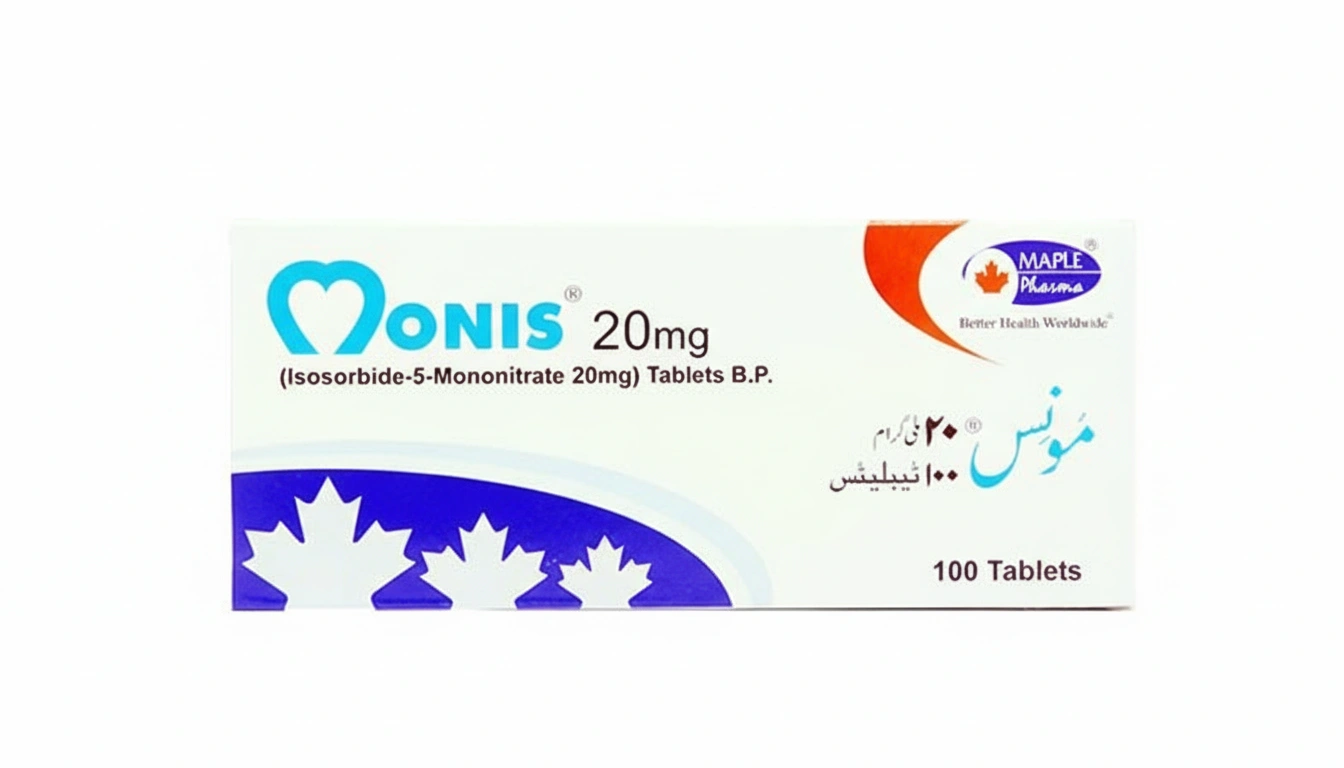
If your doctor has prescribed Monis 20mg, they are most likely trying to protect your heart from a painful and potentially dangerous condition called angina. Knowing what you are taking what it does, how it works, and what to watch out for makes a real difference in how safely and effectively you use it.
What Is Monis 20mg Tablet?
Monis 20mg is a prescription heart medication made by Maple Pharmaceuticals (Pvt) Ltd in Pakistan. Its active ingredient is Isosorbide Mononitrate (20mg), which belongs to the nitrate class of drugs.
It is the biologically active form of an older drug called isosorbide dinitrate. Unlike its parent compound, isosorbide mononitrate skips first-pass metabolism in the liver entirely. This gives it near-complete oral bioavailability and much more predictable blood levels (DrugBank Isosorbide Mononitrate).
How Does It Work?
When isosorbide mononitrate breaks down in the body, it releases nitric oxide (NO) a natural signalling gas that tells blood vessel walls to relax and widen. This process is called vasodilation. According to DrugBank, this effect acts mainly on veins rather than arteries.
When veins widen, blood pools in the peripheral circulation rather than flooding back to the heart. This reduces the load the heart carries with each beat a measurement known as preload. At the same time, arterial relaxation lowers the resistance the heart pumps against called afterload. The result is that the heart does less work, needs less oxygen, and chest pain is prevented (ScienceDirect Topics Isosorbide Mononitrate; StatPearls / NCBI Bookshelf Isosorbide).
At a cellular level, nitric oxide activates an enzyme called soluble guanylyl cyclase. This raises levels of a molecule called cyclic GMP (cGMP) inside vascular smooth muscle cells, and higher cGMP is what directly triggers vascular relaxation (DrugBank Isosorbide Mononitrate).
What Is Monis 20mg Used For?
Prevention of Angina Pectoris (Chest Pain):
This is the primary use of Monis 20mg. Angina is chest discomfort caused by reduced blood supply to the heart, usually from narrowed coronary arteries. Monis helps prevent these episodes by reducing the heart’s workload and improving blood flow to oxygen-starved areas.
There is one key limitation worth knowing: Monis 20mg cannot stop an angina attack that has already started. Its onset is too slow for that. For active chest pain, faster-acting sublingual nitroglycerin is used instead. This is clearly stated in StatPearls (NCBI Bookshelf) and in the FDA prescribing information for Monoket.
Congestive Heart Failure (CHF):
Monis is also used to manage congestive heart failure a condition where the heart cannot pump blood efficiently enough, causing fluid to build up in the lungs and other tissues. By reducing both preload and afterload, it eases the strain on an already struggling heart (Dawaai.pk Monis 20mg Tablet; StatPearls / NCBI Bookshelf).
Coronary Artery Disease:
In patients with coronary artery disease, Monis improves blood flow to the heart muscle by dilating coronary vessels and increasing oxygen delivery to areas that are not getting enough supply (ScienceDirect Topics Isosorbide Mononitrate).
Dosage and How to Take It
The standard regimen is one 20mg tablet twice daily, taken 7 hours apart typically the first dose on waking and the second dose 7 hours later. This schedule is not arbitrary. It creates a nitrate-free interval of roughly 17 hours overnight, which is essential to stop tolerance from developing (FDA Prescribing Information — Monoket).
Key instructions to follow:
- Swallow the tablet whole do not crush, break, or chew it
- It can be taken with or without food
- Take it at the same time each day for best results
- Never stop taking it suddenly without speaking to your doctor first
- If you miss a dose late in the day, skip it never double up the next dose to make up for it
What Is Nitrate Tolerance and Why Does It Matter?
Nitrate tolerance happens when the body adapts to continuous nitrate exposure and the drug gradually stops working. Multiple well-controlled clinical studies, referenced in the FDA prescribing label for Monoket (Accessdata FDA), showed that continuously delivered nitrates became no more effective than a placebo within 24 hours or less. Increasing the dose to push through tolerance has consistently failed to work.
The solution is the drug-free interval built into the dosing schedule. Taking the second dose too late in the day, or adding extra doses on your own, defeats this purpose entirely and makes the medication far less effective over time.
Side Effects
Common Side Effects:
- Headache — This is the most frequently reported side effect and can affect up to 30% of patients when they first start treatment. It reduces quickly as the body adjusts. The headache is actually a sign the medication is working it means blood vessels are dilating as they should (NDrugs.com prescribing data)
- Dizziness and lightheadedness — Caused by the drop in blood pressure, particularly when standing up quickly
- Flushing — Redness of the skin from surface vasodilation
- Nausea and heartburn
- Fatigue and sleep disturbances — Reported in approximately 6% of patients in modified-release clinical trials (NDrugs.com prescribing data)
Serious Side Effects Seek Medical Attention:
- Severe hypotension — A dangerous drop in blood pressure, especially when upright, can occur even at small doses (FDA Prescribing Label Monoket)
- Paradoxical angina — In rare cases, an excessive blood pressure drop can actually worsen chest pain rather than ease it
- Tachycardia — Rapid heartbeat as the body tries to compensate for lower blood pressure
- Increased intraocular pressure — A concern for patients who have, or are at risk of, glaucoma
- Blue lips or skin — This can be a warning sign of methemoglobinemia, a serious condition where nitrate ions stop the blood from carrying oxygen properly. Seek emergency care at once if this happens (Cleveland Clinic Isosorbide Mononitrate Tablets)
Important Warnings and Precautions
Never Take With Erectile Dysfunction Medications:
Do not combine Monis 20mg with PDE5 inhibitors sildenafil (Viagra), tadalafil (Cialis), vardenafil (Levitra), or avanafil under any circumstances.
Both nitrates and PDE5 inhibitors lower blood pressure. Together, they can cause a sudden and catastrophic drop that leads to cardiovascular collapse. A double-blind, placebo-controlled study published in the Journal of the American College of Cardiology (Webb DJ et al., 2000) confirmed that combining sildenafil with isosorbide mononitrate produces significantly greater and more dangerous blood pressure reductions than nitrates taken alone. Both the FDA label for sildenafil and the FDA label for isosorbide mononitrate list this as an absolute contraindication, with no exceptions.
Calcium Channel Blockers:
Taking Monis alongside calcium channel blockers such as amlodipine or nifedipine can cause a marked drop in blood pressure, particularly when standing. If you take both, your doctor may need to adjust the dose of one or both medications (RxList Ismo Prescribing Information).
Alcohol:
Alcohol strengthens the blood pressure-lowering effect of Monis and significantly raises the risk of dizziness, fainting, and hypotension. Avoid alcohol while you are on this medication (Drugs.com Isosorbide Mononitrate Drug Interactions).
Stopping the Medication:
Never stop Monis suddenly. Industrial workers who had long-term exposure to high-dose nitrates and then stopped abruptly suffered chest pain, heart attacks, and in some cases sudden death confirming the existence of real physical dependence. The FDA prescribing label for Monoket specifically flags this risk and recommends gradual discontinuation under medical supervision.
Conditions That Need Extra Care:
Tell your doctor before starting Monis 20mg if you have any of the following:
- Glaucoma or a risk of raised eye pressure
- Hypothyroidism (underactive thyroid gland)
- Malnutrition
- Severe kidney or liver problems
- Low blood pressure
- Hypertrophic cardiomyopathy nitrate therapy can worsen angina in this particular heart condition (FDA Prescribing Information Monoket)
Pregnancy and Breastfeeding:
Monis 20mg should only be used during pregnancy when it is clearly necessary and only under medical supervision. Animal studies have shown potential harm to the developing foetus, though human data is limited (1mg.com Monit 20 Tablet). It is not yet known whether isosorbide mononitrate passes into breast milk. If you are breastfeeding, speak to your doctor before taking this medication (FDA Prescribing Information Monoket).
What to Do in Case of Overdose
This section was completely absent from all major competitor pages and that is a serious gap for patients and caregivers.
An overdose of Monis 20mg is a medical emergency. According to Drugs.com (citing the official isosorbide mononitrate prescribing information), an overdose can be fatal.
Know the warning signs. An overdose causes a dangerous collapse in blood pressure. Symptoms can include:
- Severe throbbing headache and high fever
- Extreme confusion and dizziness
- Rapid or pounding heartbeat
- Visual disturbances
- Nausea, vomiting, or bloody diarrhoea
- Cold or clammy skin
- Difficulty breathing
- Fainting, seizures, or loss of consciousness
Watch for blue or chocolate-brown skin and lips. This can indicate methemoglobinemia a rare but life-threatening condition where nitrate ions turn haemoglobin into a form that cannot carry oxygen. The FDA prescribing labels (DailyMed / Accessdata FDA) confirm that the treatment of choice for confirmed methemoglobinemia is intravenous methylene blue, which must be given in a hospital.
What to do immediately:
- Do not try to treat an overdose at home
- Tell the medical team exactly what was taken, the strength (20mg), and how many tablets were consumed
- Do not induce vomiting unless a medical professional specifically tells you to
According to StatPearls / NCBI Bookshelf, treatment focuses on restoring central fluid volume typically by lying the patient flat with legs raised and, if needed, giving intravenous normal saline. Epinephrine and vasoconstrictors are generally not recommended, as they may cause further harm.
Lifestyle Changes That Support Monis 20mg Treatment
None of the leading competitor pages cover this yet it directly affects how well the medication works for you.
Monis treats the symptoms of coronary artery disease and angina, but it does not treat the underlying disease itself. The prescribing summary for Monit 20 on 1mg.com explicitly advises patients to make lifestyle changes alongside medication. Here is what matters most:
- Stop smoking. Smoking damages the blood vessel lining, triggers coronary artery spasm, and undermines how well nitrate therapy works. If you are on Monis and still smoking, the medication is fighting an uphill battle every single day.
- Eat a heart-protective diet. A diet low in saturated fat and salt, and rich in fibre from vegetables, fruits, and whole grains, helps slow down the arterial plaque buildup that causes angina. The World Heart Federation recommends reducing salt intake and cutting out processed foods as core steps for cardiac protection (World Heart Federation Healthy Heart Guidelines).
- Exercise, but do it carefully. Regular moderate activity strengthens the heart and improves circulation over time. However, because Monis can cause dizziness and blood pressure drops, you must discuss safe exercise limits with your doctor before starting. Avoid sudden intense exertion, especially in hot weather.
- Keep stress under control. Stress triggers adrenaline surges that raise heart rate and blood pressure, increasing the heart’s oxygen demand. This can bring on angina even in patients who are on medication. Practical steps like controlled breathing, consistent sleep, and reducing unnecessary pressure at work or home are all sensible complements to cardiac treatment.
- Cut down on sodium. High salt intake raises blood pressure and increases the load on the very heart that Monis is working to protect. Reducing processed food, salty snacks, and added salt in cooking directly supports what the medication is trying to do.
Monis works best when your daily habits work with it, not against it. Taking the tablet and then continuing to smoke and eat poorly is like trying to bail out a boat while the hole is still open.
Storage
Store Monis 20mg tablets at room temperature (18–25°C), away from direct light and moisture. Keep them out of the reach of children and do not store them in the bathroom (Dawaai.pk Monis 20mg Tablet).
References:
- DrugBank — Isosorbide Mononitrate
- ScienceDirect Topics — Isosorbide Mononitrate (Pharmacology & Toxicology)
- StatPearls / NCBI Bookshelf — Isosorbide
- FDA Prescribing Information — Monoket (Isosorbide Mononitrate), Accessdata FDA
- FDA Prescribing Information — Isosorbide Mononitrate Extended-Release (Drugs.com)
- DailyMed — Isosorbide Mononitrate Extended-Release Tablets (NLM)
- RxList — Ismo (Isosorbide Mononitrate) Prescribing Information
- Webb DJ et al. (2000). “Sildenafil citrate potentiates the hypotensive effects of nitric oxide donor drugs in male patients with stable angina.” Journal of the American College of Cardiology PubMed
- Drugs.com — Isosorbide Mononitrate Uses, Dosage & Side Effects
- Drugs.com — Isosorbide Mononitrate + Sildenafil Drug Interactions
- 1mg.com — Monit 20 Tablet (Isosorbide Mononitrate)
- World Heart Federation — Healthy Heart