
Could I Get Pregnant if I Have Sex During My Period?

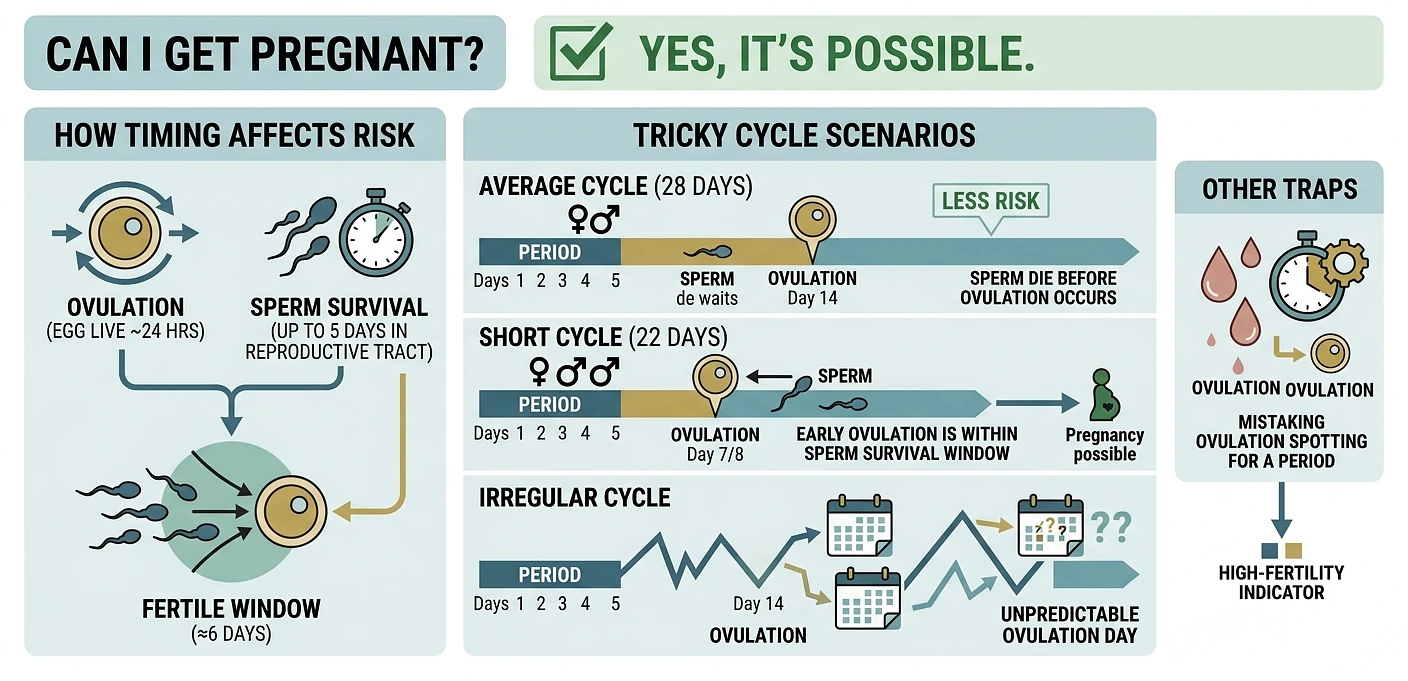
Abstract: yes, it’s possible. Less likely than other times of the month, but not zero. And that tiny window of possibility is exactly where people get tripped up.
The whole “you can’t get pregnant on your period” idea has been passed around for decades like it’s a free pass. It isn’t. Biology is messier than a neat 28-day calendar, and once you understand why, the answer makes a lot more sense.
What Happen Getting Pregnant?
Pregnancy needs two things to meet: a sperm and an egg. The egg shows up once per cycle during ovulation, lives for about 12 to 24 hours, and then it’s gone. Sperm, on the other hand, are the stubborn ones. In the right conditions inside the female reproductive tract, they can survive up to 5 days.
That survival window is the whole trick. You don’t need sperm and egg to arrive at the same moment. Sperm can show up early and wait.
So your “fertile window” isn’t one day. It’s roughly 6 days: the 5 days before ovulation plus the day of ovulation itself. The National Health Service (NHS) notes sperm can survive in the fallopian tubes for up to 7 days in some cases a reminder that the window isn’t always as tidy as textbooks suggest.
How Can I Get Sex Pregnant While I Have My Period?
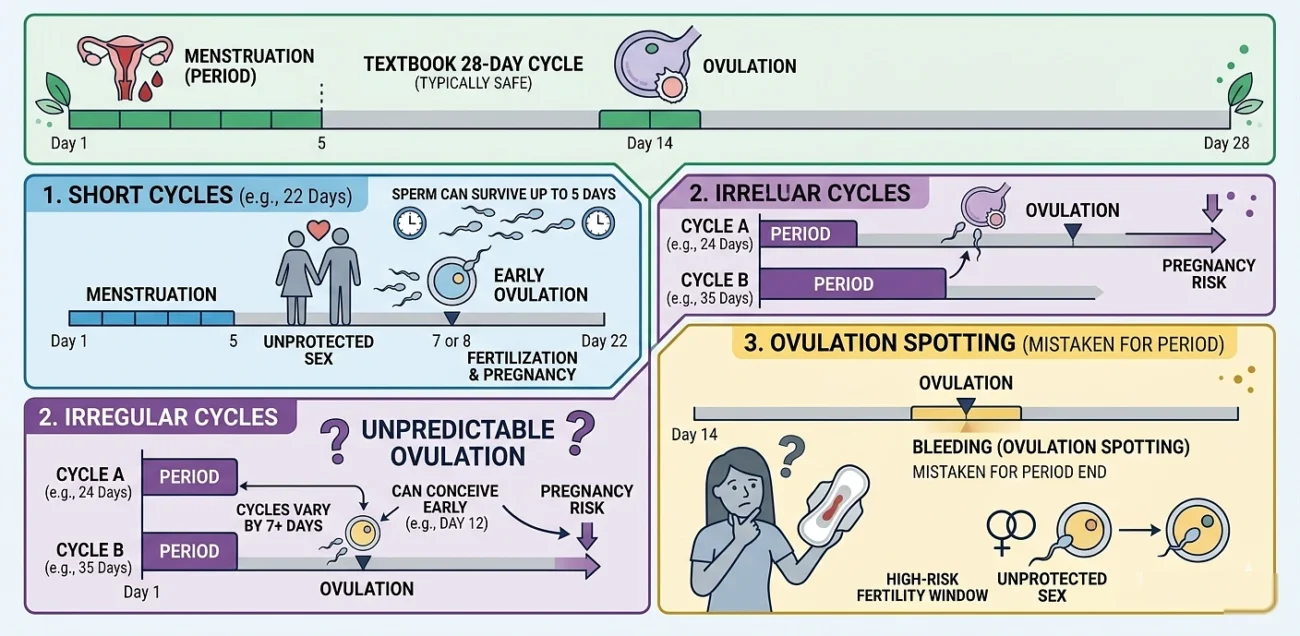
Here’s where the period thing gets interesting. In a textbook 28-day cycle, ovulation happens around day 14. If your period ends by day 5 or 6, there’s a good gap before ovulation shows up. Seems safe, right?
It is usually. But three situations flip the script:
1. Short cycles
Not everyone has a 28-day cycle. Plenty of people run shorter 21, 22, 24 days. In a 22-day cycle, ovulation can happen around day 7 or 8. If you have sex on day 5 or 6 (still technically your period for some), sperm can hang around for 5 days and catch that early egg. Pregnancy. Just like that.
2. Irregular cycles
If your cycle is unpredictable, you genuinely don’t know when you’re ovulating. In the 2022 paper Menstrual irregularity as a biological limit to early pregnancy awareness (Nobles, Cannon & Wilcox), published in Proceedings of the National Academy of Sciences, researchers analyzed 1.6 million prospectively recorded menstrual cycles from 267,209 US women. They found that 22% of women had cycles that varied by 7 or more days between consecutive cycles and that people with irregular cycles can conceive as early as day 12 of their cycle.
3. Ovulation spotting mistaken for a period
Some people bleed a little during ovulation. If you think you’re on your period but you’re actually ovulating, you’re not in a low-risk zone you’re in the highest-risk zone of the entire month.
Sperm Survival The Having Sex During Period
A lot of the confusion around period sex comes from underestimating how long sperm can stick around.
The landmark 1995 study by Wilcox, Weinberg & Baird, Timing of Sexual Intercourse in Relation to Ovulation Effects on the Probability of Conception, Survival of the Pregnancy, and Sex of the Baby (New England Journal of Medicine, Vol. 333, pp. 1517–1521), tracked 625 menstrual cycles in 221 women trying to conceive. The researchers found that conception only occurred when intercourse took place during a 6-day window ending on the day of ovulation. The probability of conception ranged from 0.10 when intercourse happened 5 days before ovulation up to 0.33 on the day of ovulation itself.
The takeaway: sperm deposited up to 5 days before ovulation can still produce a pregnancy. That’s a long runway.
Conditions matter too. Sperm survive longer when fertile cervical mucus is present the stretchy, egg-white-looking kind that shows up around ovulation. Without that mucus, the vagina’s naturally acidic environment kills most sperm within hours. But “most” isn’t “all,” and a short cycle can shrink the gap between sex during your period and ovulation to well within that 5-day sperm survival window.
So What Are the Actual Odds?
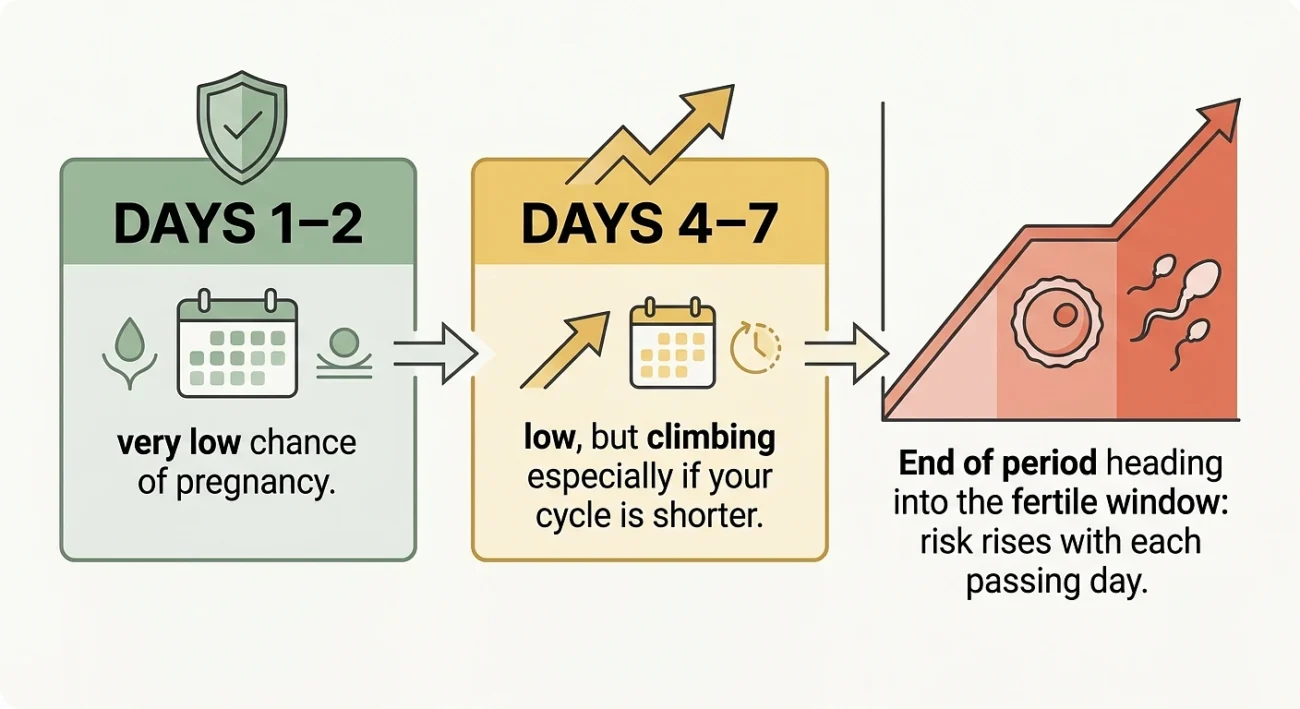
Planned Parenthood puts it plainly: having unprotected sex during your period can result in pregnancy, though it’s not super common especially early in your period.
The Cleveland Clinic’s OB/GYNs say much the same. Risk is lower during your period than at other times, but it absolutely exists, especially if your cycle is shorter than 28 days.
If You are Trying to Avoid Pregnancy
The “period method” isn’t contraception. It’s a rough probability game with terrible odds compared to actual birth control.
Real options that work:
- Condoms (pregnancy and STI protection).
- Birth control pills, patch, ring, implant, IUD, or shot.
- A combination condoms plus hormonal birth control gives the strongest protection.
If you had unprotected sex during your period and you’re worried, emergency contraception is effective when taken within 3 to 5 days depending on the type. The sooner, the better.
If You are Trying to Get Pregnant
Period sex isn’t going to help you conceive unless your cycle is quite short. Your best shot is sex every other day during your fertile window roughly days 10 through 16 of a 28-day cycle. Tracking ovulation through basal body temperature, cervical mucus changes, or ovulation predictor kits gets you much closer to the target.
References
- Wilcox AJ, Weinberg CR, Baird DD. Timing of Sexual Intercourse in Relation to Ovulation Effects on the Probability of Conception, Survival of the Pregnancy, and Sex of the Baby. New England Journal of Medicine, 1995;333(23):1517–1521
- Nobles J, Cannon L, Wilcox AJ. Menstrual irregularity as a biological limit to early pregnancy awareness. Proceedings of the National Academy of Sciences (PNAS), 2022;119(1):e2113762118
- NHS – Periods and fertility in the menstrual cycle
- Cleveland Clinic – Myth Busted: You Can Get Pregnant During Your Period
- Planned Parenthood – Can you get pregnant if you have sex during your period?
- Mayo Clinic Press – Is it possible to get pregnant if I have sex during my period?
- Mayo Clinic – Menstrual cycle: What’s normal, what’s not