
Hair Transplant Cost: Everything You Need to Know About an FUE Hair Transplant

Hair transplant cost loss is incredibly common by age 50, about half of all men and a quarter of women experience noticeable thinning or balding. For many, topical treatments and medications only slow the process, which is why surgical hair restoration has become one of the most sought-after permanent solutions. Among the available techniques, Follicular Unit Extraction (FUE) is now the most popular because it is minimally invasive, leaves virtually no visible scarring, and delivers natural-looking results when done well.
This guide breaks down exactly what an FUE hair transplant involves, what actually drives the price, realistic cost ranges in different countries, and what you can expect in terms of recovery and long-term outcome.
What Is an FUE Hair Transplant
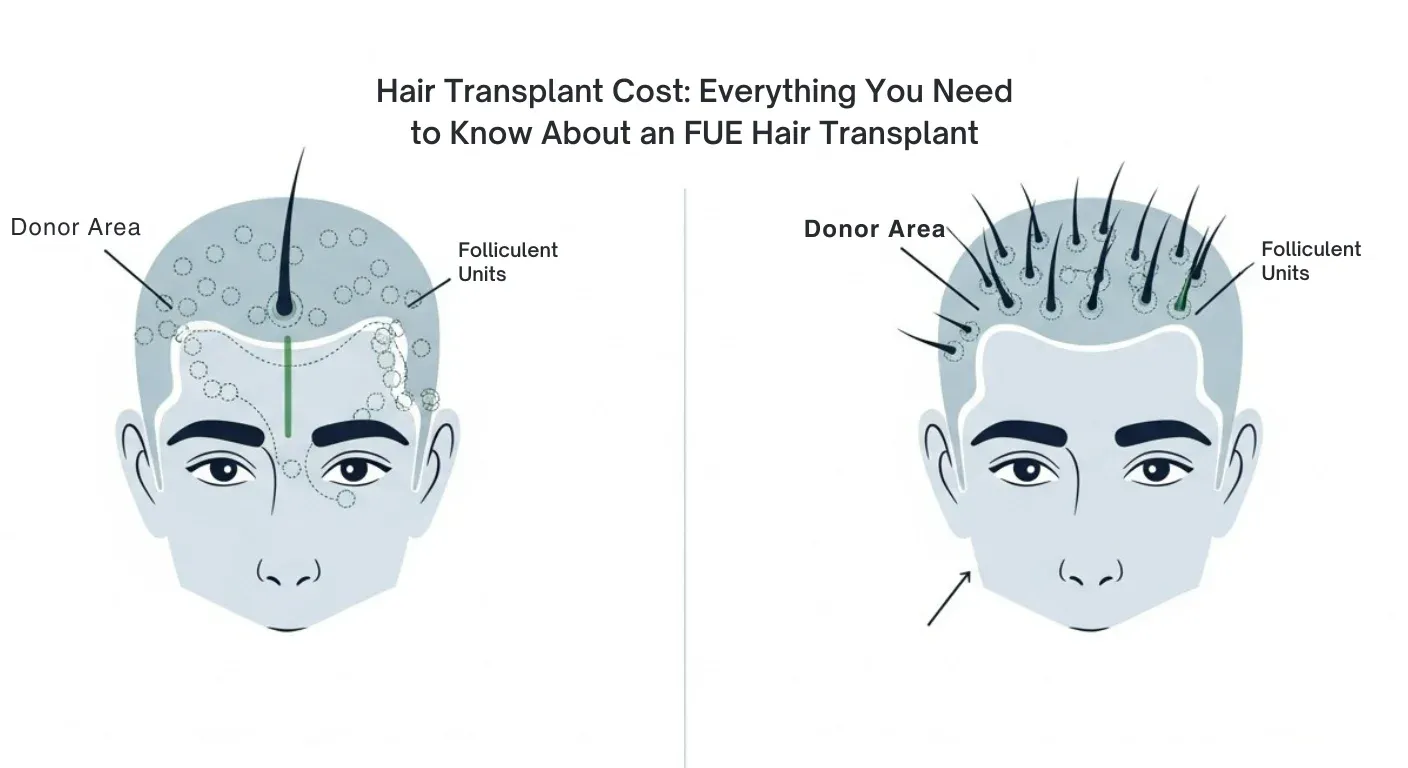
FUE stands for Follicular Unit Extraction. It is a hair restoration technique where individual follicular units (groups of 1–4 hairs that grow naturally occur together) are removed one-by-one from the donor area usually the back or sides of the scalp and transplanted to the thinning or bald recipient areas.
Unlike the older FUT (strip) method that removes an entire strip of health skin and leaves a linear scar, FUE uses a tiny punch tool (typically 0.8–1.0 mm) to extract each graft, resulting in only microscopic dot scars that are essentially invisible once healed, even with very short hair.
How the FUE Procedure Works
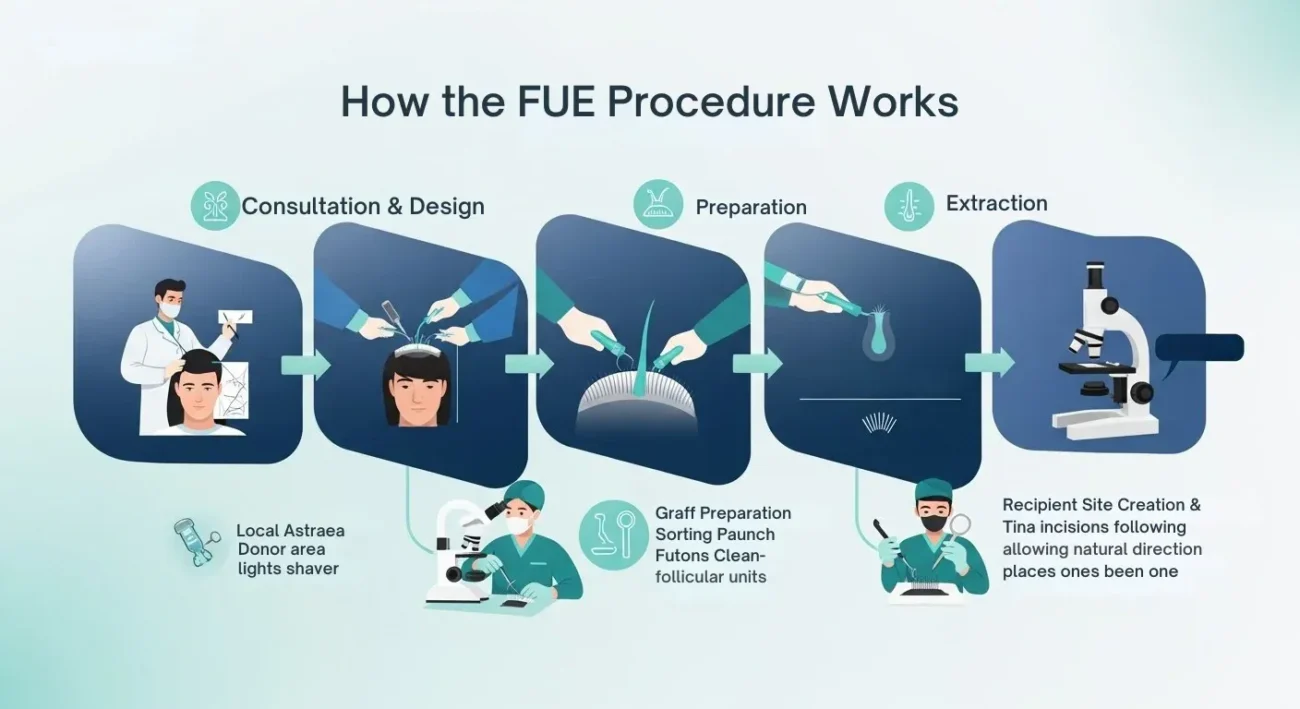
- Consultation & Design The surgeon examines your scalp, assesses donor density in the donor zone, and designs the new hairline together with you.
- Preparation The donor area is usually shaved (or partially shaved with “no-shave” FUE techniques). Local anesthesia is applied to both donor and recipient areas.
- Extraction Using a micro-punch, the surgeon removes each follicular unit individually. A typical session extracts 1,500–5,000 grafts depending on the extent of hair loss.
- Graft Preparation Technicians sort and clean the extracted follicles under microscopes to ensure maximum viability.
- Recipient Site Creation & Implantation Tiny incisions are made in the balding areas following the natural angle and direction of your existing hair. The grafts are then placed one by one.
A single session can last 4–10 hours and is sometimes split over two consecutive days for larger cases. Most patients stay awake and comfortable throughout.
Benefits of Choosing FUE
- No linear scar ideal if you like to wear your hair very short
- Faster healing than strip surgery (most people return to work in 3–7 days)
- Less postoperative discomfort
- Ability to harvest body hair (chest, beard) if scalp donor hair is limited
- Very natural-looking results when performed by an experienced surgeon
Recovery and Results Timeline
- Days 1–5: Small scabs form in the recipient area; donor area has tiny red dots
- Days 5–10: Scabs fall off; you can usually resume non-strenuous work
- Weeks 2–3: Transplanted hairs often shed (“shock loss” completely normal)
- Months 3–6: New hair starts growing
- Months 12–18: Final density and texture are visible
Transplanted hair is permanent because the follicles come from the DHT-resistant “safe zone” at the back and sides of the head.
Factors That Influence FUE Cost
The price is almost never a flat fee it is driven by:
- Number of grafts required (the single biggest factor)
- Surgeon’s experience and reputation
- Geographic location and clinic overhead
- Manual FUE vs. robotic-assisted (ARTAS) or advanced tools (Sapphire blades, DHI implanters)
- Whether the package includes accommodation, transfers, aftercare medications, etc.
- Additional sessions needed for density
Realistic FUE Hair Transplant Costs in 2025
United States & Western Europe Typical range: $4,000 – $15,000+ Average for a 2,000–3,000 graft case: $8,000 – $12,000 Per-graft pricing is common ($4–$10 per graft). Robotic FUE and top-tier surgeons in major cities (NYC, LA, London) often push the upper end.
Turkey (and other medical-tourism destinations) Typical all-inclusive package (3,000–5,000 grafts + hotel + transfers + meds): $2,000 – $5,000 Some clinics quote as low as $1,800 for smaller cases and up to $8,000 for premium or very large sessions. Per-graft pricing is rare; most clinics offer unlimited or fixed-price packages.
Other popular countries (2025 averages for ~3,000 grafts)
| Country / Region | Pricing Model | Estimated Total Cost (USD) | 2,000–3,000 Graft Estimate (USD) |
|---|---|---|---|
| United States | Per-graft: $4–$10+ | $10,000–$25,000+ for a full procedure | $8,000–$18,000 |
| Western Europe | Per-graft or Hybrid | $6,000–$15,000+ | Varies by country; Germany averages ~$7,500 for 3,000 grafts |
| Turkey | All-inclusive package | $1,500–$6,000 | $2,000–$5,000 (often includes travel extras) |
| Mexico | Package / Per-graft | $4,000–$10,000 | $3,800 for FUE offered by some clinics |
| Poland / Hungary | Per-graft | $1,400–$6,500 | $3,500–$7,000 (based on 2024–2025 data) |
| India | Per-graft / Package | $2,000–$6,000 | Varies by city, per-graft cost is low |
| Thailand | Per-graft / Package | $2,000–$7,000 | $3,000–$7,000 for 2,000 grafts |
These are approximate ranges compiled from clinic directories and patient-reported data in 2024 2025. Prices fluctuate with currency exchange and individual clinic policies.
Success Rates and Risks
When performed by a qualified, experienced surgeon, graft survival is typically 90–98%. Complications are uncommon but can include infection (rare), temporary shock loss, cysts, or overharvesting of the donor area if the surgeon is aggressive. Choosing a board-certified surgeon with thousands of documented cases dramatically reduces these risks.
Is an FUE Hair Transplant Worth the Cost
For most patients with stable hair loss who want a permanent, maintenance-free solution, yes. The hair is your own, grows naturally, and requires no special care beyond normal shampooing. Many patients report the confidence boost is life-changing. The key is realistic expectations and choosing quality over the absolute lowest price.