
The Household Illness in Your Kid That Might Not Be a Bug
The pattern shows up in pediatric emergency rooms regularly. A family walks in with two or three kids who all have the same symptoms. Headache, nausea, feeling tired and off, sometimes vomiting. Sounds like a stomach bug going through the house. Sometimes it is. Sometimes it is carbon monoxide, and by the time anyone figures that out, the whole family has been breathing it for hours or days.
Roughly 5,000 children show up in American emergency departments every year with unintentional carbon monoxide poisoning, and kids under four have the highest rate of exposure of any age group. What makes it hard to catch is that the early symptoms look almost identical to a viral illness, and parents (and sometimes clinicians) rule out CO because it never occurs to them to look.
What CO Actually Does To A Kid
Carbon monoxide binds to hemoglobin about 240 times more tightly than oxygen does. Once it grabs onto a red blood cell, that cell cannot carry oxygen anymore. The lungs are working, the heart is pumping, but the blood is quietly less able to deliver oxygen to tissues, and the brain and heart get the worst of it because they are the most oxygen-hungry organs in the body.
This is why kids are more vulnerable than adults. Children breathe more times per minute per kilogram of body weight than adults do, and their metabolic rate is higher. They absorb CO faster and reach dangerous blood levels sooner in the same environment. Newborns are the most vulnerable of all because they still have fetal hemoglobin, which binds CO even more tightly than adult hemoglobin.
The result is that in a house with a slow CO leak, the smallest kid in the family often gets sick first and gets sickest fastest.
Why “Flu” Is The Wrong First Guess
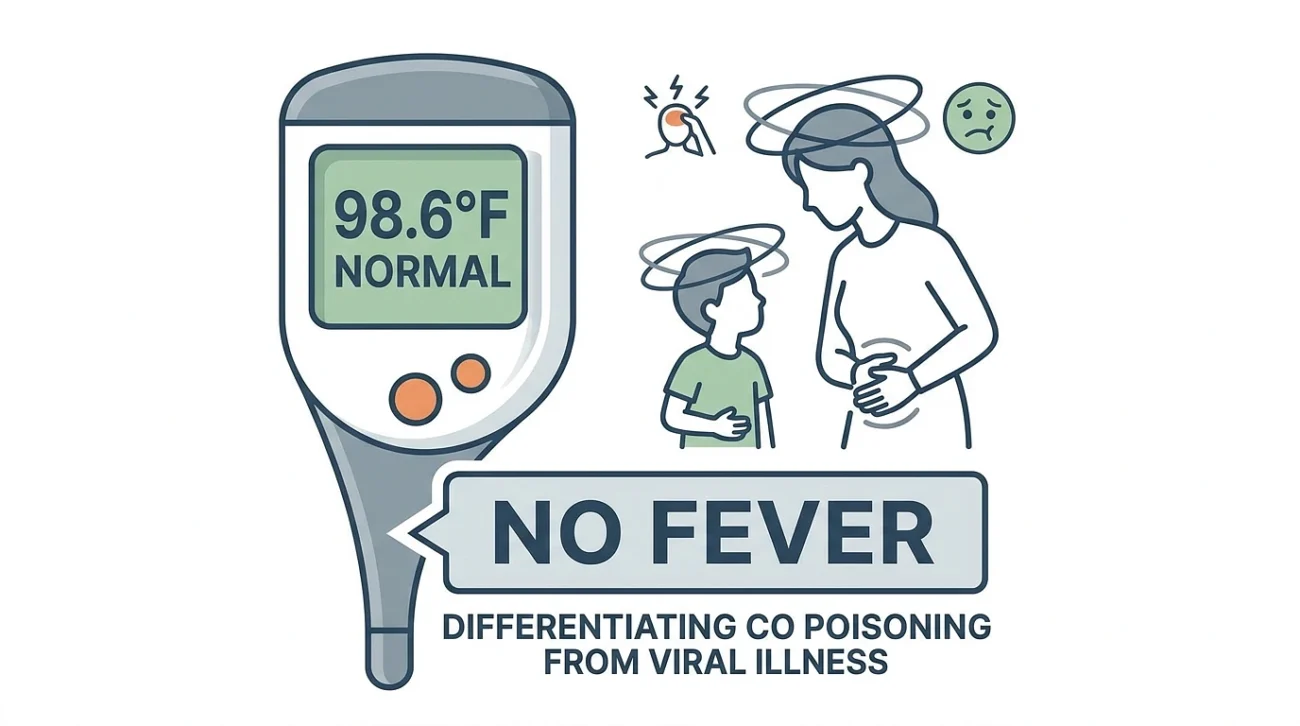
The Pediatric Environmental Health Specialty Units, a network of specialty clinics that consult on child environmental exposures, puts it directly. Early CO symptoms mimic viral illness closely enough that misdiagnosis as “bad flu” or food poisoning is common, in any season, not just cold weather.
Here is the tell that pediatric emergency doctors use. CO poisoning patients are classically afebrile. No fever. A viral illness almost always brings fever with the headache, nausea, and body ache. When several people in the same house have flu-like symptoms without any fever, especially when the house has been closed up with the AC running or with a lot of appliance use, that pattern should shift the question toward whether the house is the source.
The symptom pattern in kids is slightly different from adults. In verbal children the most common presenting symptoms are headache, nausea, and vomiting. In infants who cannot describe what they feel, the most common presenting sign is a disturbance of consciousness. Sleepiness that seems out of proportion to what is normal. Difficulty waking. Unusual quietness. Lethargy that feels different from a normal sick kid.
The other clue is the timing. CO symptoms often improve when the family leaves the house and get worse when they come back. If a kid feels better at the park or at grandma’s and then declines again after coming home, that is not usually how a viral illness behaves.
Where The CO Is Actually Coming From
Any appliance in the home that burns fuel produces carbon monoxide as a byproduct of combustion. Natural gas, propane, oil, wood, kerosene, gasoline, coal. When these appliances are working correctly and venting properly, the CO goes safely out of the house. When something fails, it does not.
The residential sources that account for most home CO poisonings:
- Gas water heaters that are installed incorrectly or vented poorly (year-round exposure risk).
- Furnaces with cracked heat exchangers or blocked flues (winter risk when heating runs).
- Gas ranges and ovens, particularly when used for heating instead of cooking.
- Gas or wood fireplaces with blocked chimneys.
- Portable generators run indoors or in attached garages, which is a major summer risk after storms and power outages.
- Cars left running in attached garages, even briefly.
- Charcoal grills brought indoors.
- Pool and spa heaters, especially indoor pools with poor ventilation.
- Boat engines with kids near the exhaust in enclosed cabins.
Water heaters are worth flagging specifically because they run year-round, they sit in basements or utility closets where nobody thinks about them, and improper venting is a well-documented cause of chronic low-level CO exposure. Professional gas water heater installation matters here because getting the vent sizing, slope, and combustion air right is not something DIY installations reliably handle, and the failures often produce leaks small enough to sicken the family gradually without ever triggering an obvious event.
The Demographic That Shows Up Most Often
Kids under four are the highest-risk age group according to CDC data on unintentional CO exposure. A few factors combine to make this the case. Little kids spend more time indoors than older ones. They breathe faster. They cannot describe subtle symptoms. And they often get put down for naps in the exact rooms where a slow leak would concentrate.
Older kids in the house often report the same symptoms but less severely, because they have larger bodies, slower breathing rates, and the ability to say “my head hurts and I feel weird.” The pattern of the youngest kid being sickest is common enough that pediatric emergency medicine literature specifically flags it as a reason to consider CO when siblings present together with similar symptoms and no fever.
Pregnant women in the same house are also at particular risk because the developing fetus is even more vulnerable to CO than the mother. Fetal hemoglobin binds CO tightly, and maternal CO poisoning can produce fetal harm at exposure levels the mother tolerates without severe symptoms.
What Actually Prevents This
Two things. Working detectors and properly maintained combustion appliances.
Detectors. Every home with any fuel-burning appliance should have CO detectors on every level of the house and outside every sleeping area. The AAP recommends checking them monthly and replacing batteries per manufacturer instructions. Detectors have a lifespan (typically 5 to 10 years depending on the model) and need to be replaced when they expire even if they still seem to be working.
Annual professional inspection of every combustion appliance. Furnace, water heater, gas fireplace, gas range. A qualified HVAC or plumbing technician can check for cracked heat exchangers, blocked flues, proper venting, and correct combustion. This is not a job for the homeowner. The failures that produce CO leaks are usually not visible to the naked eye and require testing to find.
A few other habits that matter:
- Never run a generator indoors or in an attached garage, even with the door open.
- Never use a gas oven or range as a room heater.
- Never bring a charcoal or gas grill inside.
- Never leave a car running in an attached garage even briefly.
- If your CO detector goes off, treat it as an emergency, get everyone outside, and call 911 from outside the house.
When To Call The Pediatrician Versus When To Go To The ER
Any kid with fatigue, headache, nausea, or vomiting, especially with siblings showing similar symptoms and no fever, is worth mentioning CO exposure to when you call the pediatrician. It is a fair question and any pediatrician will take it seriously. Any kid with fatigue, headache, nausea, or vomiting, especially with siblings showing similar symptoms and no fever, is worth mentioning CO exposure to when you call the pediatrician. It is a fair question and any pediatrician will take it seriously. Pediatricians also play an important role in directing families to the right specialist when a child has needs outside routine care, whether that means environmental health expertise or pediatric plastic surgery for structural concerns that require specialized evaluation.
If a CO detector goes off, if a child loses consciousness, if a child is confused or difficult to wake, or if multiple family members become suddenly and severely ill at the same time, that is a 911 call from outside the house. Do not go back in for anything. First responders can treat CO poisoning quickly with high-flow oxygen, and in severe cases hyperbaric oxygen therapy is available at specialized centers.
The other thing worth knowing is that CO poisoning can have delayed neurological effects that show up two to forty days after the initial exposure, even in cases where the child seemed to recover fully. Cognitive changes, mood disturbances, memory problems, gait abnormalities. Any child who was treated for CO poisoning should be followed for these symptoms for several weeks after the event.
The Pattern To Hold In Mind
Multiple family members with flu-like symptoms, no fever, symptoms better away from the house and worse at home, youngest kid the sickest. That pattern, together or in any combination, is worth taking seriously as CO exposure until it can be ruled out. Summer, winter, doesn’t really matter the appliances that produce CO run year-round in most homes, and generators after storms are one of the highest-risk exposures of the year in areas that lose power.
Most of the time when a household illness moves through the family, it is actually a virus. But the misdiagnosis pattern is real, the exposure sources are common, and the prevention is straightforward. A working detector on every floor, annual inspection of every combustion appliance, and the awareness that when the flu comes without fever and hits the whole household at once, the house itself is worth thinking about as the source.