
WRITE FOR US - LIFESTYLE AND WELLNESS

Hadia Zainab Curecart Direct Write For Us Lifestyle Manager

This page is managed by me, Hadia Zainab.

I am a journalist and a certified freelance medical writer from Pakistan, with bylines in international digital and print media outlets including Healthnews, The Epoch Times, CNN, Yahoo Life and Physiopedia. I have been a Member of the World Health Organization’s Fides network since February 2024, and I have been writing for Healthnews since May 2024, where I interview industry experts and write research backed articles across physical health, senior care, supplements, beauty, wellness, nutrition and skin related conditions. I also contribute to Physiopedia in physical therapy and rehabilitation, where I edit articles and update the older ones so the information stays current. My work focuses strictly on science backed health reporting.


We have received a positive response from you guys on our health write for us page, but our editor Dr. Rabeya Tufail handles those queries. She is our Editorial Director and Medical Review Lead, and as Managing Editor at CureCartDirect she personally oversees all editorial inquiries and guest content submissions on that side. She has a medical background, MBBS from Ziauddin University between 2010 and 2016, along with a certification in Biomedical Responsible Conduct of Research from the CITI Program, and she oversees the content that is only health and healthcare and medical industry related.

I was hired by the CureCartDirect team now to handle the queries regarding content that is lifestyle focused and connected to wellbeing. So that means nutrition and everyday eating, sleep, stress, movement and fitness habits, supplements from a daily use angle, skin and beauty routines, healthy ageing, motivation and habit building, and the general daily side of wellbeing.

All the new queries like this one were earlier being sent to her.
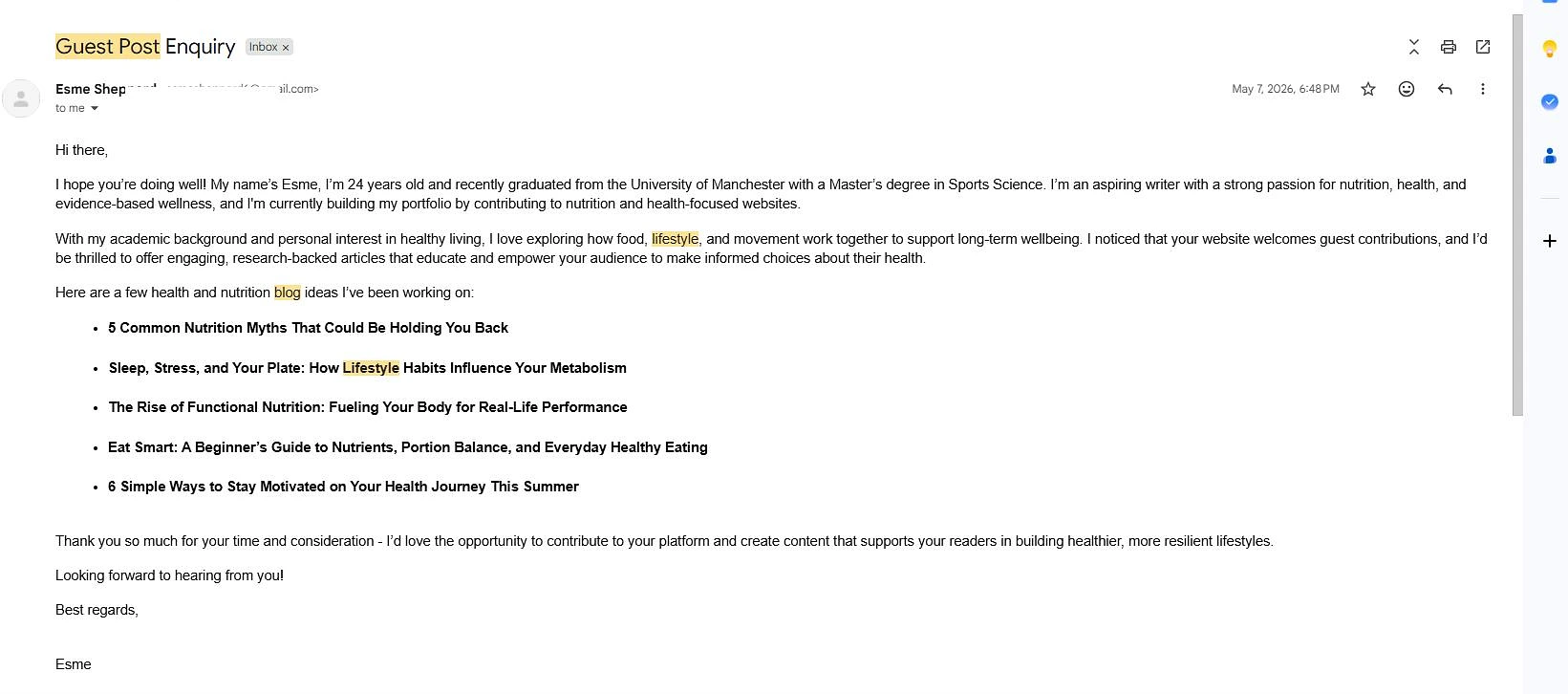
CureCartDirect now accepts lifestyle and wellbeing content queries

But now I will manage them, because my expertise and my interest align with this side of it.
What Comes To Me And What Goes To Dr. Rabeya

These come to me:

  • Nutrition and everyday eating, including portion balance, meal habits and food myths
  • Sleep, rest and recovery
  • Stress, mood and mental wellbeing as it plays out day to day
  • Movement, fitness routines, mobility and exercise habits
  • Supplements from a practical consumer angle rather than a clinical one
  • Skin, beauty and personal care routines
  • Senior care and healthy ageing in daily life
  • Motivation, habit building and behaviour change
  • Work life balance, screen time, burnout and recovery


These go to Dr. Rabeya on the health page instead:

  • Anything diagnostic, clinical or treatment related
  • Medication, dosage, drug interactions
  • Disease explainers and symptom guides
  • Medical devices and procedures
  • Anything that needs a medical review before it can be published

If you are not sure which side your idea sits on, send it to me and I will pass it across if it belongs with her. Nobody is going to lose a pitch because it landed in the wrong inbox.

We use the word lifestyle to mean the daily behaviour side of wellbeing, and not the clinical side.

Audience Need And What You Write

Think about the questions people actually post on forums.

Somebody sits down at eleven at night and types out a proper thread because something is bothering them and they cannot find a straight answer anywhere. Somebody else replies who has actually been through it, and that reply is worth more than the forty articles that came up in search earlier that evening.

If you are the person who could write that reply, that is what we are looking for.

You have the knowledge, you have been through the thing, you tested it or you work in it or you watched it happen to a hundred clients. That is the original part, and it is original because no AI and no LLM can produce it. It has not been written down anywhere yet, so there is nothing for a model to have learned from.

What we do not need is a wall of a thousand words generated by AI, because then our readers are getting the same answers they would have got from a five second chat with GPT or Gemini or Claude. If somebody can get it from a chatbot, there is no reason for them to be on our site reading it.


Write for us lifestyle with HADIA ZAINAB

What we are looking for

  • How I fixed my 3pm energy crash after tracking my meals for six weeks
  • What a physiotherapist told me about my desk setup that no article mentioned
  • Why I stopped taking magnesium after reading the actual trial data
  • The one thing that made my morning routine stick after eleven failed attempts

What we will ignore

  • 5 benefits of drinking water
  • Top 10 tips for a healthy lifestyle
  • How to improve your sleep quality
  • The importance of exercise for mental health
  • Why self care matters in 2026

Do you see the difference between those two lists?

The second set can be written by anybody, about anything, without leaving the house or speaking to a single person. Search any of them and you will find four hundred versions already ranking, all saying the same six things in a slightly different order.

The first set can only be written by the person it happened to.

That is our content criteria and it applies to every lifestyle, wellbeing and self development pitch that reaches us. We are not asking for perfect writing and we are not asking for credentials. We are asking whether the thing you are about to send us could have come from anybody else.


Topic Ideas We Can Accept

Broad categories are where most pitches go wrong. We don't need another piece on self care, or on mindfulness, or on healthy relationships, because those words are so wide that a piece written under them ends up saying nothing.

We want the narrow version that sits inside them.

So not self care routines, but what a shift worker does about a routine when their sleep moves by eight hours every week. Not healthy relationships, but how you actually hold a boundary with a parent who does not accept it. Not mindfulness, but the two minute version somebody managed to keep going for a year when the twenty minute version failed.


Mind and mental wellbeing

  • Anxiety and low mood in daily routine, the practical side rather than the clinical
  • Self reflection and journaling, including what did not work
  • Emotional intelligence at work and at home
  • Overcoming limiting beliefs, where there is actual behaviour change behind it
  • Mindset shifts and how they hold up over months rather than weeks

Movement and fitness

  • Fitness challenges and goal setting that survived past week three
  • Exercise for parents fitting it around childcare
  • Mobility and desk posture for people who sit all day
  • Returning to exercise after a break, an injury or a long gap
  • Training around a condition, without giving clinical advice


Food and daily nutrition

  • Portion balance and everyday eating rather than diet plans
  • Food myths and where they came from
  • Meal habits for people who cook for one, or for a household
  • Supplements from a consumer angle, cost, evidence, whether it is worth it
  • Eating on a low budget without the usual advice

Rest, stress and daily structure

  • Sleep habits and what actually shifted somebody’s sleep
  • Burnout, recovery and the return to work
  • Screen time and evening routine
  • Immune health through daily habits rather than pills
  • Healthy ageing and staying independent


What Do You Get By Putting Such Effort In For Us

Fair thinking, and worth answering properly rather than pretending the question is rude.

First of all you are contributing to the wellbeing of people who are genuinely looking for help with something. Somebody reads your piece at the point where they are stuck, and they do the thing differently afterwards. That is not a small outcome and it is the main reason most of our contributors write for us.


First of all you are contributing to the wellbeing of people who are genuinely looking for help with something. Somebody reads your piece at the point where they are stuck, and they do the thing differently afterwards. That is not a small outcome and it is the main reason most of our contributors write for us.

Beyond that, here is what you actually get:

  • Your name on the work: You are listed as the author with a proper profile. The piece is yours, it stays yours, and it does not get quietly reassigned or stripped later.
  • A portfolio piece you can point at: Put it on your LinkedIn, put it on your CV, send it to a client or an employer who wants to see published work.
  • Analytics if you need them: If you need to show performance for a job application or a pitch, ask me and I will share the numbers on your post. Most sites will not do this.
  • We will vouch for you: If somebody contacts us to verify that you wrote for us, we will confirm it and endorse the work. That applies where the work was approved and it was good, because that is the only kind of endorsement worth anything.
  • Readers who are actually looking: We publish for people who came searching for practical, honest guidance rather than filler written to hit a word count. So your work reaches somebody who wanted it, rather than disappearing into a feed on a Tuesday. And writing for our lifestyle section puts your name next to topics that stay relevant for years rather than trending for a week.

Who Can Contribute Lifestyle Content

People we want to hear from

  • Anybody who has been through the thing and paid attention while it was happening
  • Practitioners, so dietitians, physiotherapists, trainers, therapists, sleep specialists, coaches with actual clients
  • Researchers and students who can read a paper properly and explain it plainly
  • Journalists and writers who already work in health, wellness or lifestyle
  • People with a niche nobody covers, whatever it happens to be
  • Career changers building a portfolio, as long as the idea is genuinely yours


People we are going to say no to

  • Anybody sending an article that came out of a single AI prompt
  • PBN operators and anybody placing content on behalf of a link network
  • Outreach agencies working through a spreadsheet of two hundred sites
  • Anybody who decided on the link before deciding on the topic
  • Manifestation, mindset and life coaching content with nothing underneath it
  • Anybody pitching us something already published elsewhere

That last group in particular. Self development is welcome here, but only the part that has behaviour, evidence or lived experience behind it. Mindset content that is just encouragement dressed as advice does not go on a site that sits next to health information.

Give A Look At Some Of Our Previously Published Posts:

  1. Why Most Barefoot Shoe Transitions Fail: Some Thoughts on the Muscles Nobody Trains (check how we added images for better illustration of the concept)
  2. The Household Illness in Your Kid That Might Not Be a Bug (How Narrowed Topic)
  3. Migraine Prevention When the Medications Stopped Working: What the Chicago Data Says About Acupuncture as the Next Step
  4. Daycare Babies Get 12 to 15 Infections in Their First Year and Most of It Is Normal
  5. Heart Failure: The First Two Weeks Home Decide Whether Your Parent Goes Back to the Hospital

What Writers Often Experience Elsewhere

Most people who write guest content have a few complaints, and they are usually the same ones.

You send the piece, it goes live, and six months later it has quietly vanished. Or the link is gone. Or the byline changed. Or nobody ever replied to you again after publication.

Here is how we work instead.

  • We are not a link farm. We are not selling placements and we do not have a rate card. If somebody emails asking for pbn placement and such collabs, they do not get a reply.
  • Your work stays yours. Once it is published under your name, it stays under your name. We are not going to strip the byline or reassign the piece to a house account later.
  • We do not disappear the article. Pieces do not get deleted for performance reasons three months after publication.
  • You get editorial feedback. If I am not going to publish something, I will usually tell you why. If it needs work, I will tell you what.
  • We will confirm you wrote it. If you put us on a CV and somebody asks us later, we will verify it and we will say so properly.
  • Our readers are actually reading. This is not a general audience that arrived by accident. They came looking for something specific, which is why engagement on our lifestyle pieces holds up rather than dropping off after the first paragraph.

What Makes The Content Helpful For Our Site

This is the part most guidelines skip, so here is what actually separates a piece I publish from one I send back.

  • It answers the question the reader arrived with. Not the topic. The question. Somebody searching about sleep is not looking for an overview of sleep, they are looking for whether the thing they tried last night was a waste of time.
  • The value is at the top. If the reader has to scroll past four hundred words of background to find the answer, most of them have already gone. Say the useful thing early and then explain it.
  • It says something the top results do not. Before you write, look at what already ranks for your topic. If your piece is going to say the same things, there is no reason for it to exist. What can you tell somebody that the other nine results cannot?
  • Depth goes where the topic needs it. Some sections deserve six paragraphs and some deserve two lines. Even coverage across every section usually means nothing was investigated properly.
  • It takes a position. If the evidence points somewhere, say so. Pieces that carefully balance every side and conclude that it depends on the individual are not useful to anybody.
  • It reads like a person wrote it. Varied sentences, plain words, the occasional aside. Not the smooth uniform register that every AI produces by default.
  • Structure serves the reader, not the word count. Headings that tell somebody what is inside the section. Bullets where a list genuinely helps, prose everywhere else.
  • It admits what is uncertain. If the research is thin or mixed, say that. Readers trust it far more than confidence that is not earned, and honestly it protects you as well.
Our Review Process
What happens after I receive your submission
You Submit Topic + draft Intake Path 1–4 day review -Draft ready = fastest -Topic-first = needs approval -Must be unpublished elsewhere -Idea approved before writing Draft Arrives 3 Checks Fact check = strictest -Originality & AI feel -Grammar & readability -Broken link = rejection -Hallucinated source = rejection Published 1–3 working days Editorial Rights Title, edits, links, images You keep the byline

Two ways in. Send the topic with the finished draft — that's the fastest route. Or email to discuss first: we agree on a topic that hasn't already been published on the site, and I approve the idea before you write anything. Once approved, send the written version.

Originality and AI feel — checked by editorial judgement, not a detector score. A zero on a plagiarism or AI checker doesn't automatically mean the piece is clear, and I may not even check it that way. I'm matching it against how many times this exact thing has already been answered online, whether it follows patterns typical of AI-generated content, and whether anything in it could only have come from you. If I have concerns, I'll explain them properly rather than send a flat rejection.

Grammar and readability get reviewed so the published piece reads clean from the first line to the last.

Fact and source check gets the strongest scrutiny of all three. Since AI tools became common, two problems show up constantly — links that return a 404, and facts attributed to a source that never actually said them. Either one is a direct rejection, not a revision request. Open every link in your own draft before sending, and confirm the claim you attached to a source is actually in that source.

If approved, publication typically follows within one to three working days. Our team keeps full editorial rights — including rewriting the title and headings, restructuring or shortening sections, adding internal or external links, adding or replacing images, writing or changing the meta description and alt text, setting the URL slug and category, and updating the piece later to keep it current. You're credited as the author throughout, and the work stays under your name.

Lifestyle content requirements at CureCartDirect

Guidelines You Need To Follow To Get Approved

The requirements above are the must haves. These guidelines are what decides whether the piece gets published after it clears them, so please read through before you write anything.

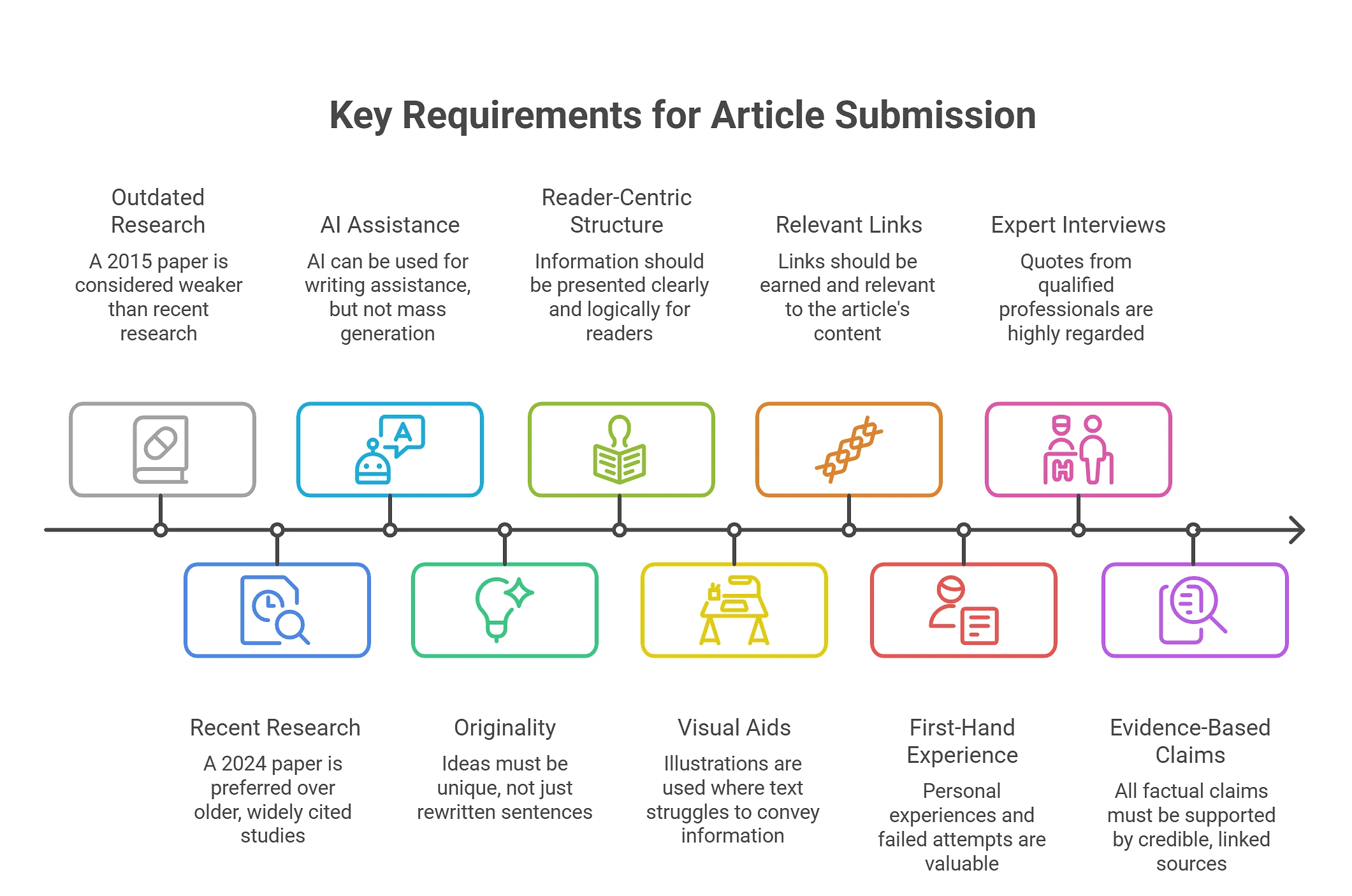
Original Means The Idea, Not The Word Order

I am going to repeat original by original, and it does not mean I run your draft through a plagiarism checker and call it a day. Plenty of completely plagiarism free articles get rejected here.

The idea has to be unique.

Take a topic like "foods that boost your immune system". Search it and you will find thousands of versions. Citrus, garlic, ginger, yoghurt, spinach, turmeric, in some order, with a stock photo of a lemon at the top. Every single one of them passes a plagiarism check, because the sentences are all rewritten. None of them are original in any way that matters.

Now narrow it and give it an angle nobody has taken.

What happens to immune support advice when somebody works nights and eats at three in the morning? Which of those foods is actually useless on an empty stomach, and where does that claim come from? What did a dietitian tell you when you asked her which one of the six she would drop first?

Same broad topic. Completely different article, and one that has never been written, because it needed somebody to go and find out.

That narrowing is what I mean by original.

AI As Assistance Is Fine, Mass Generation Is Not

Use AI to help you write. I am not going to pretend that is unusual and I am not going to police your process. Use it to tidy a paragraph, to restructure something that is not flowing, to check whether you have explained a term properly.

What we do not accept is the entire article generated, lightly edited, and sent over.

And there is something happening in this industry I want to name directly, because it comes up constantly in my own work as well. People run a draft through ZeroGPT or Originality, see a high score, then feed it back into another AI tool to rewrite it until the score drops, and then send it over as AI free content.

Think about what that actually is. You used AI to write it, then used AI to hide that you used AI, then used AI to check whether the AI hid it well enough.

I would ask you honestly, isn't this a mockery of the whole thing? The reader still gets a piece nobody actually wrote. Please avoid it. I would much rather receive a rougher draft with a real idea in it than a polished one that has been through three tools and still says nothing.

Do Not Make The Reader Juggle Information

Nobody should have to fight through a wall of paragraphs to reach the thing they came for.

Look at how Healthline lay out a piece. You land on it and within a few seconds you already have the answer, sitting there in a short summary or a clear opening line. Then if you want the depth, it is all underneath, properly organised, and you can spend the next fifteen minutes in it. That choice belongs to the reader, not to the writer.

That is what I want here. Give the value at the top in a glimpse. Then earn the fifteen minutes for anybody who wants them.

Break the text up. Headings that tell somebody what is inside the section rather than labelling a topic. Short paragraphs. A list where a list genuinely helps and prose everywhere else. A reader who is frustrated at paragraph three never reaches your good part in paragraph eleven.

Use Illustrations Where The Text Cannot Do The Job

Images are not decoration and I do not want a stock photo at the top of every section because the template says so.

Use one where the words are struggling.

Say you are writing a piece with a section headed something like "How to check your desk setup in sixty seconds". That section needs a picture. You are describing screen height relative to eye level, elbow angle, where the feet sit, and no amount of careful writing beats one simple diagram with three arrows on it. The reader looks at it once and understands the whole thing.

Same goes for anything with a before and after, anything with a sequence of steps, anything comparing two things side by side, and anything involving a number that lands harder as a chart than as a sentence.

But a section explaining why sleep matters does not need a photo of somebody sleeping. That image adds nothing and it just pushes the useful part further down the page.

Links, And What We Do Not Accept

We do not add forced links and we do not add city name links into general articles.

Here is the version I keep receiving. Somebody writes a general piece about morning routines or stress management, perfectly reasonable topic, and then somewhere in the middle the word London or New York appears out of nowhere with a link on it. Nothing in the article was about London. Nothing led there. It arrived because somebody needed it to arrive.

That is spam and we are going to say no to it.

A link earns its place when the article has already walked the reader toward it. If your piece is genuinely about something local, and the location is doing real work in the article, then the link makes sense. If it is not, take it out.

On internal links, and this one is specific to us. We have received articles from you guys where our own posts have been forcefully internal linked all over the body, apparently to make the piece look SEO friendly. Please do not do that. If a link to one of our articles genuinely helps the reader at that point, add it. If it does not fit, ignore it completely. We are not going to reject a piece for having no internal links and we do not need them forced in.

Write The Part The LLMs Still Cannot

This is worth saying plainly because it is the whole reason this page exists.

There is an enormous amount of first hand ground that ChatGPT cannot reach no matter how advanced it gets, because the information has never been written down. What a physiotherapist tells you in the room that never appears in any article. What happened when you actually tried the thing for six weeks. What a nutritionist says off the record about a supplement that everybody sells. What the failed version looked like before the version that worked.

Nobody has published any of that, so nothing has been trained on it.

That gap is where your value sits, and it is the only part of an article that a reader cannot get faster somewhere else.

Evidence Based Writing Standards

Any factual, medical, statistical or research based claim in your article has to be supported by a credible source that I can go and check.

That means the source is named, it is linked, and the link works. If a claim cannot be sourced, either cut it or say plainly in the piece that the evidence is thin, which is often more useful to a reader anyway.

Keyword Integration

We do not need the old school approach here, so please do not repeat a keyword fifteen times through the article.

You know how that reads. Somebody writes about sleep hygiene and then every third sentence carries the phrase sleep hygiene, so you get sentences like "improving your sleep hygiene requires a consistent sleep hygiene routine, and sleep hygiene experts recommend". Nobody talks like that. It reads as written for a machine, and these days it does not even help.

Use the phrase where it naturally belongs, in the title, once or twice in the body where it fits the sentence, and then write normally. Here is the test I apply. If somebody who knows nothing about SEO read your article out loud, would they notice a phrase repeating for no reason? If yes, take some out.

Title And Heading Structure

One clear title that reflects what the article actually covers.

And whatever your title claims, the body has to deliver it. If the headline says you are going to explain why something happens, then explain why it happens, properly, and reasonably early. Do not leave the reader still waiting for it at the bottom of the page.

This is the most common reason a well written piece still gets sent back. The title promised something specific, the article circled around it, and somebody arriving from search would have hit back within seconds. Headings work the same way. A heading is a promise about what sits underneath it.

type of posts we reject instantly

We Reject These Types of Write-for-Us Pitches Instantly

Honestly this one gets under my skin, so I am just going to say it.

We sat down and wrote out detailed guidelines on our health write for us page. What we publish, who reviews it, what happens to your submission once it lands. Took a while to write.

And then I open the inbox and there is somebody asking me for pricing on casino, betting, dating and crypto posts, wanting to know how many do follow links come with each one and whether the placement is permanent.

Another one sent me a bulleted list of niches, general, CBD, casino and gambling, adult, expecting a number against each like a takeaway menu.

Why on earth would you send a casino guest post to a health and lifestyle site like us?

Open the homepage. Read one article. Read the name of the site. And the giveaway in almost all of them is the same, nobody has looked at a single thing we have published. If they had, they would already know we do not sell placements, there is no rate card, and no amount of money puts a gambling article in front of people who came here to sort their sleep out. A couple even ask whether our posts get marked as sponsored, which tells me they know perfectly well what they are pitching. So those get deleted and I do not write back.

If your email has such type of concern, or a list of grey niches, or a count of do follow links, do not bother sending it, I am sorry, we don’t accept this.

One Last Test Before You Send It

There is a question Google suggests creators ask themselves about their own work, and it is genuinely a good one, so try it on your draft before it reaches me.

Would you bookmark this? Would you send it to a friend who was dealing with the thing it covers? Would you expect to see it referenced by a publication you actually respect?

Or put it the way I do. Imagine somebody you know personally comes to you next week with exactly this problem. Would you send them your article, or would you just explain it to them yourself because the article does not really say what you would say? 

If the honest answer is the second one, the piece needs another pass before it is ready for review.

Done Reading The Guidelines?

Send us the email at curecartdirect@gmail.com

or you can also fill the form below