
Heart Attack Symptoms, Causes And Recovery: The Warning Signs People Wait Too Long To Act On

Key Takeaways
- People wait 2 to 3 hours on average before ringing for help. The artery opening treatment works best inside 90 minutes. That gap is where the damage happens.
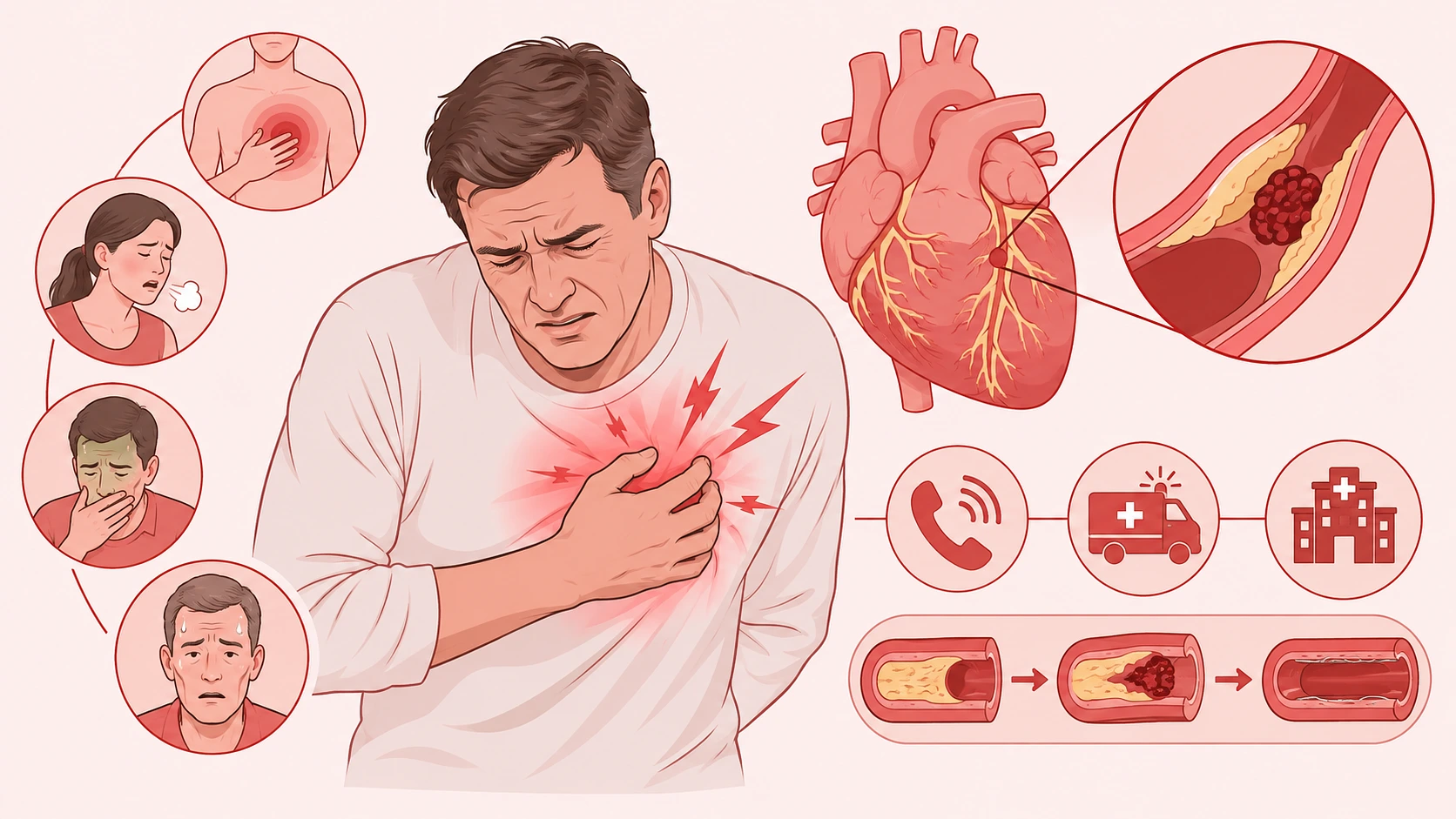
- A heart attack symptoms usually feels like pressure or a weight, not a stab. Chest tightness with sweating, nausea or breathlessness is the combination to act on.
- Women, diabetics and people over 75 often get no chest pressure at all, and get sent home more often because of it.
- Ring the emergency number, chew 1 adult aspirin if you are allowed it, sit on the floor, unlock the door. Never drive.
- Almost every heart attack is a cracked cholesterol plaque and a clot. Smoking, blood pressure, diabetes and family history are what built the plaque.
- Recovery depends on tablets taken without gaps for 12 months and on cardiac rehab, which cuts deaths by about a fifth and which most people do not go to.
My father called it indigestion for 6 hours. He was 58, it was 2009, the pain started after Sunday lunch, and by the time the ambulance came the front wall of his heart had been without blood for long enough that a third of it was gone. He lived another 12 years on the two thirds. The cardiologist was very kind about it and also very clear: the first hour would have been worth more than all 12 years of tablets put together.
I am not going to pretend to be a doctor. I have read a great deal since, I have sat through his rehab appointments and later his heart failure ones, and I have a strong opinion, which is that the posters have the wrong emphasis. They list symptoms. The problem is not that people do not know the symptoms. The problem is that they know them and still wait.
How A Heart Attack Actually Feels
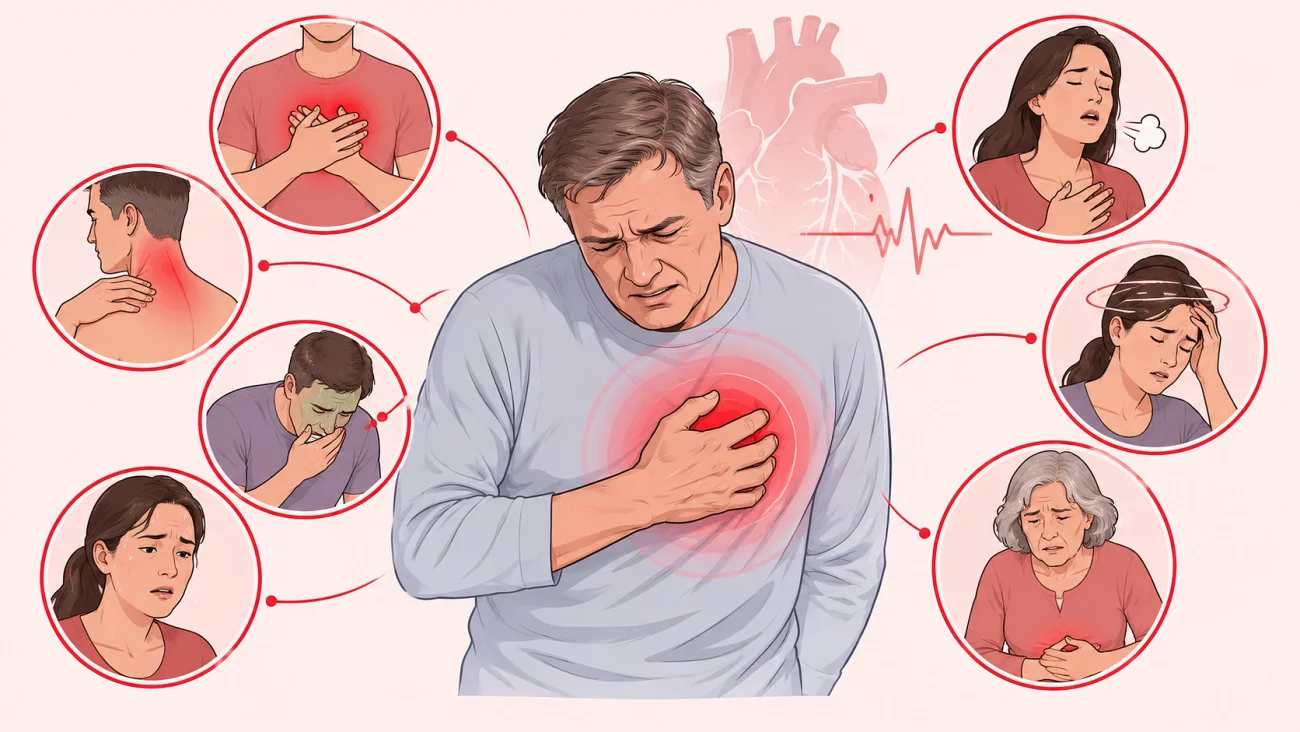
Not like the films. Almost nobody clutches their chest and drops. What people describe afterwards is pressure, tightness, a weight, a band, “like something heavy was sitting on me”, and because it was dull instead of sharp they decided it could not be the heart. My father said it felt like he had eaten too fast. He had, as it happened. That was the whole trouble.
The list, for what it is worth:
- Pressure, squeezing, heaviness or tightness in the middle of the chest, going on for more than a few minutes, or stopping and starting. About 2 in 3 people get this.
- An ache spreading into the left arm, or both arms, the jaw, the neck, between the shoulder blades, or the top of the stomach.
- Being short of breath, with or without the chest feeling.
- Breaking into a cold sweat, or going grey.
- Feeling sick, or being sick. This is the one that gets called a stomach bug.
- Feeling faint, or a sudden strong feeling that something is badly wrong.
On its own, chest tightness could be a few things. Chest tightness plus sweating plus feeling sick is a heart attack until somebody with an ECG says it is not, and I would rather be embarrassed in an ambulance than right at a funeral.
Women Get Sent Home More
Women have the chest pressure less often. What they get instead is breathlessness, feeling wiped out for days before, nausea, back or jaw pain, and a heartburn that will not go, and none of those sound like a heart attack to the woman having it or, too often, to the doctor she sees. Women are sent home from emergency departments on the first visit more often than men and die more often in the first year. Some of that is biology. A lot of it is that nobody in the room said the word heart.
Some People Get No Warning
Around 1 in 5 heart attacks are silent. They turn up on an ECG done for something else, months later. Diabetics, because the nerve damage dulls the pain, and people over 75. In those groups it can be nothing but sudden breathlessness, or confusion, or a fall.
What To Do In The First 10 Minutes
Ring. 911, 999, 112, whichever is yours. Do not drive to the hospital and do not let your wife drive you, because the paramedics can do an ECG in your kitchen, give the first drugs, and take you to the hospital with the catheter lab instead of the one round the corner, and about a third of the people who die of a heart attack symptoms die before they get through any hospital door.
While you wait, if you are not allergic to it and nobody has told you not to, chew an adult aspirin, 300 mg, or 4 of the small 75 mg ones. Chew, do not swallow, because it gets into the blood faster that way, and it thins the clot that is doing the damage. Then sit on the floor with your back against the sofa so that if you pass out you do not hit your head. Then unlock the front door. That is it. Not “give it 20 minutes”. Not an antacid. Not a phone call to your daughter to ask what she thinks. My mother rang me first. I told her to ring 999. That cost another 10 minutes.
What Causes One
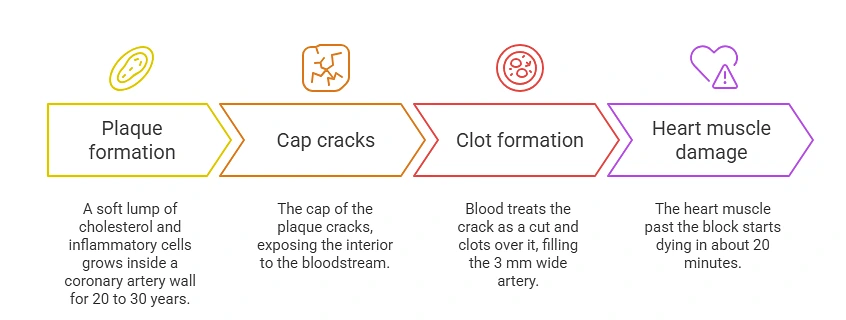
It is nearly always the same thing. Inside the wall of a coronary artery there is a soft lump of cholesterol and inflammatory cells, a plaque, that has been growing for 20 or 30 years without anybody knowing. One day its cap cracks. Blood treats the crack as a cut and clots over it, and because the artery is only 3 mm wide, the clot fills it. The heart muscle past the block starts dying in about 20 minutes. That is a heart attack. The stent, the clot busting drug, the aspirin, all of it is about that one clot in that one artery.
What grows the plaque is what every poster says, and the posters are right about this part:
- LDL cholesterol, the stuff the plaque is made of. Your genes set most of it. Diet moves it a bit.
- Smoking, which about doubles the risk and makes the cap more likely to crack.
- High blood pressure.
- Diabetes, which doubles or triples it.
- A parent or sibling who had one young, before 55 for men and 65 for women.
- Being older, being male, sitting all day, carrying weight, and years of stress, each adding a little.
There is a minority of heart attacks with no plaque at all. In women under 50, and especially around childbirth, the commonest cause is the artery wall tearing from the inside, called spontaneous coronary artery dissection. Coronary spasm does it, cocaine does it, and once in a while a clot arrives from somewhere else. These are the people who are told “but you are so fit”, and they are also the ones most often sent home the first time.
What Happens At The Hospital
Briefly, because by this point it is out of your hands, which is the point.
The ECG in the ambulance usually says which kind it is. If the artery is fully blocked, the pattern is called a STEMI and the patient goes straight to the catheter lab, where a tube goes in through the wrist, dye shows the block, a balloon opens it, and a stent stays behind. Door to balloon in 90 minutes is the target, and good units do 60. If there is no catheter lab in reach, a clot dissolving drug goes in instead. If the artery is only partly blocked, an NSTEMI, blood tests called troponins confirm the damage and the same procedure usually happens within a day or 2. A few people with several blockages need a bypass.
Then, and this shocks families, most people are home in 2 to 5 days. My father was home on the Thursday. He looked fine. He was not fine, and the next 12 years were about that.
Recovery
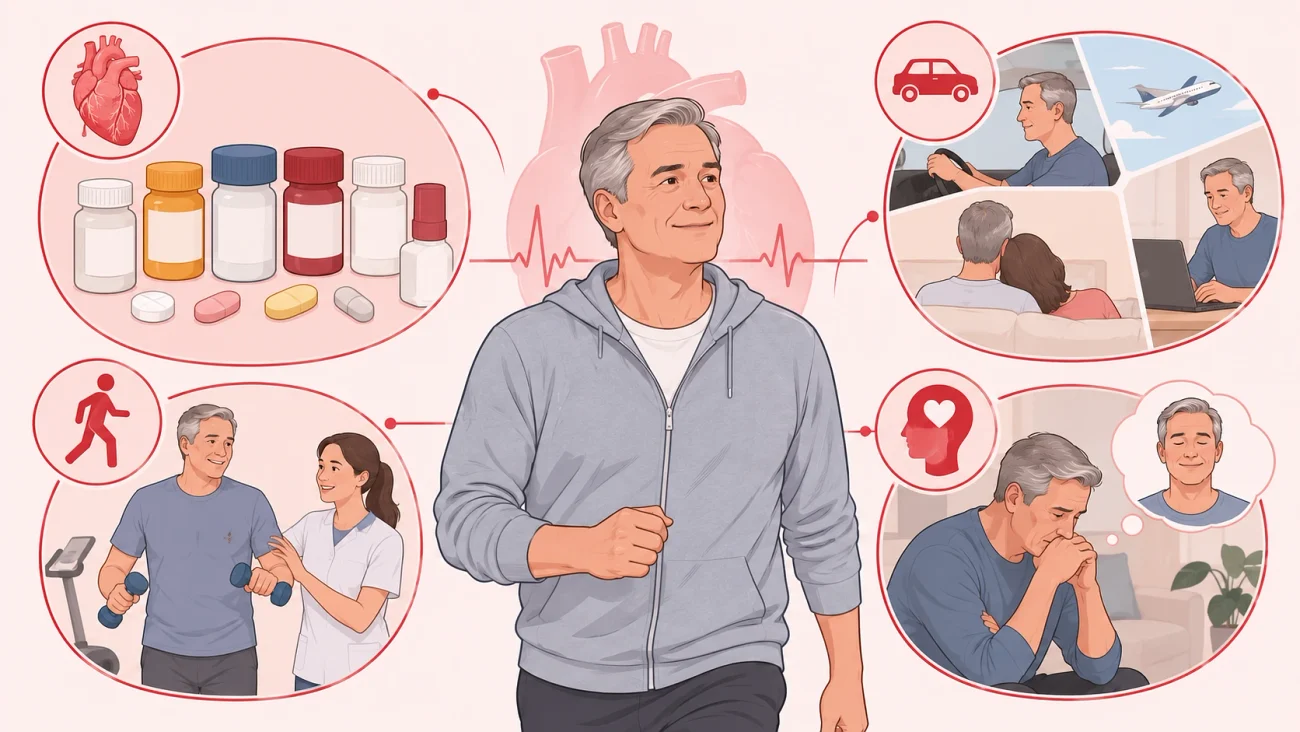
The Tablets
He came home with 5 and a printed sheet, and this is the part where I would grab anyone reading this by the collar.
- Aspirin, forever, and a second blood thinner, clopidogrel or ticagrelor, for 12 months, so the stent does not clot.
- A statin at a high dose, whatever the cholesterol reading was, because it calms the other plaques.
- A beta blocker, which slows the heart and makes a dangerous rhythm less likely.
- An ACE inhibitor, which protects the damaged muscle while it heals.
- A GTN spray to keep in a pocket, for chest pain that comes back.
The most common way to have a second heart attack in the first year is to stop the second blood thinner early. People stop it because they feel well, or a dentist tells them to, or the repeat prescription lapses over a bank holiday. It stops when the cardiologist says. Not before.
Cardiac Rehab
This is a 6 to 12 week programme of supervised exercise and classes, run from most hospitals, and it cuts the chance of dying in the following years by around a fifth. Fewer than half the people offered it go. My father did not go. He said he could walk on his own, and he could, and nobody was there to tell him that 10 minutes to the shop and back was not walking, or that the Sunday lunch had not changed, and 2 years later he was back on the same ward with fluid on his lungs. If I could change one thing about those 12 years it would be that, more than the 6 hours.
Ordinary Life
Driving is usually a week after a stent, 4 weeks otherwise, and longer for lorry and bus licences. Work is 2 to 6 weeks for a desk and longer for anything physical. Sex is when you can climb 2 flights of stairs without symptoms, and the GTN spray and erectile dysfunction tablets must never be taken within a day of each other, because together they drop blood pressure to the floor. Flying is fine after a couple of weeks with no complications.
The Head
About 1 in 5 people are depressed in the months after, and most are never asked. Nearly everybody is frightened of every twinge. Some people lie awake listening to their own heartbeat. This is normal, it gets better, the rehab classes deal with it as much as with the exercise, and treating it improves survival, not just mood. My father would not have used the word depressed. He stopped going out. It amounted to the same thing.
When To Ring Again
After a heart attack, the bar for ringing is lower, not higher. Chest pressure the spray does not clear in 5 minutes, or that comes back after clearing. New breathlessness at rest. A racing or irregular heartbeat. Fainting. Ankles that swell over a few days. A stent can clot, another plaque can crack, and the rhythm can go wrong, and all of it is fixable if somebody picks up the phone.
Ring earlier than you think you need to. That is the article. Everything else is detail.
This is written from family experience and for information, not as medical advice. Chest pressure, tightness or pain lasting more than a few minutes, particularly with sweating, nausea or breathlessness, is an emergency. Ring the emergency number rather than waiting to see.