
Potty Training Tips For Toddlers: Pee Comes In A Weekend, Poop Is Where Every Three Day Method Falls Apart
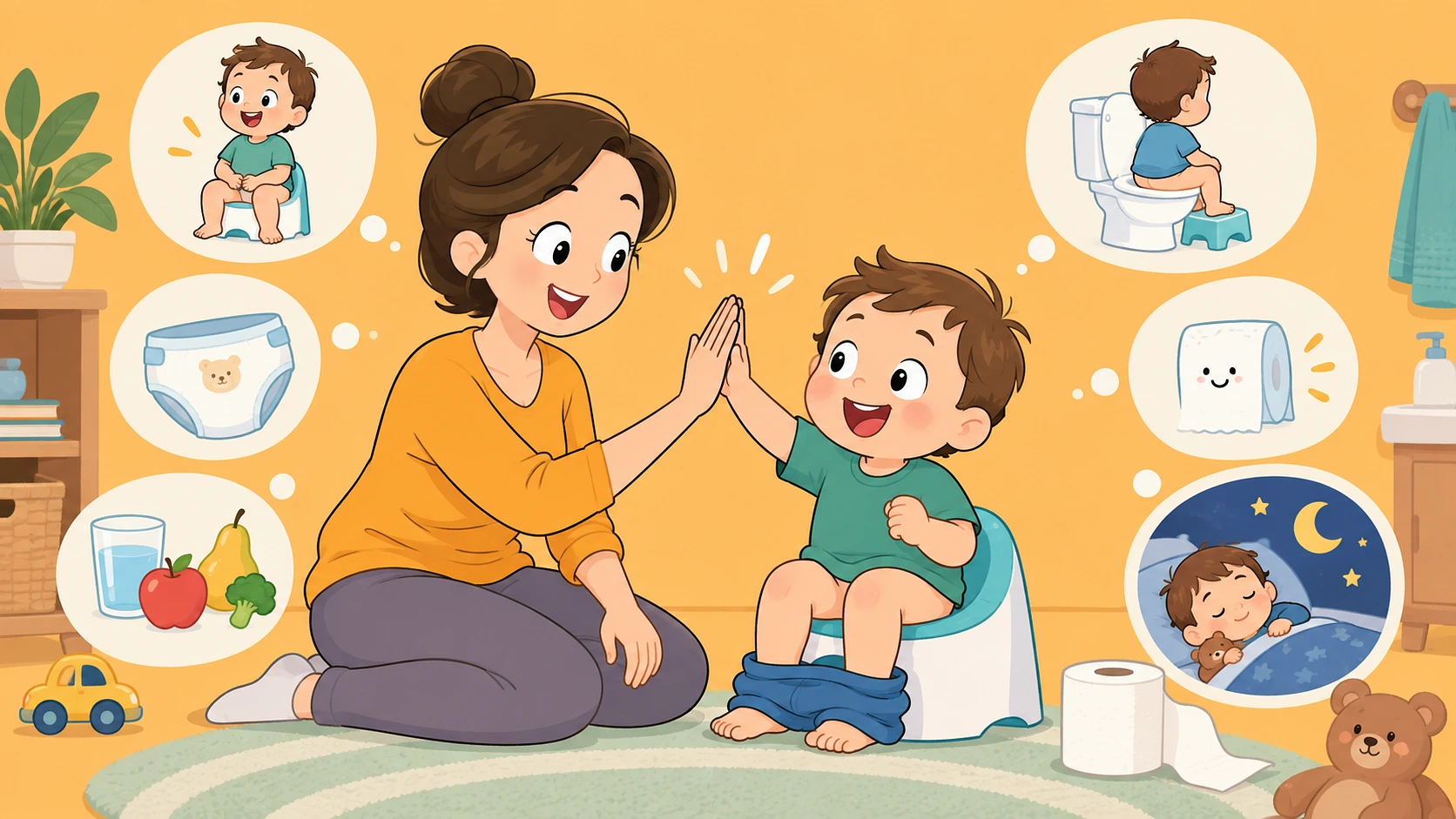
We did the 3 day method with our son at 2 years and 4 months: nappy off on the Friday morning, potty in the middle of the living room, juice on tap, and nobody leaving the house. By Sunday evening he was peeing in the potty every time and had been for a walk in pants without an accident. Then he did not poo for 4 days, and on the 5th he stood behind the sofa, went red, and asked for a nappy. That is the part the books put in a small paragraph near the end, and it is the part that decides whether potty training takes a weekend or a year.
Pee and poo are 2 different projects. They use, they carry different fears, and a child who has cracked one has not necessarily started the other. Most of this is about the second, because the first mostly takes care of itself.
Signs A Toddler Is Ready To Start
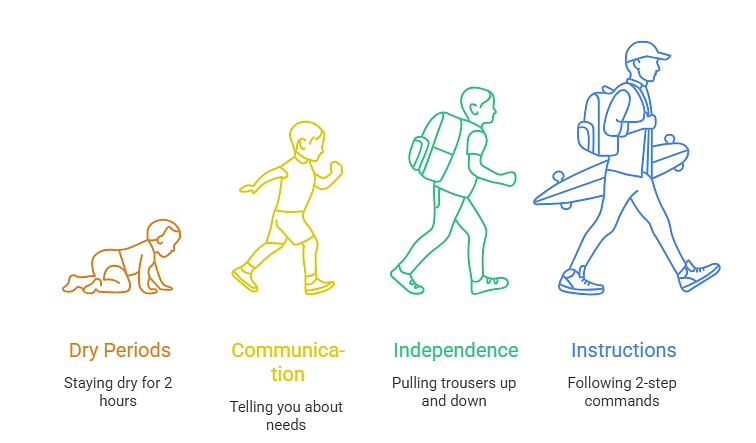
The average age for daytime dryness is 2 and a half to 3, girls a few months ahead of boys, with a normal range from 18 months to nearly 4. The age matters less than the signs.
- Staying dry for 2 hours at a stretch, or waking dry from a nap, which means the bladder can hold and the brain is getting the signal.
- Telling you, or showing you, that a wee or a poo is happening, even if it is only going quiet behind a chair.
- Pulling at a wet nappy or asking for a change.
- Pulling trousers down and up, more or less.
- Following a 2 step instruction, such as “get your cup and bring it here”.
- Some interest in the toilet, whether that is following you in or wanting to flush.
4 out of 6 is enough to begin. A child with none of them is not ready, and starting anyway does not train the child; it trains the parent to hover. Pick a boring fortnight as well. A new baby, a house move, a change of nursery, or a cold all push everything back, so if one is coming, let it land first.How The 3 Day Method Works For Pee
The method most people mean goes like this. Clear 3 days. Child bare from the waist down at home, no nappy, no pull up, and no pants either, because pants feel like a nappy to a 2 year old. Potty within reach. Plenty to drink. Every 20 to 30 minutes, “do you need a wee?”, and every success gets a fuss. Every accident gets a calm “wee goes in the potty” and a change of trousers with no drama.
It works for pee because the bladder fills often, so there are 10 or more chances a day to make the connection; because a wee starting with nothing to catch it is impossible to ignore; and because a 2 year old will do almost anything for applause. By the end of day 2 most children are getting to the potty at least half the time. By day 3 the parent is the one being trained to notice the signs.
What Makes The Weekend Go Better
- Leggings or nothing. Buttons, dungarees, and tights are a wee on the floor while everybody fights the fastener.
- A potty, not the toilet, for the first weeks. Feet on the floor, nothing to fall into, and it can be carried to whichever room the child is in.
- No pull ups in the day from the first morning. They feel like a nappy and get used like one. Nappies at night are a separate matter and fine.
- Accidents are information. A child who wees on the floor and looks at it has just learned something. Say what happened, change the trousers, move on.
By day 3 or 4 it will feel finished. It is finished for wee. The poo has not started, and the reason is usually that the child is holding it.
Why Toddlers Hold Poo After Potty Training Starts
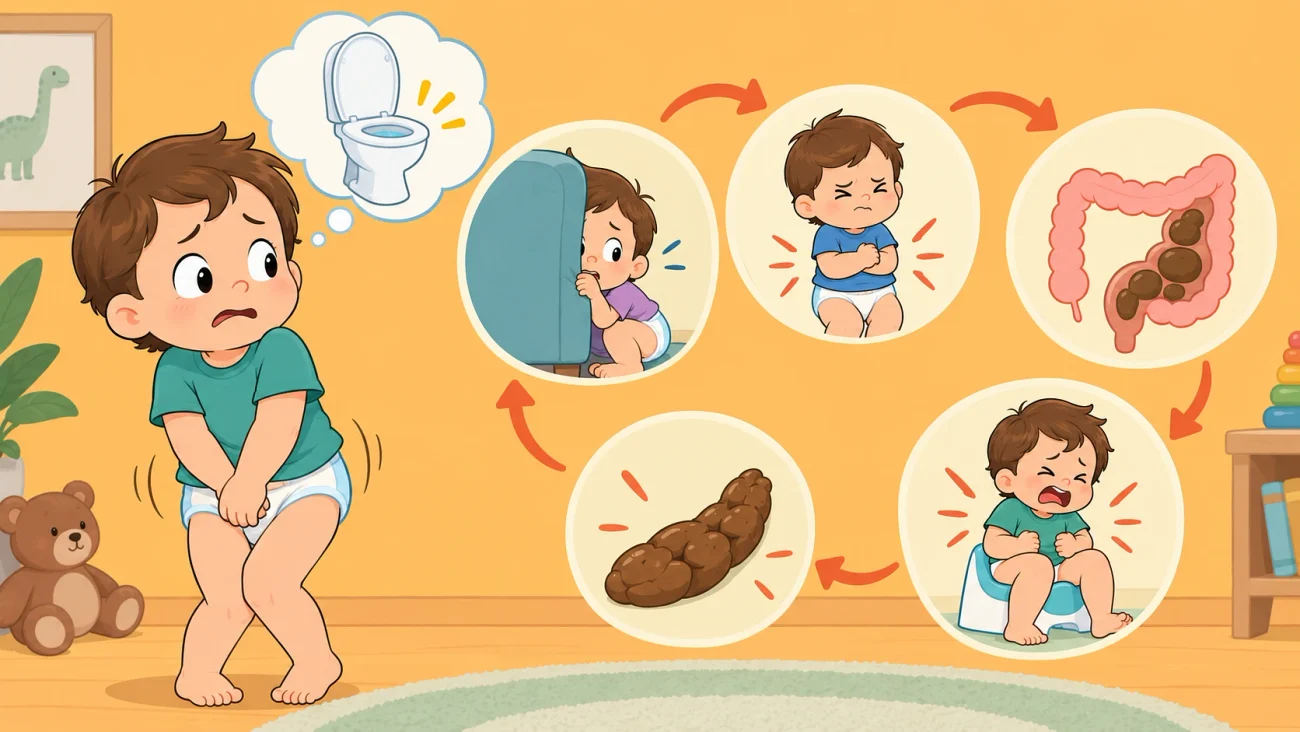
Nearly every 3 day method fails on the poo, and it fails for a reason that makes sense from the child’s immunity.
A wee is nothing. A poo is a part of the child’s body, produced by the child, then taken away and flushed into a hole. A lot of 2 year olds are genuinely frightened of that, and the fear shows up as asking for a nappy to poo in, hiding to poo, or refusing to poo at all. Holding it is easy, because the muscles that keep a poo in are the same ones the child has just learned to use for the wee, and holding a wee is exactly what was praised all weekend.
Then the loop starts.
- A poo held for 2 days is bigger and harder than one that came on time.
- A bigger, harder poo hurts on the way out.
- A poo that hurt is a poo the child holds harder next time.
- Within 2 or 3 weeks the child is constipated, the bowel is stretched, the urge to go is weaker, and a behaviour problem has become a medical one.
Doctors see this constantly, and the parents nearly always arrive saying “he was fine until we potty trained”. The goal with poo is not to get it in the potty. The goal is to keep it soft and coming every day, by whatever route, while the child gets used to the idea.
How To Get Poo Going Without A Fight
Nappy On, In The Bathroom:
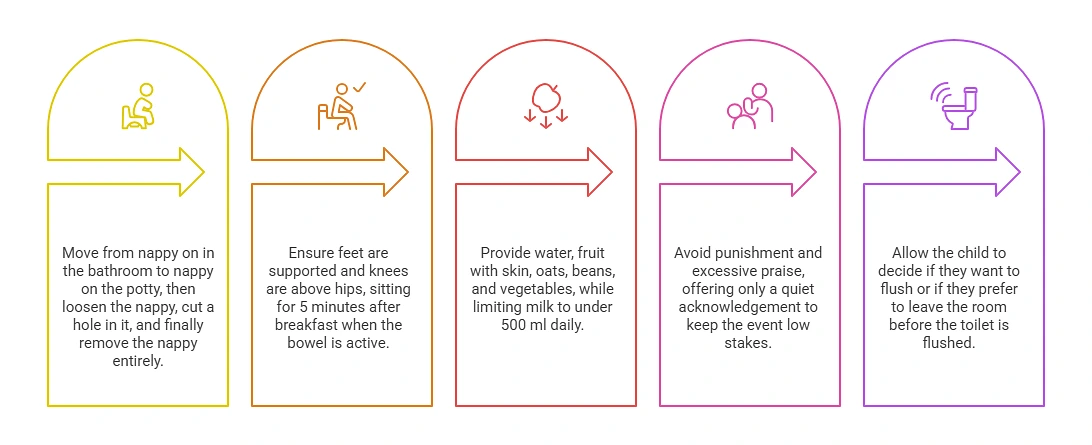
If the child asks for a nappy to poo, give it, and do not treat it as going backwards. The poo coming on time matters more than where it lands. What changes is the location. Nappy on, standing in the bathroom. Then nappy on, sitting on the potty. Then the nappy loosened. Then a hole cut in the nappy so the poo drops into the potty. Then no nappy. Each step takes days or weeks and moves at the child’s pace, not the calendar’s.
Feet Up, Knees Above Hips:
A child on a toilet with legs dangling cannot push; the pelvic floor does not relax with the stronger knees below the hips. A potty solves this on its own. On the toilet, a step under the feet and a child seat so the bottom is not falling through. 5 minutes sitting like that after breakfast, when the bowel is most active, is the best habit on this page.
Keep The Poo Soft:
- Water all day, more than seems reasonable.
- Fruit with the skin on, pears especially, plus oats, beans, and vegetables at every meal.
- Less milk if the child is drinking over about 500 ml a day, because milk fills them up and firms things up.
- If the poo is already hard, in balls, or the child strains and cries, that is a GP visit, because diet alone will not undo it at that point and a stool softener will. The softener is not a failure and not a habit; it breaks the loop, and most children are off it within a few months. Do not buy one over the counter for a toddler without a doctor’s say so.
No Punishment, And Not Too Much Praise:
Anger about poo makes a child hold poo; that part everyone knows. The less obvious part is that a huge celebration tells a child this is a big, high stakes event, and high stakes is what a nervous child wants to avoid. A quiet “you did a poo in the potty, well done” and then getting on with the day works better than a dance.
Let The Flush Wait:
Some children want to flush and wave goodbye. Some are terrified of the noise and the disappearance. For the second group, leave it until the child has left the room. It costs nothing and it removes a fear that can hold things up for months.
Why Night Dryness Comes Later And On Its Own
Staying dry at night is not learned. It depends on a hormone, vasopressin, that tells the kidneys to make less urine overnight, and most bodies start making enough of it somewhere between 3 and 7. 1 in 5 five year olds is still wet at night, and 1 in 20 ten year olds. A night nappy takes nothing away from daytime training. When it is dry most mornings for a couple of weeks, try without. Until then, leave it on.
When Potty Training Problems Need A Doctor
- No poo for 3 days, or fewer than 3 a week for more than 2 weeks.
- Hard balls or pebbles, or a poo so big it blocks the toilet.
- Crying, straining, or bleeding with a poo.
- Soiling, small smears in the pants most days, which in a previously clean child is nearly always overflow from constipation and not a behaviour.
- A swollen tummy, or a child who has gone off food.
- A child over 4 still refusing to poo anywhere but a nappy.
- Wetting that comes back after months of dryness, which can be a urine infection, especially with a fever.
None of these are emergencies. All of them are appointments, and the appointment comes before another 3 day method, because a constipated child cannot be trained out of constipation.
Our son took 3 days for the wee and about 4 months for the poo, with a fortnight of a softener in the middle, a nappy with a hole in it for a while, and a stretch where he would only go with the bathroom door shut and nobody looking. He is 6 now and none of it is remembered by anyone but me. The method got the wee. Patience and a stool softener got the rest.
This is written from experience and for information. It is not medical advice. A child with painful, hard, or infrequent stools, bleeding, soiling, or a swollen tummy should see a doctor before any potty training method is tried or continued.