
Acne Scars Come in Three Shapes, and Each Shape Needs Its Own Fix

Where do you start when you want acne scars gone? For most of us it starts with a treatment name, someone online had CO2 laser and the results looked great, so the search begins with the laser and the price. But that result was on their scars, and yours may not even be the same kind.
So before any machine comes into it, stand in front of a mirror with good light coming from the side, and look at what your scars actually are.
A Pinhole, a Grain of Rice or a Soft Dip Tells You Which Scar You Have
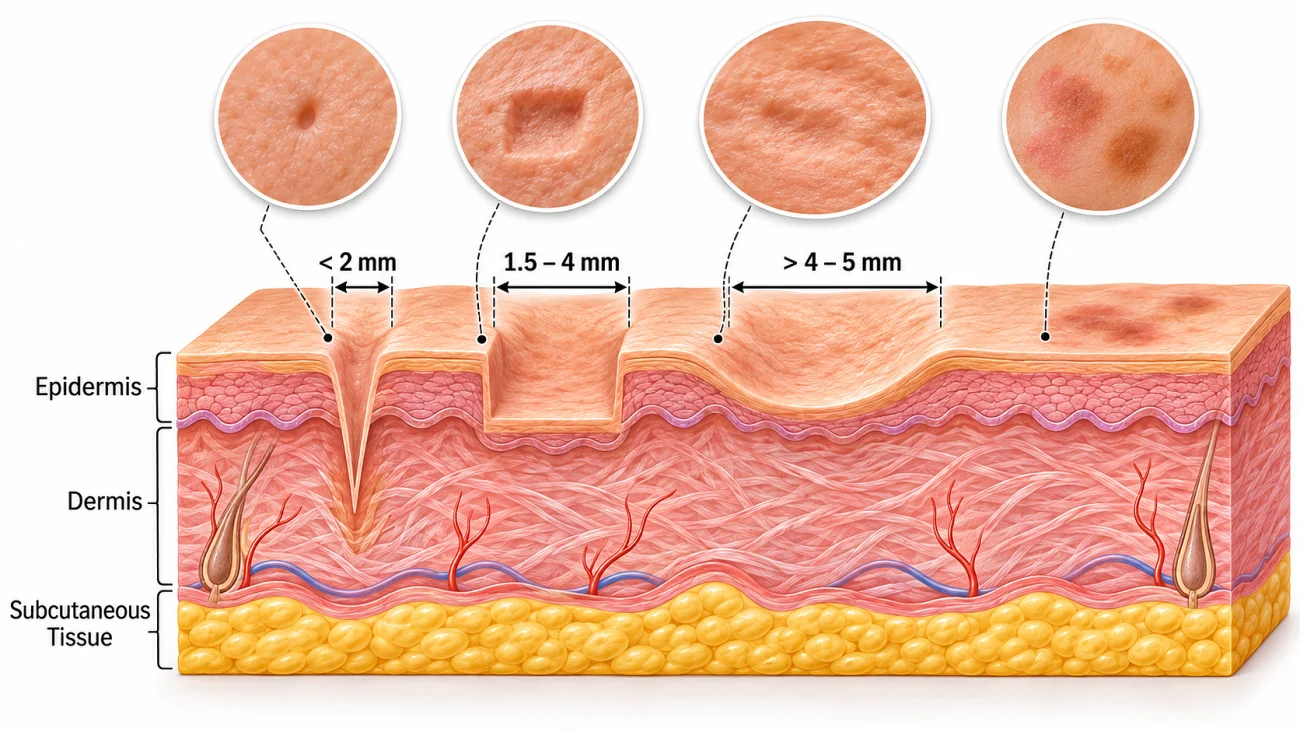
The way dermatologists sort atrophic acne scars goes back to a 2001 paper by Jacob, Dover and Kaminer, and it is mostly about size and shape.
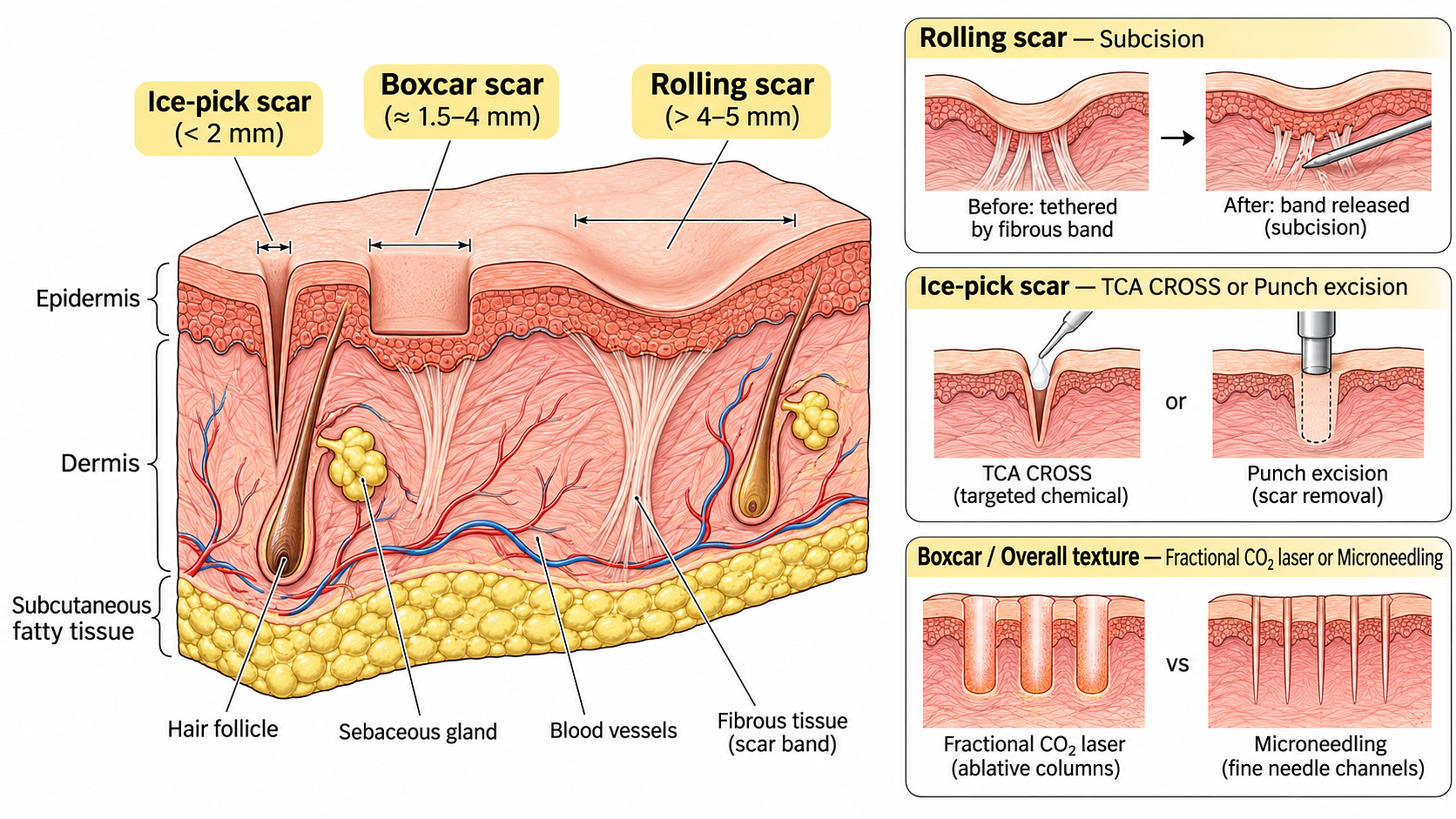
- Ice-pick scars are under 2 mm wide, about the size of a pinhole, but they go deep.
- Boxcar scars are usually 1.5 to 4 mm across, about the size of a grain of rice, with sharp edges and a flat floor.
- Rolling scars are wider than 4 to 5 mm and have soft, sloping edges, so the skin looks wavy more than dented.
Why does the size matter so much? Well, each one sits at a different depth and for a different reason, so a treatment that smooths the surface will help a shallow boxcar scar far more than an ice-pick one that runs down like a tunnel.
And those red or brown marks left after a pimple has healed, are they scars too? Not in this sense, the skin there is flat, only the color has changed, so creams and pigment treatments are usually enough and no layer of skin has to be removed.
Rolling Scars Are Held Down From Underneath
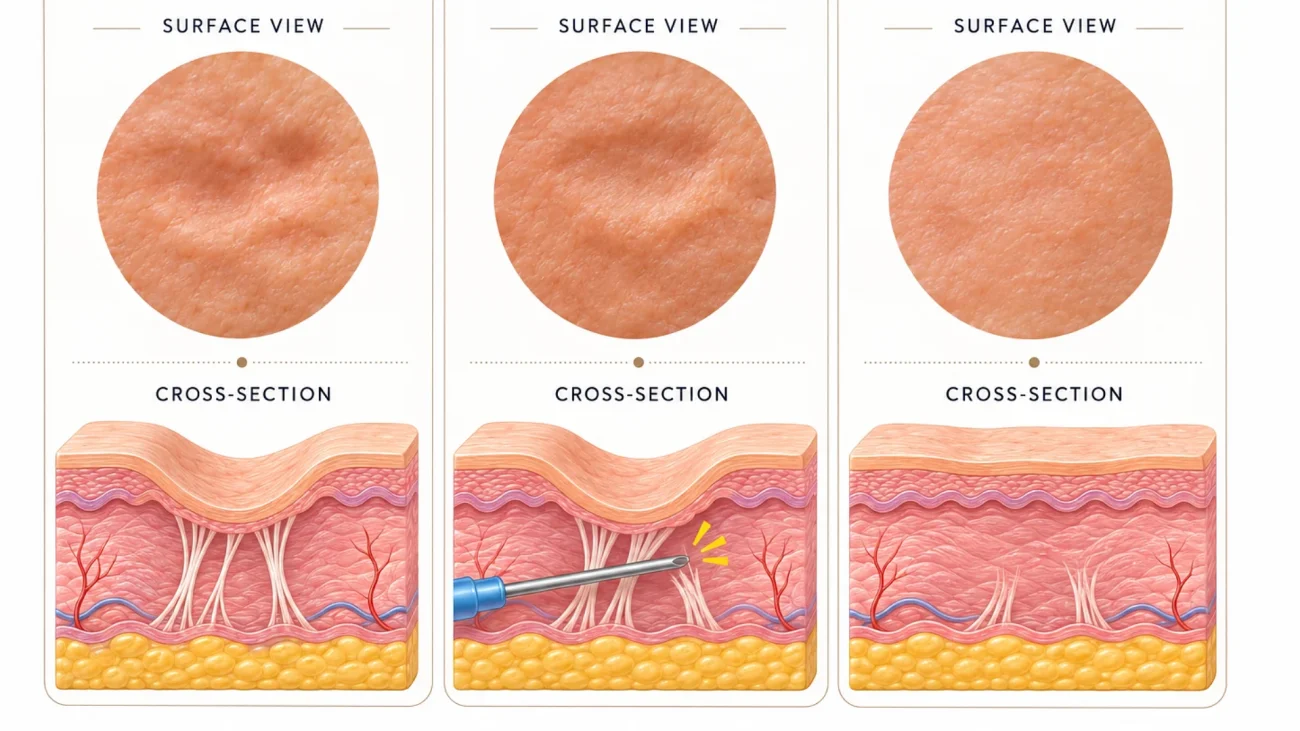
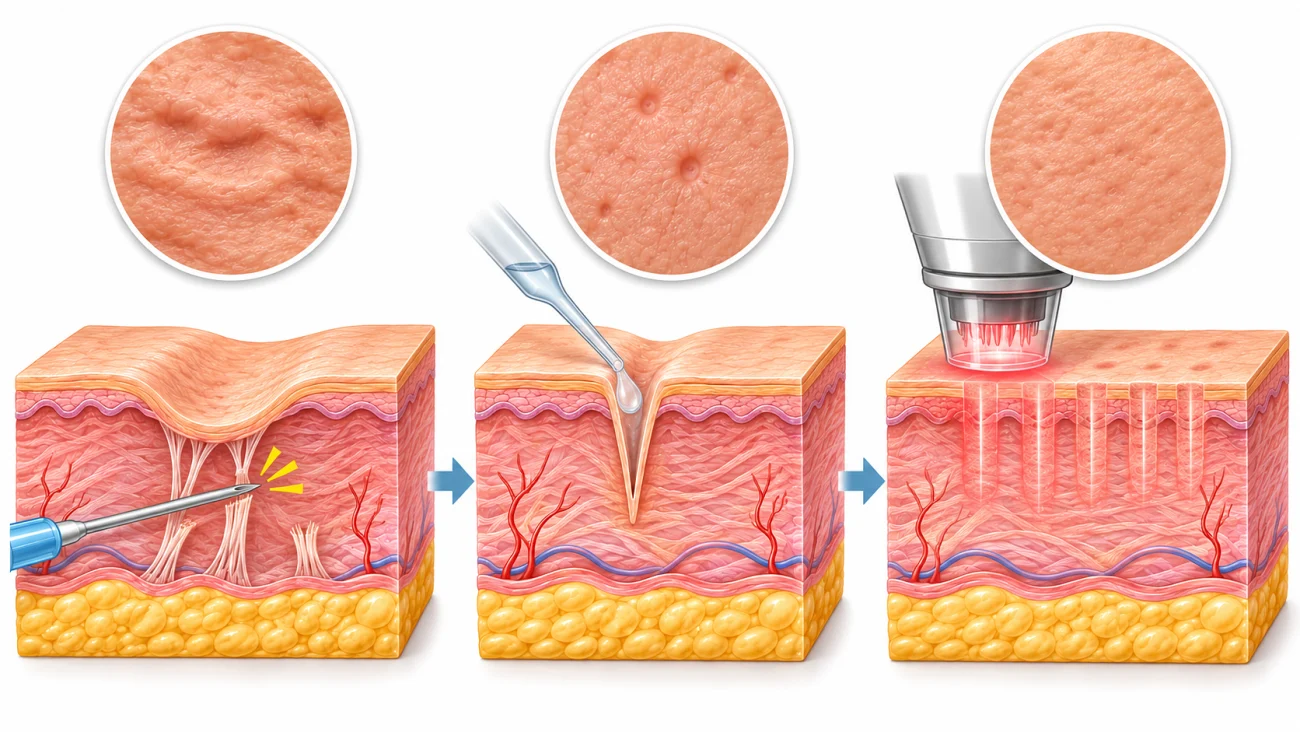
A rolling scar looks the way it does because bands of scar tissue under the skin are pulling the surface down, a bit like a mattress button. Now you can resurface the top as many times as you like, but if that band is still there, the dip stays. That is why dermatologists use subcision for these, a needle is slid in under the scar to cut the band, and the skin can rise back up.
Ice-pick scars have their own tools as well. One is TCA CROSS, where a strong acid is placed right inside each scar, one by one, so it slowly fills from the bottom. For the deeper ones, the 2001 paper describes punch excision, the scar is cut out with a tiny round blade matched to its size and the small wound is stitched closed.
So a face that has all three shapes, and plenty of faces do, is not really a one-laser job.
The Bigger Difference Between CO2 and Microneedling Is the Brown Patches
Both of them make the skin repair itself, the difference is in how much damage they do to get it started.
Let’s say your scars are mostly boxcar and rolling and the choice is down to a fractional CO2 laser or microneedling. On how much the scars improve, the two are closer than you would expect. A 2026 review in Lasers in Medical Science put together 17 studies with 1,068 patients and could not find a significant gap in average scar scores between CO2 and needling treatments.
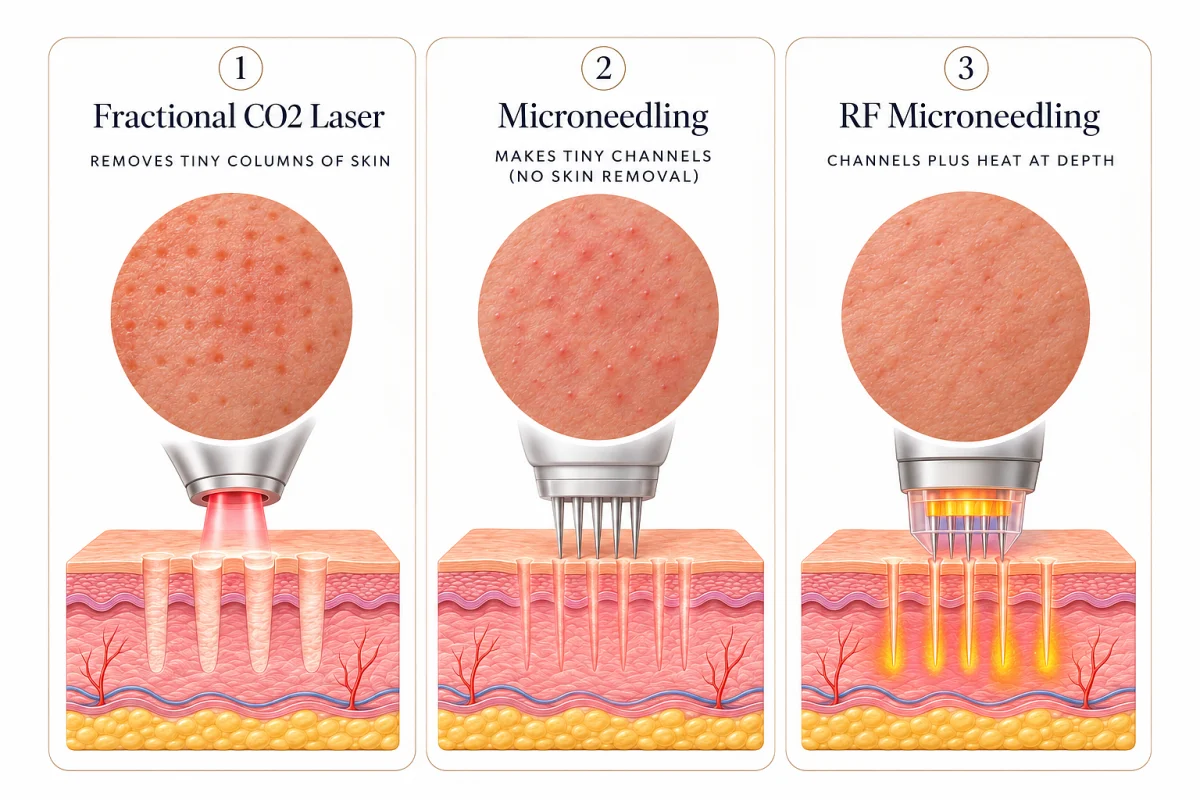
Fractional CO2 removes skin. The laser burns away tiny columns of tissue across the treated area, leaving untouched skin in between, and that skin is what heals the gaps with new collagen. Because it actually takes material off, it is good at softening the sharp edges of boxcar scars, often in a single session, but the face stays raw and swollen for days and the surface can take up to around two weeks to close over, with pinkness hanging on for weeks after that.
Microneedling removes nothing. Fine needles make thousands of small channels into the deeper skin while the surface stays mostly intact, and the body answers those channels with fresh collagen. Recovery is a few days of redness that looks like sunburn, but you pay for that easy healing with more visits, usually several sessions spaced about a month apart.
Radiofrequency microneedling sits in between. The needles go in the same way, then send heat out of their tips once they are inside the skin, so the deeper layers get warmed while the top stays cool. It tends to need fewer sessions than plain microneedling, with a day or two more swelling.
| Fractional CO2 | Microneedling | RF microneedling | |
| What it does | Removes tiny columns of skin | Makes channels, removes nothing | Channels plus heat at depth |
| Sessions | Often one | Several, about a month apart | Fewer than microneedling |
| Recovery | Days raw, up to around 2 weeks to heal, pink for weeks | A few days of redness | A few days plus a day or two of swelling |
| Pigment risk | Highest | Lowest | In between |
On medium to dark skin that pigment risk weighs the most, since the marks it leaves can take months to fade, and that is why many dermatologists lean toward microneedling, the radiofrequency kind, or gentler laser settings there, sometimes after a small test patch behind the ear or along the jaw first.
If your skin is on the darker side, that pigment risk is not a small print item, it can leave you with marks that take months to fade.
Ask the Doctor How the Laser Will Be Set for Your Skin
A fractional CO2 laser is not one fixed treatment. The doctor decides how deep it goes, how close together the tiny spots are and how much energy goes into each, and two clinics using the same machine can give two quite different results. So if your search was for , or any other area, the question to take into the consultation is not only “do you have CO2” but how the settings will be chosen for your scar depth and your skin tone.
Dr. Cameron Rokhsar’s consultant for fractional CO2 laser resurfacing in SoHo says: ablative CO2 carries a greater risk of darker or lighter pigment in darker skin, and that a non-ablative laser can be the safer choice for some patients. It also puts the social downtime after a fractional session at about a week, longer if the treatment is more aggressive, and during that time and after it, sunscreen is part of the treatment and not an optional extra.
A Face With All Three Scar Types Is Usually Treated in Rounds
One of the larger comparisons, a 2025 network meta-analysis in PeerJ covering 68 trials and 4,480 patients, ranked laser combined with platelet-rich plasma (PRP) at the top on one of the main scar scoring scales. On some of the other measures the authors found the rankings too close to separate, so it is not a winner’s list, but it does point the same way, mixed scars respond better to a mixed plan.
In practice that often means subcision for the rolling scars first, TCA CROSS or punch excision for the ice-pick ones, and then laser or microneedling over the whole area for the texture that is left, each in its own session.
And when a clinic shows you before and after photos, check that the scars in them are the same type as yours, taken in the same light and from the same angle. A great result on shallow boxcar scars says very little about what will happen to deep rolling ones.