
Health Impacts of Dale Heath ICE Detention in Colorado

Dale Heath, a longtime Colorado resident and green card holder, was detained by ICE over decades-old, low-level marijuana charges, resulting in significant health impacts on him and his family. Held in the Aurora detention facility, Heath report lost weight and struggle emotionally. His family also suffer severe emotional and financial distress: his wife, Kelli, described managing the family’s business and two children alone as emotionally draining.
The case illustrates the broader, often severe, mental health and family instability issues associated with ICE detentions, even for long-standing community members. Heath was ultimately reunited with his family after his green card was reinstated.
The Aurora ICE Processing Center in Colorado has become a flashpoint in discussions about immigration detention and human health. Operate by the private prison company GEO Group since the 1980s, this facility can hold up to 1,532 people awaiting immigration proceedings. What happens inside these walls reveals troubling patterns about how detention affects both physical and mental health.
When Detention Turns Deadly
Since 2012, three people have died while detained at the Aurora facility. Each death tells a story of medical care that fail at critical moments.
The Case of Kamyar Samimi
Kamyar Samimi was a 64-year-old permanent resident who had live in Colorado for over 40 years. In December 2017, just two weeks after being taken into ICE custody, he died. Samimi had been taking methadone for two decades to manage opioid dependence. When detained, he did not receive appropriate treatment for his withdrawal symptoms.
An ICE internal review found that Samimi never had a face-to-face evaluation with a physician during the two weeks his condition deteriorated. A medical expert reviewing the case call it “one of the most egregious failures to provide optimal care” and note “the complete lack of medical leadership, supervision and care that this detainee was expose to is simply astonishing.”
The ACLU of Colorado had to file a lawsuit under the Freedom of Information Act just to obtain basic information about what happen to Samimi. His daughter, Neda Samimi-Gomez, didn’t receive a call about her father’s death until two days after it occurred.
A Soccer Injury That Should Not Have Been Fatal
On October 13, 2022, Melvin Ariel Calero Mendoza collapsed in his dorm at the Aurora facility. The 39-year-old asylum seeker from Nicaragua had injure his toe playing soccer months earlier. That minor injury eventually killed him.
Calero Mendoza reported severe pain in his legs and feet to medical staff three times before his death. Two weeks before he collapsed, a nurse documented alarming symptoms: severe pain, elevated blood pressure, low blood oxygen levels, and an area on his leg that was “warm to the touch.” These are textbook signs of a dangerous blood clot. Yet no additional tests were ordered.
His care was handled almost entirely by license practical nurses rather than doctors. When he finally collapsed, the 911 call reveal shocking gaps in emergency preparedness. The detention officer couldn’t tell the dispatcher the facility’s correct address, didn’t know how paramedics could access the building, and repeatedly put the call on hold.
An autopsy confirmed that Calero Mendoza died from a pulmonary embolism a blood clot that travel from his untreated leg injury to his lungs. His partner, Dorling Peralta, and their two children in Nicaragua are still processing the loss. “We want a better life for our kids,” Peralta said. Instead, a treatable injury became a death sentence.
The First Deat Evalin-Ali Mandza
In 2012, Evalin-Ali Mandza, 46, died of cardiac arrest while detained at Aurora. A Department of Homeland Security review found that medical staff were unfamiliar with the chest pain protocol, appropriate cardiac medication wasn’t administered during his heart attack, and the delay in getting him to a hospital all contributed to his death. Like the deaths that would follow, Mandza’s death was preventable with proper medical care.
The Mental Health Crisis Behind Bars
Immigration detention doesn’t just harm physical health it devastates mental well-being. Research consistently shows that the experience of being detained causes severe psychological distress, with effects that can last long after release.
Depression, Anxiety, and Trauma
A systematic review in BMC Psychiatry analyzed studies of immigration detention across multiple countries and found that adults, adolescents, and children all experienced high levels of anxiety, depression, and post-traumatic stress disorder. The review found that longer detention periods were associated with more severe mental health symptoms.
At Aurora specifically, over half of surveyed detainees reported having diagnosed mental illness, most commonly depression and PTSD. These rates far exceed what you’d see in the general population.
Researchers from the Albert Einstein College of Medicine interviewed people who had been detained in ICE facilities and published their findings in the Journal of General Internal Medicine. They identified a troubling pattern: the systems appeared to be “harmful by design.” Detainees described experiencing poor conditions and inhumane treatment, a pervasive sense of injustice, barriers to accessing care, and resulting health problems. The researchers concluded that detention causes harm by its very nature.
The Weapon of Isolation
Solitary confinement is supposed to be a last resort for safety. At Aurora, immigration rights groups have documented its use as routine punishment.
A formal complaint filed with federal authorities describes the experience of “Felix,” a detainee who spent more than 10 separate periods in solitary confinement. Guards would taunt him about deportation, making airplane sounds and gestures. When he became upset, he’d be punished with more isolation.
Felix attempted suicide three times while detained. After one attempt, when he jumped from a second-story landing and had to be hospitalized for his injuries, ICE still refused to tell his lawyers where he was or allow them to communicate with him.
Another detainee, “Mateo,” spent 15 days in solitary after defending himself when attacked by another person in his dorm. He asked staff to review security camera footage that would prove he didn’t start the fight. “ICE and GEO didn’t do anything to protect me,” he said. “There were cameras recording the incident but no one ever talked with me about what happened.”
The Health Impact of Release
What happens when people are finally released from detention? A study published in SSM – Population Health tracked detainees before and after release and found that people reported fewer physical symptoms, less psychological stress, and better overall health once free. The key factors in recovery were reuniting with family, regaining physical freedom, and having autonomy to make their own choices again.
This finding suggests that detention itself pre-existing conditions or trauma is what drives much of the health deterioration researchers observe.
Medical Care That Isn’t Really Care
The pattern of deaths at Aurora reflects broader, systematic failures in how medical services are provided.
One Doctor for 1,500 People
In 2019, the Aurora facility had 46 medical personnel total including just one full-time physician to serve up to 1,500 detainees. Think about that ratio: one doctor responsible for 1,500 people. That’s not healthcare; it’s triage at best.
An internal ICE report from 2018 noted the “complete absence of physician leadership” at the facility. When Kamyar Samimi’s condition worsened over two weeks, he never once saw a doctor face-to-face. When Melvin Calero Mendoza showed signs of a dangerous blood clot, no physician evaluated him.
This staffing pattern means that serious medical decisions are often made by nurses with limited training rather than doctors. Licensed practical nurses typically complete one to two years of training and are qualified to check vital signs and provide basic care—not diagnose complex conditions or make critical medical decisions.
Dental Neglect
Medical problems aren’t limited to life-threatening emergencies. The ACLU documented an asylum seeker who developed a severe toothache and repeatedly requested to see a dentist. Her requests were ignored. The pain became so unbearable that she eventually pulled her own tooth out.
COVID-19 Spreads Unchecked
When the COVID-19 pandemic hit, detention centers became hotspots. The Aurora facility recorded over 780 confirmed cases. In a congregate setting where people sleep in dorms, share bathrooms, and eat in common areas, implementing safety measures like social distancing is nearly impossible.
In early 2019, Representative Jason Crow’s office discovered that ICE had initially concealed a mumps outbreak at the facility. Only after Crow raised public health concerns did the agency acknowledge the outbreak.
How Detention Conditions Compound Health Harms
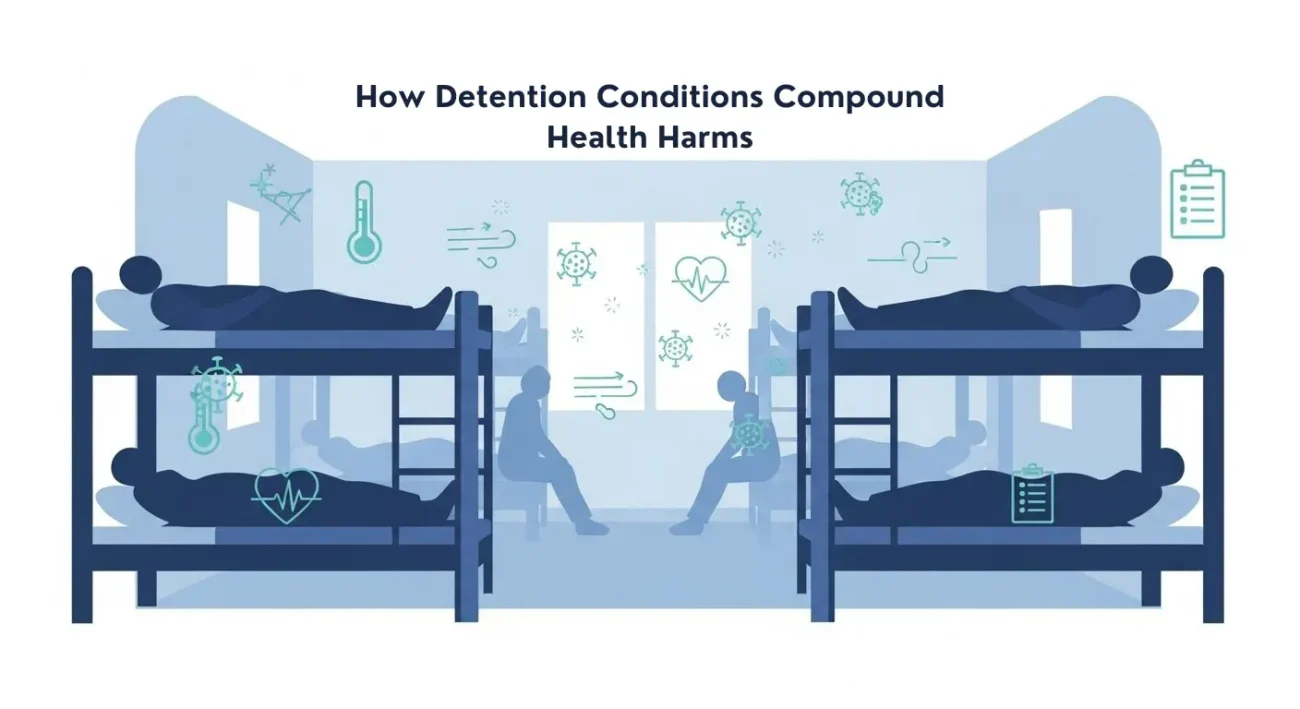
Individual problems medical neglect, isolation, poor conditions don’t just add up; they multiply. Research in the Journal of Immigrant and Minority Health found that for each additional adverse condition a detainee experienced, their odds of worsening health increased by 39%, and their likelihood of reporting good health decreased by 24%.
This cumulative effect means that detention becomes more harmful the longer it continues and the worse the conditions are. Someone experiencing both medical neglect and solitary confinement faces worse health outcomes than someone experiencing either one alone.
The researchers concluded that you can’t fix immigration detention by addressing one single problem. The harm comes from the combination of punitive conditions that characterize these facilities.
The Human Stories
Statistics can feel abstract. But behind every data point is a person and a family torn apart.
Mateo Lozano was eight years old when his older brother Jaime was deported in 2012. Because Mateo and his mother were undocumented, they couldn’t visit Jaime in the Aurora facility. Instead, they would stand outside, hoping Jaime could somehow feel their presence.
When Jaime finally returned four months later, he told stories that changed how young Mateo understood America. Jaime had worked as a janitor in the facility for about 10 cents per hour. Guards treated him “like an animal.” He’d been put in isolated detention for trying to break up a fight between other detainees punished for attempting to help.
“Jaime’s experience really gave me a different perspective about my place in the U.S. as an immigrant,” Mateo Lozano later reflected. “It made me realize that there are a lot of people here who would take away my rights just because they don’t want me in the country.”
Lorena Barreras’s 19-year-old son was working as a painter in Grand Junction when he was arrested by local law enforcement in 2020. He posted bail and was released only to be immediately arrested by ICE agents as he exited the courthouse. He was transferred to Aurora and eventually deported, even though he was never convicted of any crime. Years later, Barreras still cries when she remembers seeing her son in shackles and an orange jumpsuit.
The Transparency Problem
One of the most troubling aspects of the Aurora facility is how difficult it is to find out what’s happening inside.
Attorney Elizabeth Jordan, who has represented families of detainees who died at Aurora, notes: “Unfortunately it is not uncommon for families to be left completely in the dark, or pretty close to completely in the dark, about what happened to their loved ones while in ICE detention.”
Laura Lunn, director of advocacy and litigation at Rocky Mountain Immigrant Advocacy Network, puts it bluntly: “ICE has so much control and power over the narrative that is spun around what is happening within the facilities they own and operate.”
Representative Jason Crow began conducting regular oversight visits to the Aurora facility in 2019 after learning about poor conditions. In 2019, Congress passed legislation requiring ICE to allow members of Congress to access detention facilities without notice. However, in March 2025, the Trump administration informed Crow’s office that they would no longer provide written updates or electronic files about conditions at the facility.
When three U.S. representatives from New Jersey recently tried to conduct oversight at an ICE facility in their state, they were denied entry, and the Trump administration charged one of the lawmakers with a crime.
The Profit Behind the Pain
While detainees suffer in Aurora, GEO Group profits. The company reported net income of $33.4 million in just the fourth quarter of 2018 and was valued at $2.3 billion. The Aurora facility is just one of many detention centers that contribute to this revenue.
GEO Group’s contract with ICE includes operating the Aurora facility at capacity. In early 2019, even after the deaths of Mandza and Samimi and despite having only one full-time physician on staff, ICE agreed to increase the facility’s capacity to 1,500 detainees.
This business model creates a fundamental conflict of interest. The more people detained and the longer they stay, the more money the company makes. Yet providing high-quality medical care, mental health services, and humane conditions costs money—money that cuts into profit margins.
What Healthcare Professionals Observe
A survey of healthcare professionals who had provided care to immigrants recently released from detention offers an insider perspective on the health impacts. Published in BMC Health Services Research, the survey found that 57% of clinicians observed medical conditions they attributed directly to detention.
These healthcare providers described conditions ranging from untreated chronic diseases to new mental health disorders developed during detention. Their observations corroborate the testimonials of detainees and families: detention makes people sick.
The study’s authors note that clinicians working with detained or formerly detained immigrants must be aware of these health harms and provide trauma-informed care that addresses the psychological damage caused by detention.
Why This Matters
The Aurora ICE Processing Center is not an isolated case of poor management. It’s an example of what happens when immigration enforcement is privatized and detention becomes routine.
Research published in Health and Human Rights argues that immigration detention in the United States exists without adequate oversight or transparency. The fragmented system of care operates with law enforcement security often dictating medical decisions rather than healthcare professionals. Analyses of preventable deaths reveal gross deficiencies in access to care, quality of care, and transparency.
The authors call for reaffirming the human rights of detained immigrants and addressing the social-structural determinants of health that make detention so harmful. They note that over 20 million children in the U.S. have at least one immigrant parent, and more than 16.7 million people have at least one undocumented family member. The harms of detention ripple through entire communities.
The Path Forward

Researchers and advocates have proposed several approaches to addressing the health crisis in immigration detention:
Increased Transparency: A commentary in the Journal of Migration and Health calls for publicly reported health metrics in ICE detention facilities, similar to what’s required in other federally funded healthcare facilities. Currently, ICE exists as an anomaly with a drastic lack of quality monitoring and accountability.
Alternatives to Detention: Multiple studies conclude that policies aimed at improving specific conditions in detention centers may reduce some harms, but alternatives to detention would be most effective at protecting health. Case management programs, community-based supervision, and other non-detention approaches could address immigration proceedings without the severe health consequences of incarceration.
Independent Oversight: The legislation that allows members of Congress to conduct unannounced visits to detention facilities is an important accountability mechanism, but it needs to be consistently enforced and expanded.
Better Healthcare Standards: The healthcare provided in detention facilities should meet the same standards required in other healthcare settings, with adequate staffing, physician oversight, and quality assurance measures.
The End
The evidence from Aurora three preventable deaths, widespread mental health crises, medical neglect, and dehumanizing conditions paints a clear picture. Immigration detention, as currently practiced in the United States, causes serious harm to human health. This harm is systematic, predictable, and in many cases, intentional. These choices reflect priorities: efficiency over care, cost savings over human dignity, deterrence over health. The result is a system where people seeking asylum or awaiting immigration hearings suffer physical and psychological damage that can last a lifetime or end in death. Melvin Calero Mendoza traveled over a month by foot and car from Nicaragua to the U.S. border, believing he was making his family’s life better. His last words to his partner were: “I’m going to turn myself in. I’m going to be OK.” He wasn’t. A treatable toe injury killed him because the medical care at Aurora failed him at every turn.
References:
- von Werthern M, Robjant K, Chui Z, et al. The impact of immigration detention on mental health: a systematic review. BMC Psychiatry. 2018;18(1):382. Published December 6, 2018.
- Diaz C, Ortiz V, Sanchez L, Fernandez J, Andrade EA, Akiyama MJ, Ross J. Harmful by Design-a Qualitative Study of the Health Impacts of Immigration Detention. Journal of General Internal Medicine. 2023;38(9):2030-2037.
- Patler C, Luan Wen L. Cumulative Risk of Immigration Prison Conditions on Health Outcomes Among Detained Immigrants in California. Journal of Immigrant and Minority Health. 2021.
- Long E, Henao-Agudelo M, Torres OJ, Rosenberg A, Corliss HL, Capitanio JP, Brindis CD. Release from US immigration detention may improve physical and psychological stress and health: Results from a two-wave panel study in California. SSM – Population Health. 2021;16:100939.
- Nwadiuko J, Diaz C, Wang NE, Fredricks K, Polk S, Mitra N, Yun K. The health related experiences of detained immigrants with and without mental illness. Preventive Medicine Reports. 2025;49:102889.
- Saadi A, De Trinidad Young ME, Patler C, Estrada JL, Venters H. Understanding US Immigration Detention: Reaffirming Rights and Addressing Social-Structural Determinants of Health. Health and Human Rights. 2020;22(1):187-197.
- Nwadiuko J, Diaz C, Yun K, Acuna L, Polk S. A call for increased transparency and accountability of health care outcomes in US Immigration and Customs Enforcement detention centers. Journal of Migration and Health. 2024;10:100249.