
Gum Cancer: Causes, Symptoms and Treatment

Let’s be honest. Most of us don’t spend much time thinking about our gums. We brush, maybe floss, and get on with our day. But here is something that rarely comes up in conversation your gums can actually develop cancer.
What makes gum cancer so dangerous is how much it looks like normal dental problems. People ignore it, dentists sometimes misread it, and by the time anyone figures out what is really going on, the cancer may have already spread.
What Exactly Is Gum Cancer
Gum cancer grows in the soft tissue of your gums. The medical name for it is gingival squamous cell carcinoma. That sounds complicated, but it simply means the flat cells on the surface of your gums have started growing out of control.
This type of cancer is not common. It makes up less than 10% of all cancers that form inside the mouth. But do not let that fool you into thinking it is harmless. The tissue covering your gums is paper-thin, so cancer can break through to the jawbone very quickly. And once it reaches the bone, doctors automatically classify it as stage 4.
You will generally hear about two types based on where they show up:
- Maxillary gum cancer — grows on the upper jaw.
- Mandibular gum cancer — grows on the lower jaw and is more common.
About 95% of the time, gum cancer turns out to be squamous cell carcinoma. In rare cases, you might see osteosarcomas that begin in the jawbone or mucosal melanomas that tend to look darker.
There is also a slower-growing form called verrucous carcinoma. And at the very earliest point something doctors call carcinoma in situ the cancer sits only in the outer gum layer and has not pushed deeper yet. That is the easiest stage to treat.
Here is something that might surprise you. Unlike other oral cancers where men account for up to 75% of cases, gum cancer affects men and women almost equally. Men usually develop it between ages 55 and 79, while women tend to get it later, often after 75.
What Causes Gum Cancer?
There is no single cause. Like most cancers, gum cancer starts when something goes wrong with a cell’s DNA, causing it to divide and grow without any brakes. But several known risk factors raise your chances significantly.
Tobacco The Number One Risk Factor:
It does not matter whether you smoke cigarettes, cigars, or chew tobacco. All of them damage gum cells over time, and that damage can eventually turn cancerous.
Chewing tobacco is particularly risky because it presses directly against the gum tissue for long periods. Even smokeless products like snus have been linked to leukoplakia those thick white patches on the gums that sometimes become precancerous. Quitting tobacco at any point lowers your risk, so it is never too late.
Alcohol:
Drinking heavily on its own puts you at greater risk. But pair alcohol with tobacco and the danger goes up dramatically. Alcohol basically helps tobacco’s chemicals soak deeper into your gum tissue, speeding up the damage.
HPV Infection:
Human papillomavirus, or HPV, is better known for causing throat cancers. But it can contribute to gum cancer too. Getting vaccinated against HPV is one of the smartest preventive steps you can take, especially if you are younger.
Poor Oral Hygiene and Gum Disease:
This one might catch you off guard. Scientists have found a link between a specific bacterium called Porphyromonas gingivalis the main troublemaker behind periodontal disease and gum cancer.
Certain precancerous conditions also raise the stakes:
- Proliferative verrucous leukoplakia (PVL) — causes stubborn white patches on the gums.
- Oral lichen planus — creates recurring sores that are tough to treat.
- Erythroplakia — red patches with a frightening conversion rate of up to 90% if left alone.
Good oral hygiene may matter more than most people realize.
Ill-Fitting Dentures:
Dentures or dental appliances that rub against your gums constantly can create callous-like growths over time. Whether that directly triggers cancer is still debated, but chronic irritation to the gums is taken seriously as a risk factor by most specialists.
Other Factors Worth Knowing:
- Being over 60 years old.
- Too much sun exposure, which can cause lip cancers that extend to the gums.
- Certain inherited genetic conditions.
Gum Cancer Symptoms What to Watch For
This is where gum cancer gets really tricky. In its early stages, it looks almost identical to gingivitis or a basic tooth infection. That resemblance is exactly why so many cases get missed or misdiagnosed.
And here is something worth stressing if a dentist jumps to conclusions and treats a suspicious area without doing a biopsy first, it can actually cause harm. Any unusual spot in the mouth deserves a proper tissue sample before treatment begins.
Early Warning Signs:
At the start, gum cancer might not hurt at all. You might only notice:
- A small sore that refuses to heal.
- A patch of tissue that looks slightly off.
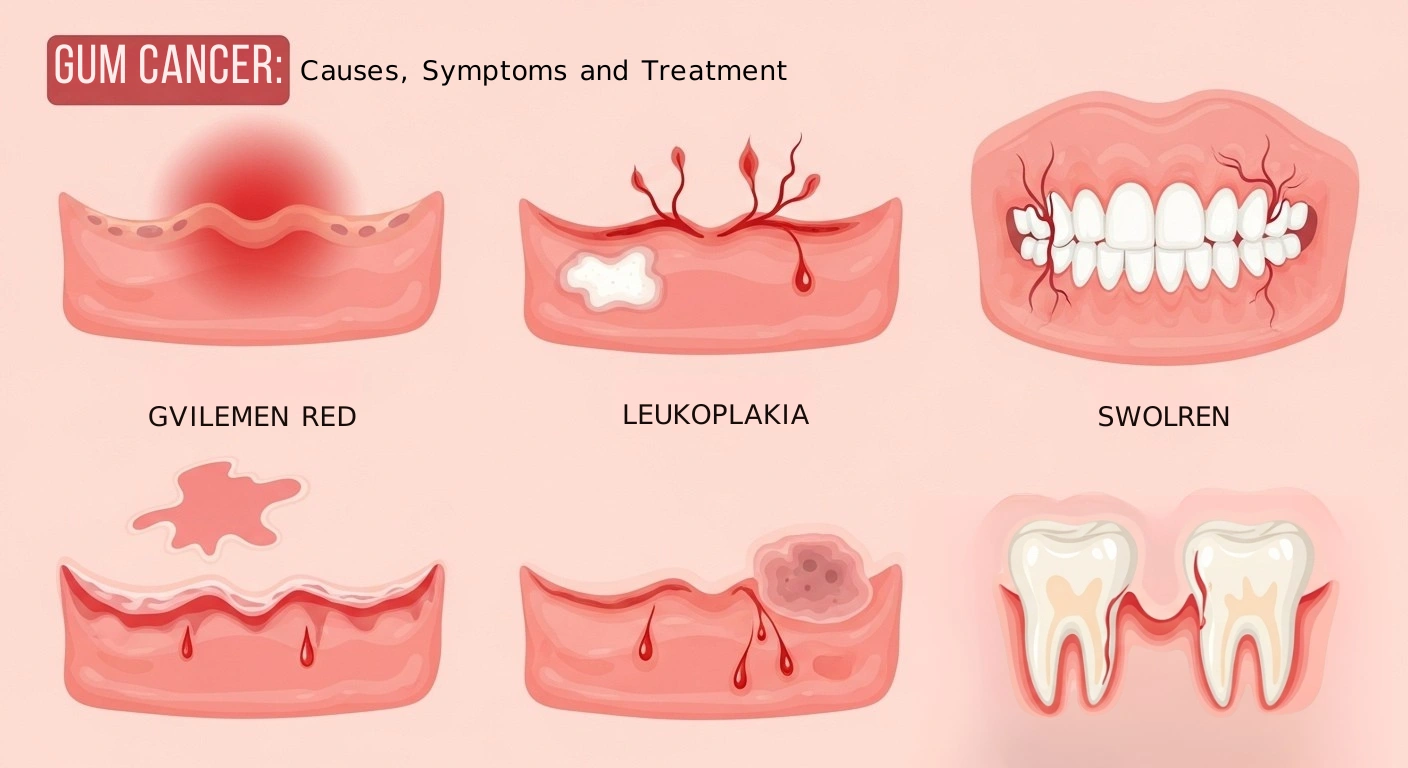
- White spots on your gums, known as leukoplakia.
- Red spots on your gums, known as erythroplakia.
Here is a number that really drives the point home. Up to 90% of untreated erythroplakia cases eventually become cancerous. Leukoplakia is lower, somewhere between 3% and 38%, but still worth watching.
What Does Gum Cancer Look Like?
It usually shows up in one of two ways:
- Growing outward — a visible lump or mass rising from the gum surface.
- Growing inward — a sunken crater or open sore that does not close up.
Either form can appear red, white, or a mix of both.
Symptoms You Should Never Ignore:
If any of these stick around for more than two weeks, book a dental appointment:
- Sores or ulcers on your gums that bleed easily and will not heal.
- Numbness or unexplained pain in your gums, jaw, or face.
- A lump or thick patch on your gums.
- Teeth becoming loose for no clear reason.
- Trouble chewing or swallowing.
- Changes in your voice or trouble speaking.
- Dentures that suddenly feel different or loose.
- Ear pain or neck pain with no obvious cause.
- A jaw that feels stiff or locked.
- Swollen lymph nodes along your neck.
One thing that catches many people off guard the size of a tumor does not always predict how fast or aggressively it spreads. Sometimes a small growth is more dangerous than a larger one.
When Cancer Reaches Later Stages:
At advanced stages, you might also feel:
- Constant tiredness and low energy.
- Weight dropping without any changes in diet.
- Loss of appetite.
- Deep pain that over-the-counter painkillers cannot relieve.
| Feature | Gingivitis or Gum Disease | Gum Cancer |
|---|---|---|
| Appearance | Red, swollen gumline | Lump, crater, or red and white patches |
| Bleeding | During brushing or flossing | Random bleeding with no clear trigger |
| Pain | Tender when touched | Deep aching, numbness, or sometimes no pain |
| Loose Teeth | Only in severe gum disease | Can happen even with healthy gums |
| Sores | Usually heal in 1 to 2 weeks | Last beyond 2 weeks and do not close |
| Treatment Response | Gets better with proper hygiene | Does not improve no matter what you try |
| Lymph Nodes | Stay normal | May swell in the neck |
| Ear or Neck Pain | Not a typical sign | Can appear without any obvious reason |
How Do Doctors Diagnose Gum Cancer?
Most of the time, the first red flag comes up during a routine dental cleaning or checkup. Your dentist or hygienist spots something unusual that you may not have even noticed. This alone is a solid reason to keep those regular dental visits on your calendar.
What the Diagnostic Process Looks Like:
Once something suspicious turns up, here is what typically follows:
- Biopsy — The dentist removes a tiny piece of tissue and sends it to a lab. Looking at it under a microscope is the only reliable way to confirm cancer.
- Imaging scans — CT, MRI, or PET scans help doctors see how far the cancer has traveled.
- TNM staging — T measures the tumor’s size, N checks whether lymph nodes are involved, and M looks for spread to distant parts of the body.
Here is one fact that surprises most people. Because gum tissue is so thin, once cancer touches the jawbone underneath, it jumps straight to a stage 4 classification. Catching it before that point makes an enormous difference.
Gum Cancer Stages and Survival Rates
Understand the stages helps you see why timing matters so much:
| Stage | What It Means | 5-Year Survival Rate |
|---|---|---|
| Carcinoma in situ | Cancer sitting only in the outer gum layer | Close to 100% with treatment |
| Stage 1 | Tumor smaller than 2 cm, still in the gums | 70 to 90% |
| Stage 2 | Tumor between 2 and 4 cm, still localized | 60 to 75% |
| Stage 3 | Cancer has reached nearby lymph nodes | 40 to 50% |
| Stage 4 | Cancer has invaded bone or spread to distant organs | 20 to 30% |
Overall, the five-year survival rate for oral cancers sits around 68%. But when the cancer is caught while still localized, that number climbs to roughly 87%. Without any treatment at all, early-stage survival falls to just 31%.
It is also worth mentioning that survival rates tend to be lower among Black and American Indian or Alaska Native populations. This gap likely has more to do with differences in healthcare access and socioeconomic conditions than with genetics.
Treatment Options for Gum Cancer
Which treatment your doctor recommends depends on the stage, where exactly the cancer sits, whether it has spread, and your overall health.
Surgery The First Line of Defense:
Surgery is almost always where treatment begins. If the tumor is small and has not spread, removing it along with a small border of healthy tissue around it can sometimes cure the cancer entirely.
When things are more advanced, the surgeries get bigger:
- Mandibulectomy — removes part of the lower jawbone for lower gum cancer.
- Maxillectomy — removes part of the upper jaw for upper gum cancer.
- Neck dissection — takes out lymph nodes in the neck that contain cancer.
Reconstructive Surgery:
When a major surgery changes the shape of your face, jaw, or mouth, reconstruction helps bring things back. Surgeons use several methods:
- Bone grafts from other parts of your body.
- Skin grafts to replace lost tissue.
- Muscle flap techniques to rebuild structure.
- Prosthetic coverings for restoring chewing and speech.
Many patients who use prosthetics end up eating and speaking normally again, which is genuinely encouraging.
Radiation Therapy:
Radiation usually comes after surgery to clean up any cancer cells that might still be hanging around. Sometimes, if surgery is not practical, radiation becomes the main treatment.
But there is a catch. Radiation can seriously damage the jawbone. That is the main reason doctors prefer surgery as the first option for gum cancer whenever they can.
Chemotherapy:
Chemo plays a smaller role in gum cancer compared to other cancers. Doctors typically pair it with radiation for advanced cases or use it to shrink a tumor before operating. On its own, chemotherapy has not shown long-lasting results against gum cancer.
Immunotherapy A Promising New Direction
This is where cancer treatment is heading, and the early results are encouraging. Two drugs are already making a difference:
- Nivolumab (Opdivo) — blocks a protein called PD-1 on cancer cells.
- Pembrolizumab (Keytruda) — also targets PD-1.
By blocking PD-1, these drugs let your immune system’s T cells recognize the cancer and fight it. They tend to work best when the tumor cells actually carry the PD-1 protein.
Scientists are also testing some newer approaches:
- Injection-based immunotherapy — delivering the drug straight into the tumor rather than through an IV.
- Photo-immunotherapy — using light combined with immune system activation to treat cancers that keep coming back.
Both are still in the research phase, but they offer real hope for patients who have run out of other options.
How to Check Your Own Gums for Cancer at Home
You will not find a step-by-step self-exam guide on most medical websites, but this is one of the most useful things you can do. It takes less than five minutes once a month.
Get Set Up:
Stand in front of a mirror with good lighting. Grab a clean piece of gauze or tissue to hold your tongue, and wash your hands first.
Look at Your Lips:
Pull your upper lip upward and lower lip downward. Check for sores, bumps, or color changes on the inside surface. Run a finger along both lips to feel for anything unusual.
Examine Your Gums Carefully:
This is the step that matters most. Pull each cheek away from your teeth so you can see both your upper and lower gums clearly. Look for:
- White or red patches anywhere on the gum surface.
- Lumps, swelling, or raised areas.
- Sores that look raw, rough, or crusty.
- Anything different around dental work or dentures.
- Changes behind your back molars — an area most people forget.
Check Your Tongue and the Floor of Your Mouth:
Stick out your tongue and look at the top, bottom, and both sides. Use the gauze to gently pull it left and right for a better view of the edges. Then press your tongue against the roof of your mouth so you can inspect the floor underneath.
Feel for Lumps:
Run your clean fingers along your gums, the inside of your cheeks, and under your tongue. Then feel along your jawline and down both sides of your neck. You are looking for any lumps, hard spots, or swollen lymph nodes.
Write It Down:
If anything looks or feels off especially if it has been there for more than two weeks jot down what you found and the date. Then schedule a dental appointment. There is no need to panic, but ignoring it is not a smart move either.
The Emotional Side of Gum Cancer
Nearly every article about gum cancer talks about tumors, surgeries, and survival numbers. But hardly anyone talks about what this disease does to you emotionally. That needs to change.
Dealing with the Shock:
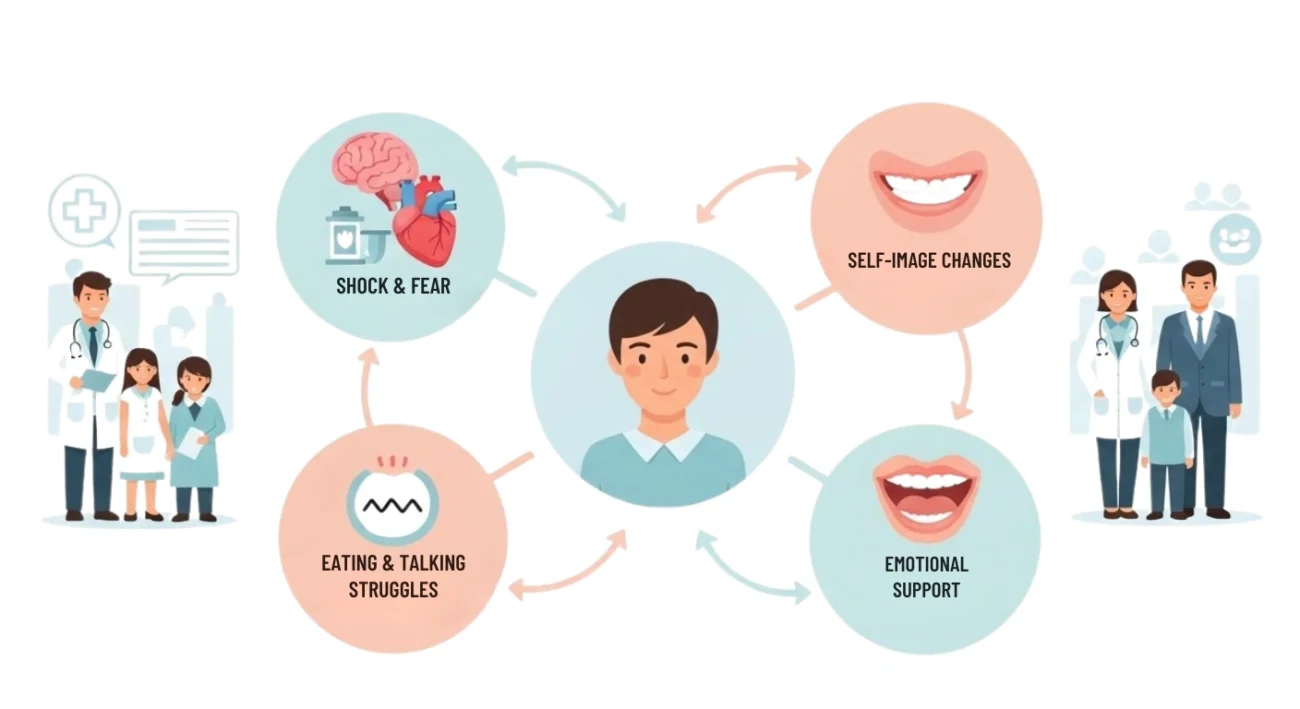
No one walks into a dental office expecting to hear the word “cancer.” The shock hits hard. Most patients describe a mix of disbelief, fear, and anger sometimes all at once. If you feel that way, you are not alone, and those feelings are completely normal.
Changes to How You Look and Feel About Yourself:
This is what makes gum cancer different from many other cancers. Treatment can change your face, your smile, and the way you talk. Surgeries on the jaw, gums, or teeth can alter your appearance in ways that affect confidence and how comfortable you feel around other people.
Struggles with Eating and Talking:
When treatment affects the parts of your body you rely on for eating and speaking, it goes beyond physical discomfort. Sharing a meal with family, having a normal conversation, even laughing these simple things can suddenly become difficult or painful. That kind of frustration wears on you.
Why Emotional Support Is Not Optional:
If you or someone close to you is dealing with gum cancer, please take the emotional side seriously:
- Talk to a therapist or counselor who works with cancer patients.
- Look into support groups, either locally or online.
- Be open with the people around you about how you are feeling.
- Ask your medical team about mental health services most cancer centers have psychologists and social workers available.
Studies consistently show that patients who take care of their mental health alongside treatment tend to recover better and feel more in control of their lives.
Life After Treatment Ends
Getting through treatment is a huge milestone, but the journey does not stop there. Your doctor will put together a follow-up plan to keep an eye on things long term.
Dealing with Side Effects:
Depending on what treatment you went through, you might deal with:
- Dry mouth that does not seem to go away.
- Trouble swallowing certain foods.
- Food tasting different than it used to.
- Dental problems linked to radiation.
- Sores inside your mouth.
Working with a dietitian can help you figure out meals that work around these challenges. Your dentist might also suggest special mouthwashes or laser treatment to ease mouth sores.
Making Changes That Actually Help:
If you still smoke or drink, stopping now is the single best thing you can do. Continuing tobacco or alcohol use after a cancer diagnosis cuts survival rates by 20 to 30%. Quitting, on the other hand, boosts your chances by as much as 25%.
Eating well matters too. A diet built around whole foods and plenty of plants is part of what cancer survivorship guidelines recommend. Some research even suggests that what you eat may play a role in slowing the growth of existing oral cancers.
Final Thoughts
Gum cancer does not show up often, but when it does, it means business. It hides behind everyday gum problems, which is why too many people catch it late. The bright side is that early detection turns gum cancer into one of the most treatable cancers there is. So keep up with your dental visits, check your mouth once a month, and if something will not heal after two weeks, get it looked at. A few minutes of attention today could protect your health for years to come.