
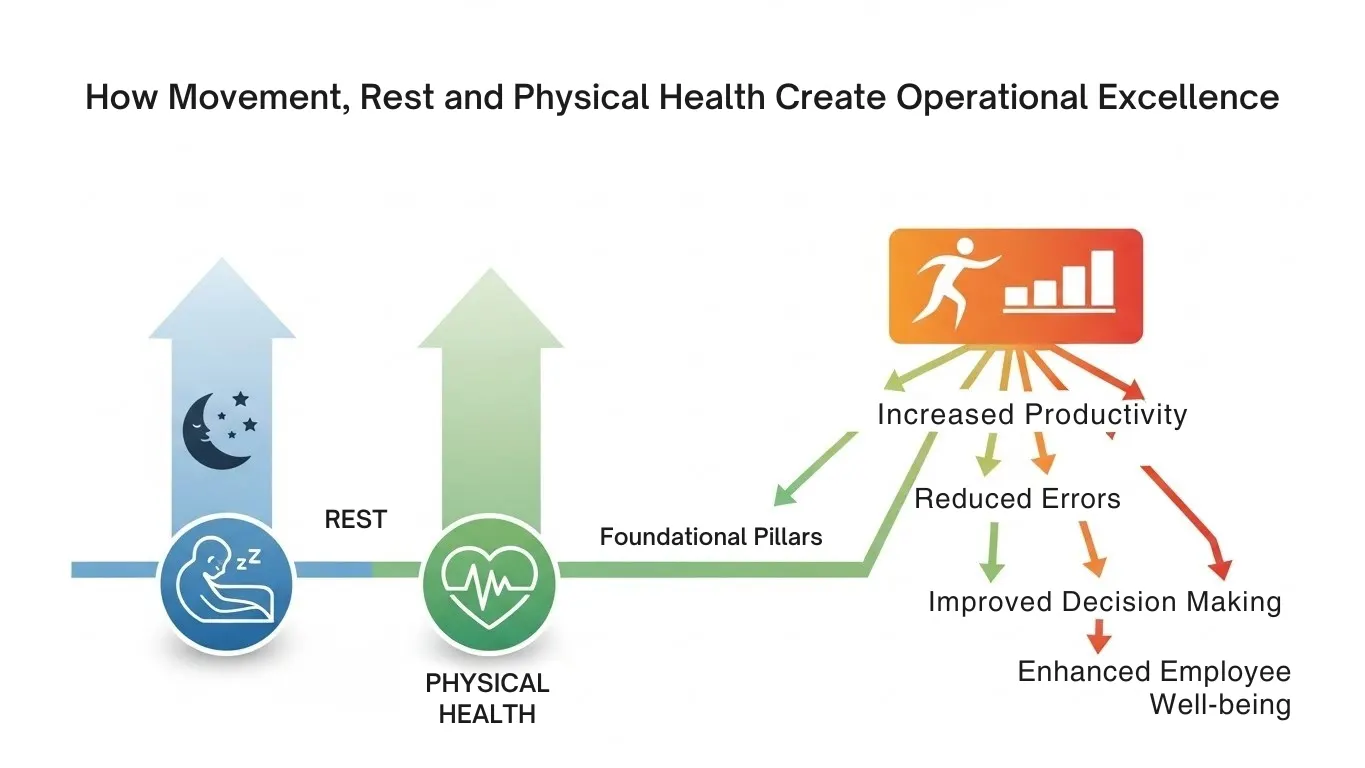
How Movement, Rest and Physical Health Create Operational Excellence

Content Published By: Dr. Antti Rintanen, MD, MSc, is an occupational team writes at the internet doctor where he covers a broad range of subjects from the intersection of health, nutrition, and performance ability to think clearly, adapt under pressure, maintain productivity, and prevent costly errors depends heavily on three physiological pillars: movement, rest, and overall physical health.
Operational excellence is often framed in terms of systems, strategy, and technology. While these elements matter, the foundation of consistent high-level performance is surprisingly biological. In my clinical practice, I see this pattern all the time. When patients are drained and mentally overloaded, even the most skilled of the professionals drop in clarity and stress tolerance. These same physiological limitations show up in workplaces of every size, often long before the organisation realises what’s happening.
For leaders aiming to build resilient, high-performing teams, understanding these pillars isn’t optional. It’s a competitive advantage that directly shapes output, consistency, and long-term sustainability.
Movement Is the Engine of Cognitive Performance
Humans were designed to move. Regular movement increases blood flow to the brain, optimises glucose utilisation, and elevates neurotransmitters responsible for focus, motivation, and mood regulation. Any movement is beneficial. Some studies suggest that even small bursts of physical activity a short walk, a stretching routine, or brief mobility exercises can improve attention and executive function during the workday, although results across trials are mixed. One small experimental study showed improvements in reaction time and Stroop performance, while a larger meta-analysis reported modest and sometimes non-significant effects on cognition (Journal of Sport and Health Science 1;PLOS ONE 2).
In work environments where alertness and rapid information processing matter, even the possibility of cognitive benefits combined with the well-established physiological advantages of breaking up long periods of sitting makes movement an important part of a healthy work rhythm. Teams that incorporate brief, regular movement opportunities may experience steadier concentration and reduced fatigue, especially when combined with adequate rest and supportive work design.
Rest Creates Consistency, Not Slowness
A common misconception in productivity culture is that rest is a luxury or a slowdown. Physiologically, the opposite is true. Rest particularly high-quality sleep is the mechanism through which the brain repairs metabolic stress, consolidates memory, and restores emotional regulation.
Many of my burn out patients suffer from chronic sleep deprivation. Even moderate sleep deprivation has been shown to impair cognitive and motor performance to a level comparable with legally defined alcohol intoxication (Occupational and Environmental Medicine 3). Reviews of workplace fatigue consistently show that being awake for more than 16–19 continuous hours significantly degrades performance, especially in complex or safety-critical tasks (Neuroscience & Biobehavioral Reviews 4).
For operational teams, that means slower reaction times, more errors, reduced creativity, and increased interpersonal friction. No amount of software, automation, or “hustle” can compensate for the consequences of systemic sleep debt.
When organisations normalise structured recovery reasonable working hours, protected downtime, and predictable schedules performance stabilises. People make better decisions. They collaborate more effectively. They handle complexity without burning out. Rest isn’t the absence of productivity; it’s the foundation that allows productivity to be repeatable.
Physical Health Shapes Reliability and Output
Beyond movement and rest, general physical health determines how consistently a team can perform. Musculoskeletal pain, chronic fatigue, cardiovascular deconditioning, and metabolic issues don’t only affect quality of life they directly degrade work quality.
In my clinical practice, musculoskeletal disorders remain one the most common reasons for sick leaves. Research in nursing and other sectors shows that musculoskeletal disorders are strongly associated with presenteeism, productivity loss, and work limitations: people come to work, but their performance is compromised by pain and physical limitations (Journal of Nursing Scholarship 5).
Employees in poor physical health experience more fluctuations in daily performance, are more prone to stress reactivity, and are significantly more likely to require unplanned sick leave. In contrast, a workforce with strong baseline health handles workloads more reliably, maintains attention for longer periods, and recovers more quickly from intensive projects or peak operational periods.
Supporting physical health in the workplace doesn’t require dramatic changes. Small, evidence-based interventions education on posture, ergonomic improvements, micro-breaks, accessible movement opportunities, and a culture that respects recovery — compound into substantial organisational benefits (International Journal of Environmental Research and Public Health 6;University of Helsinki – Workplace Health Promotion Review 7).
Operational Excellence Requires a Physiological Strategy
Many organisations invest heavily in workflow optimisation but overlook the biological limits that determine whether those workflows succeed. Systems are only as effective as the human bodies and brains operating them.
Leaders who integrate physiology into their operational strategy create environments where:
- Cognitive performance remains high throughout the day
- Stress doesn’t accumulate to the point of burnout
- Teams adapt more fluidly to uncertainty
- Absenteeism decreases and reliability increases
- Performance gains become sustainable rather than fragile
This is operational excellence built on biology, not just management theory.
A High-Performing Team Is a Healthy Team
Movement, rest, and physical well-being are not personal lifestyle choices that employees must manage privately. They are organisational performance drivers. When a company supports these pillars, it enhances both productivity and human sustainability.
The most effective leaders recognise that operational excellence is not only about what people do it’s about the physical systems that make high performance possible. When teams move regularly, sleep adequately, and maintain strong baseline health, the entire organisation benefits: sharper thinking, steadier emotions, fewer errors, and a culture that can sustain excellence long term.
References:
1 https://www.sciencedirect.com/science/article/abs/pii/S1744388122000627
2 https://journals.plos.org/plosone/article?id=10.1371/journal.pone.0219565
3 https://pubmed.ncbi.nlm.nih.gov/10984335/
4 https://www.sciencedirect.com/science/article/pii/S0149763418305220
5 https://sigmapubs.onlinelibrary.wiley.com/doi/full/10.1111/jnu.70020
6 https://www.mdpi.com/1660-4601/17/6/1901
7 https://helda.helsinki.fi/items/f4865675-55dd-474c-bb21-eb01517c4843