
Normal Sinus Rhythm, Sinus Rhythm Arrhythmia

Key Takeaways
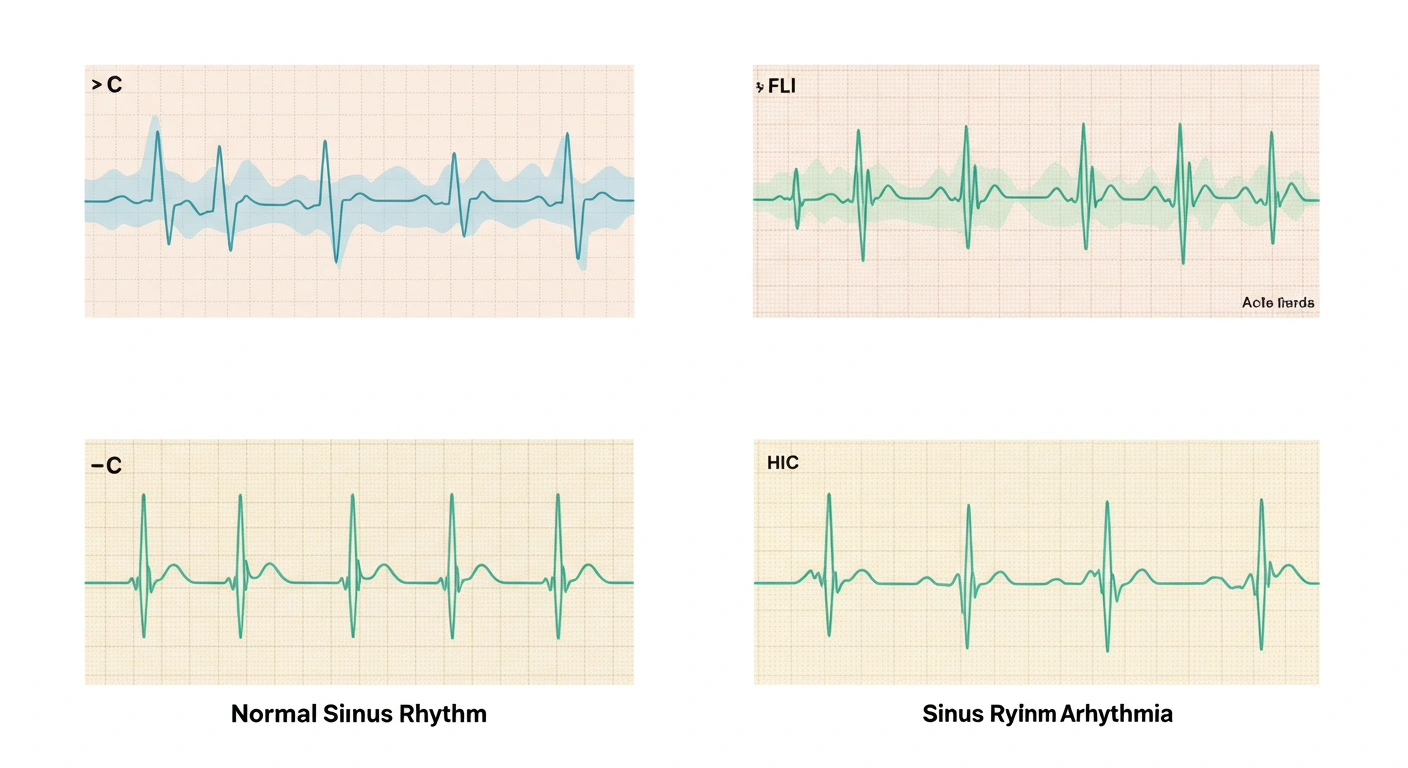
Normal sinus rhythm is your heart’s steady, predictable beat usually 60 to 100 bpm set by the sinoatrial (SA) node. Almost the same thing, just with a gentle ebb and flow tied to your breathing. Both produce identical-looking P waves on an ECG. The giveaway for is a P-P interval that varies by more than 120 ms (0.12 seconds) speeding up when you inhale, slowing when you exhale (Cleveland Clinic; LITFL ECG Library).
Look at almost any ECG strip and you’ll spot one of two patterns. One ticks along like a metronome. The other wavers a little, but in a way that’s actually healthy. Knowing the difference between Normal Sinus Rhythm (NSR) is what separates a harmless quirk of breathing from something worth a second look. Here’s what each one really means, how they show up on an ECG, and when (if ever) you should worry.
What Is Normal Sinus Rhythm?
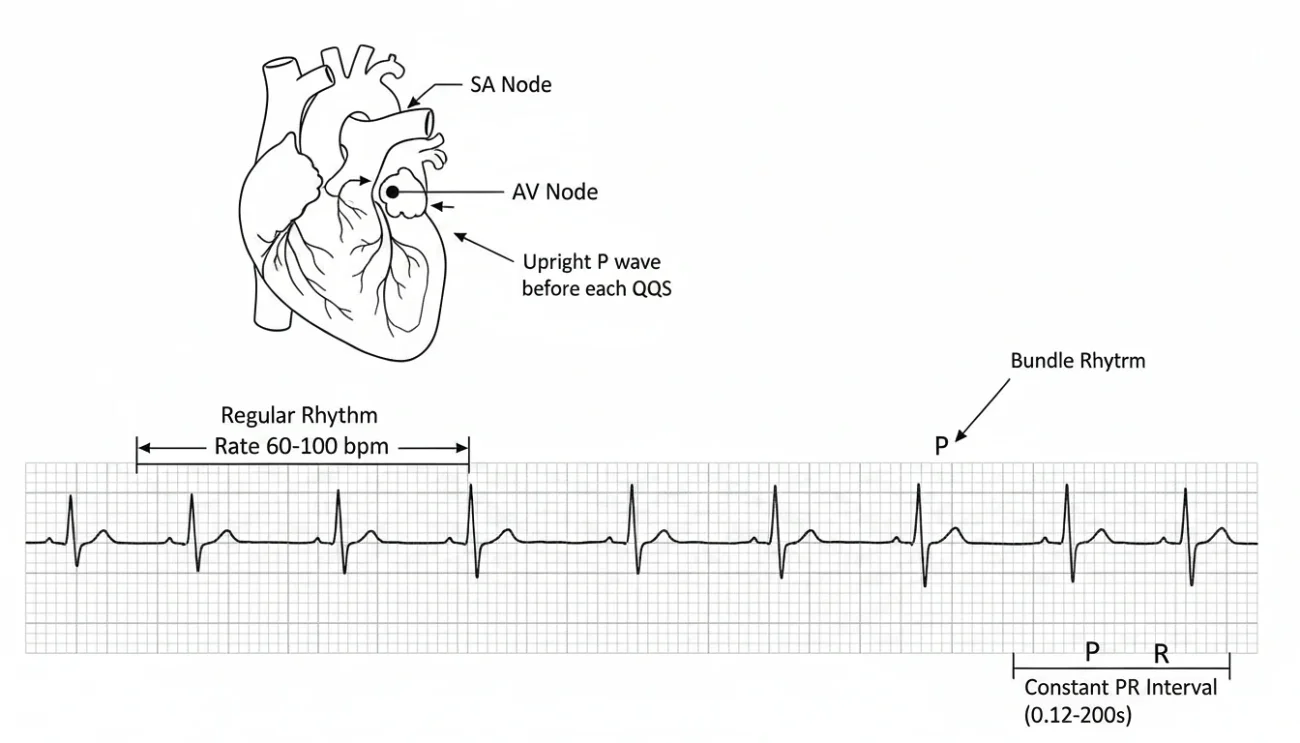
NSR is a normal healthy heart beating in the way it’s supposed to. A small group of pacemaker cells in the right atrium (the SA node) generates electrical impulses. These are conducted through the AV node and the His-Purkinje system, stimulating each beat in the right order (LITFL ECG Library).
An ECG to be NSR, there are some requirements. Adults should have a rate between 60 and 100 beats per minute (bpm). Each QRS complex must be preceded by an upright P wave in lead II and the PR interval must remain constant at roughly 0.12-0.20seconds (ACLS Certification Institute).
What Is Sinus Arrhythmia?
Has all the hallmarks of NSR, but one: the heart isn’t quite regular. Your heart rate speeds up slightly when you inhale, and slows down when you exhale. It’s also called respiratory sinus arrhythmia (RSA). It’s most common in children, young people and athletes (StatPearls/NCBI).
What’s behind it? Your vagus nerve. The vagal tone moves up and down with each breath falling on inhalation (so the heart rate rises) and rising on exhalation (so it falls). Stop breathing for a moment and the waves flatten (ECG Waves).
ECG Differences Between NSR and Sinus Arrhythmia
| Feature | Normal Rhythm | Sinus Arrhythmia |
|---|---|---|
| Rhythm | Regular R-R and P-P intervals | Irregular; P-P varies by more than 120 ms |
| Rate | 60–100 bpm | Usually 60–100 bpm (can run faster or slower) |
| P Wave | Upright in lead II, identical shape each beat | Upright in lead II, identical shape each beat |
| PR Interval | 0.12–0.20 sec, steady | 0.12–0.20 sec, steady |
| QRS Complex | Under 0.12 sec | Under 0.12 sec |
| Tied to Breathing? | No | Yes speeds up on inhale, slows on exhale |
The defining clue for sinus arrhythmia on an ECG is simple: a P-P interval variation of more than 120 milliseconds about 3 small boxes between the shortest and longest cycles, with that variation tracking the breath (LITFL ECG Library; Healio).
What Causes Normal Sinus Rhythm?
Honestly, nothing “causes” NSR in the way conditions cause symptoms. It’s just what a properly working SA node and conduction system look like at rest. If your heart is healthy, this is its default.
What Causes Sinus Arrhythmia?
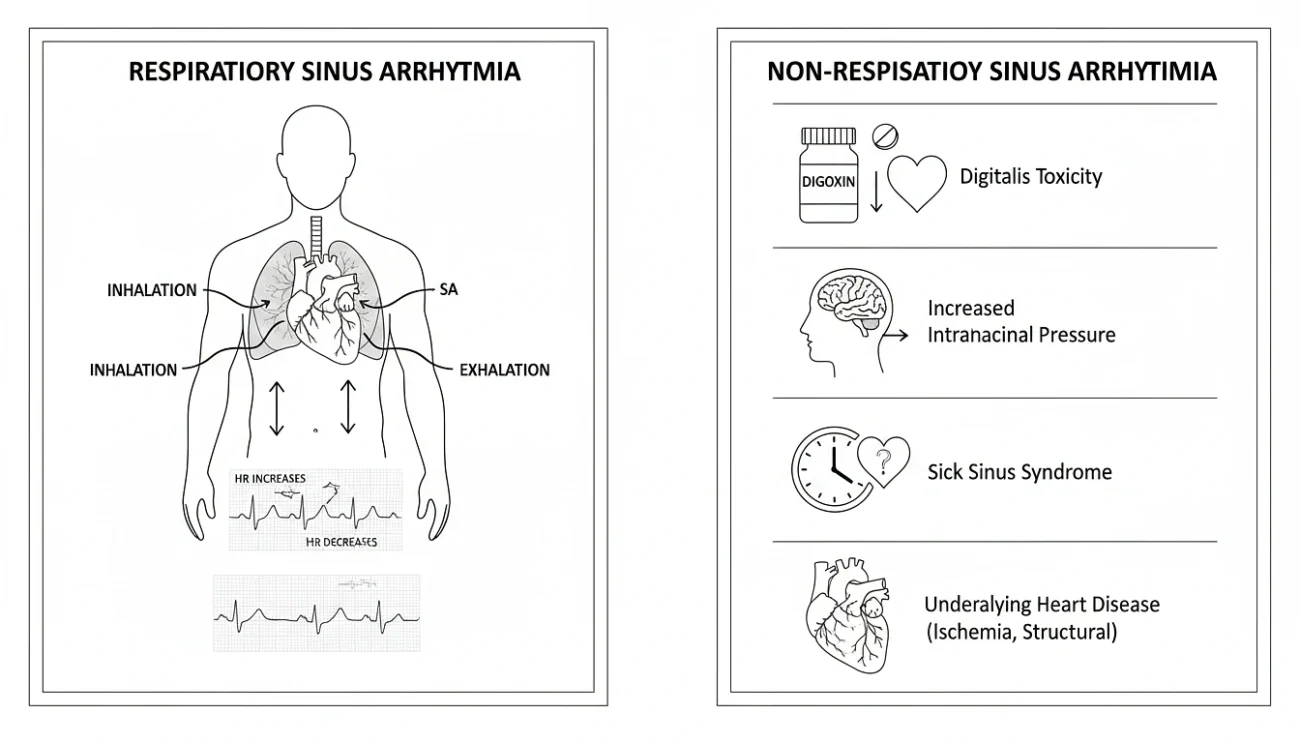
Respiratory sinus is the day-to-day kind, caused by your autonomic nervous system. The vagus nerve controls the SA node’s rate of contraction in response to the slight pressure fluctuations in the chest cavity during breathing. It’s a good sign when you have a noticeable RSA as it implies excellent heart fitness and the parasympathetic nervous system is nicely functioning (ECG Lectures).
Non-respiratory arrhythmia is the version that doesn’t follow the breath, and it’s worth paying attention to especially in older adults. Possible triggers include:
- Digitalis (digoxin) toxicity – too much digoxin ramps up vagal tone and dampens SA node firing (Medscape; ECG Waves).
- Increased intracranial pressure – often part of the Cushing reflex (Springer; StatPearls).
- Underlying heart disease – things like ischemia or structural heart problems (ECG Waves).
Does It Actually Matter Clinically?
For the vast majority of people, sinus is harmless and needs no treatment. Spotting it in a young, healthy person is honestly reassuring it tells you the autonomic nervous system is doing its job (StatPearls/NCBI).
One study (cited in StatPearls/NCBI) published in the Journal of the American College of Cardiology in 2002 compared the respiratory in two groups of healthy adults and found it was less than 20% the magnitude in adults between 50-71 years old compared to those under 31years of age which is consistent with the clinical observation that this rhythm decreases with age.
When to See a Doctor
On its own, sinus arrhythmia rarely needs medical attention. But you should see a doctor if you notice:
- Fainting or feeling like you might pass out.
- Chest pain or shortness of breath.
- Palpitations or a racing heart that isn’t tied to activity.
- A resting heart rate that stays under 50 bpm and leaves you feeling off.