
How to Get Periods Immediately to Avoid Pregnancy

Key Takeaways
- You cannot force a period to prevent pregnancy. Periods happen when there’s no pregnancy, not the other way round.
- Emergency contraception is what you actually need. Levonorgestrel (Levonelle) within 72 hours, ulipristal (ellaOne) within 5 days, copper IUD within 5 days.
- The copper IUD is the most effective option close to 100% and it doubles as long-term contraception if you keep it.
- In England, the morning-after pill is free at participating high-street pharmacies as of October 2025, no appointment, no prescription.
- Parsley, rue, pennyroyal, vitamin C megadoses, and high-dose pill stacks are not safe alternatives. People have died.
- The sooner, the better. Effectiveness drops every hour you wait.
You can’t bring on a period to undo unprotected sex. The body doesn’t have a flush button. What the body has is hormones, ovulation, and a five-day window during which a sperm cell is still possibly inside you waiting for an egg that hasn’t been released yet. Everything that works as emergency contraception works on that window. Everything that doesn’t work is, at best, a distraction, and at worst the thing that lands you in A&E.
The Thing About Parsley
A study published in the Journal of Toxicology: Clinical Toxicology in 2003 Ciganda and Laborde, “Herbal Infusions Used for Induced Abortion” went through every call made to the Montevideo Poison Centre between 1986 and 1999 from women who’d taken herbs to try to end an early pregnancy. Eighty-six cases. Thirty different plants. The repeat offenders were rue (Ruta chalepensis, the same family as the garden plant), parsley, and a herbal mix called Carachipita that contained pennyroyal. Multiple women developed organ failure. Five died four from rue, one from Carachipita.
This isn’t an old story. The same plants show up in TikTok videos and pregnancy forums every month. The reason they “work” at high enough doses is that they’re toxic to the liver and kidneys, not because they’re gently nudging your cycle along. Apiol, the compound in parsley people are aiming for, is in the same category. So is pulegone in pennyroyal.
Vitamin C megadoses get pushed around in the same circles. They don’t reliably trigger menstruation. They can give you kidney stones.
The other myth taking three or four regular contraceptive pills together is a misremembered version of something called the Yuzpe regimen, which was real emergency contraception in the 1970s and 80s. It’s been replaced for a reason. The dose depends on which brand and which formulation you have lying around, and getting it wrong gives you the side effects without the contraception.
Are You Able to Obtain Your Period Right Away?
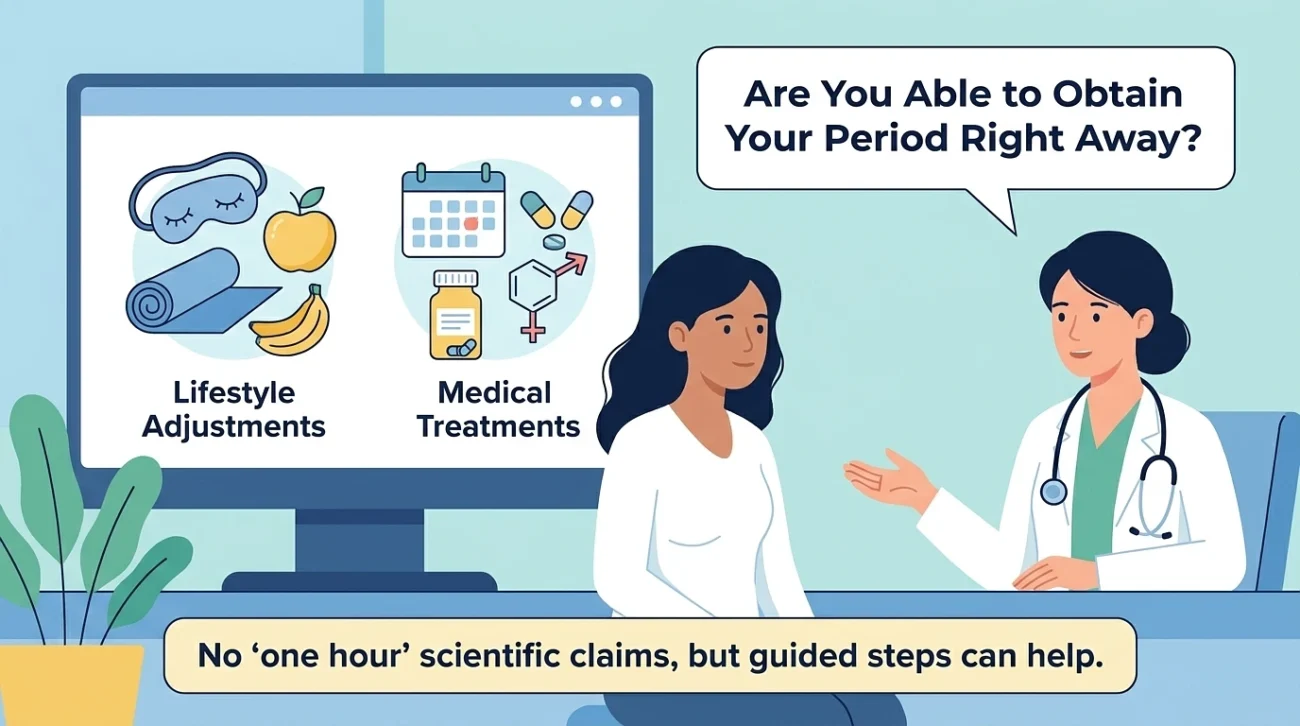
The internet is rife with “one hour to get your period” type promises, but there are no scientific claims to get your period to start instantly. But some lifestyle adjustments, home remedies, and medical treatments can make your period regular or help you get it in a couple of days, guided by a professional.
What Actually Prevents Pregnancy After Sex
Levonorgestrel. Sold in the UK as Levonelle and various generics. One pill, taken as soon as you can, licensed for use up to 72 hours after sex. It delays ovulation, so if the egg hasn’t been released yet, sperm dies waiting. If ovulation has already happened, levonorgestrel can’t do much. The Cochrane review by Shen and colleagues “Interventions for emergency contraception,” 2019, pooling 115 trials and over 60,000 women confirmed it’s more effective than the old combined-pill methods and that timing dominates everything else: every hour counts.
Ulipristal acetate. Sold as ellaOne. Works the same way but for longer up to 120 hours, 5 full days. It’s more effective than levonorgestrel in the day or two right before ovulation, which is also the highest-risk window in your cycle. If it’s been more than 24 hours since the sex, ellaOne is usually the better pill.
The copper IUD. This is the one nobody talks about and it’s by far the most effective. A copper coil fitted within 5 days of unprotected sex prevents close to 100% of expected pregnancies. The 2019 systematic review by Goldstuck and Cheung in the International Journal of Women’s Health pooled 8,550 emergency-use insertions and found a failure rate of 0.093%. Roughly one pregnancy per thousand. The randomised trial by Turok and colleagues in the New England Journal of Medicine in 2021 “Levonorgestrel vs. Copper Intrauterine Devices for Emergency Contraception” recorded zero pregnancies among 321 women who got a copper IUD. Zero.
The catch is that you need a clinician to fit it, which means a phone call to a sexual health clinic or GP rather than a walk to Boots. The upside is that once it’s in, it stays as your regular contraception for up to ten years if you want it to.
Where to Actually Get this in the UK
Free, no prescription, no appointment: walk into a community pharmacy. From October 2025, NHS England expanded the Pharmacy Contraception Service so that oral emergency contraception is supplied free across participating pharmacies in England. The pharmacist asks a few questions about your cycle, decides which pill fits, and hands it over.
Also free:
- Sexual health clinics (search NHS Find a Clinic).
- Your GP book an emergency appointment, you don’t have to tell reception why.
- Brook centres if you’re under 25.
- The national sexual health helpline, 0300 123 7123.
If the pharmacy isn’t doing the free scheme, you can still buy over the counter. Levonelle and its generics run about £15 to £25. EllaOne is around £30 to £35. Superdrug, Lloyds, Boots and most independents stock both. Online pharmacies are next-day delivery, which is fine if you’ve got two days left on the clock, less fine if it’s hour 60 of 72.
For the copper IUD, ring your local sexual health clinic and say “I need emergency contraception, I want the coil.” They prioritise these. If you can’t get through, NHS 111 will route you.
A Real Timeline
Hour 0 to 24: levonorgestrel. This is when it works best.
Hour 24 to 72: still take levonorgestrel if that’s what you can get quickly, but ulipristal is more effective in this window.
Hour 72 to 96: levonorgestrel is past its licensed window. UK clinical guidance still allows it off-licence up to 96 hours, but effectiveness is dropping fast. Ulipristal is the better pill.
Hour 96 to 120: pills are running out of road. Copper IUD is the option that still works at near-full effectiveness.
Past 120 hours: speak to a clinician. There are still options in some circumstances.
After You’ve Taken It
Your next period might be early. It might be a week late. It might be lighter than usual or much heavier. None of this means the pill failed.
What does mean something is failing: a period that’s more than seven days late. Take a pregnancy test. If it’s positive, that’s a separate conversation with a clinician, and the morning-after pill doesn’t affect a pregnancy that’s already established it can’t harm it, but it can’t end it either.
If you vomited within two to three hours of taking the pill, the dose may not have absorbed. Go back to the pharmacy or clinic for a repeat.
Emergency contraception covers the sex that already happened. It doesn’t protect you for the rest of your cycle. If you have unprotected sex again three days later, you’d need it again.
When to Skip the Pharmacy & Ring a Clinician
A few situations don’t fit the standard pharmacy route:
- You’re outside 5 days
- You’re on enzyme-inducing medication (certain epilepsy drugs, some HIV medications, St John’s Wort) which reduces how well levonorgestrel and ulipristal work — you may need a copper IUD or a doubled pill dose
- You weigh significantly more than the average the pill trials were based on (the pills’ effectiveness drops at higher body weight; the copper IUD’s doesn’t)
- The sex wasn’t consensual a sexual assault referral centre (SARC) handles emergency contraception, STI prevention, evidence collection and longer-term support in one place, and you don’t have to involve police if you don’t want to
References
- Turok DK, Gero A, Simmons RG, Kaiser JE, Stoddard GJ, Sexsmith CD, Gawron LM, Sanders JN. Levonorgestrel vs. Copper Intrauterine Devices for Emergency Contraception. New England Journal of Medicine, 2021;384:335–344
- Goldstuck ND, Cheung TS. The Efficacy of Intrauterine Devices for Emergency Contraception and Beyond: A Systematic Review Update. International Journal of Women’s Health, 2019;11:471–479
- Shen J, Che Y, Showell E, Chen K, Cheng L. Interventions for emergency contraception. Cochrane Database of Systematic Reviews, 2019, Issue 1, Art. No.: CD001324
- Ciganda C, Laborde A. Herbal Infusions Used for Induced Abortion. Journal of Toxicology: Clinical Toxicology, 2003;41(3):235–239
- NHS England. Free ‘morning after pill’ for women at high street pharmacies thanks to NHS expansion, October 2025