
Meth Sores: Causes, Symptoms and Skin Care Tips

You’ll hear the same answer if you walk into any dermatology clinic in a county that suffers from a high rate of stimulant use, meth sores doesn’t usually present as a standalone issue. They appear in groups, at various stages of recovery on the face, arms, hands and they are nearly always, the person who has them reports feeling something that no medical instrument can detect. Bugs. Crawling. Under the skin.
That sensation has a name, and understanding it is the key to understanding everything else about these wounds.
Key Takeaways:
- Meth sores are open wounds, scabs and lesions that form on the skin of chronic methamphetamine users, typically on the face, mouth, arms and hands.
- They’re a secondary effect and not a result of burning the drug. They are caused by a combination of compulsive picking, lowered immunity, poor circulation and poor hygiene.
- Compulsive scratching driven by a sense of crawling insects under the skin is the principal symptom, known as formication.
- Meth themself is not contagious but an infected sore can transmit infection via contact.
- The immediate risk is infection that may progress to cellulitis, abscess or sepsis in an immune compromised body.
- While meth use is ongoing, sores will not heal permanently, however, once meth use stops, small sores may heal after 1-2 weeks and larger wounds after 1-3 months.
What Are Meth Sores?
Meth sores are open wounds, scabs and lesions that occur on the skin care as the result of long-term use of methamphetamine. They are usually located around the mouth, face, arms and legs, and tend to occur in clusters, leaving permanent scars in severe cases.
Here's what's surprising: the drug doesn't just go out there and burn a hole in the skin. Meth sores are the secondary effect in a series of reactions which begins in the brain, the blood stream and then manifest on the surface. They are seldom a result of one factor. Compulsive picking, a lowered immunological system, inadequate circulation and poor hygiene all build up against one another, and the wound is what remains when they clash.
Also, it is important to note when they occur. Meth sores do not appear during a user’s first time or experimentation, but a few weeks or months of continuous use is the common time frame required for them to appear, and in severe cases, the sores may appear within the first month on formication or not at all due to individual biology.
That distinction matters for treatment, which we’ll get to. Treat the sore as a skin problem alone and you’re bailing water out of a boat with a hole still in it.
Causes of Meth Sores
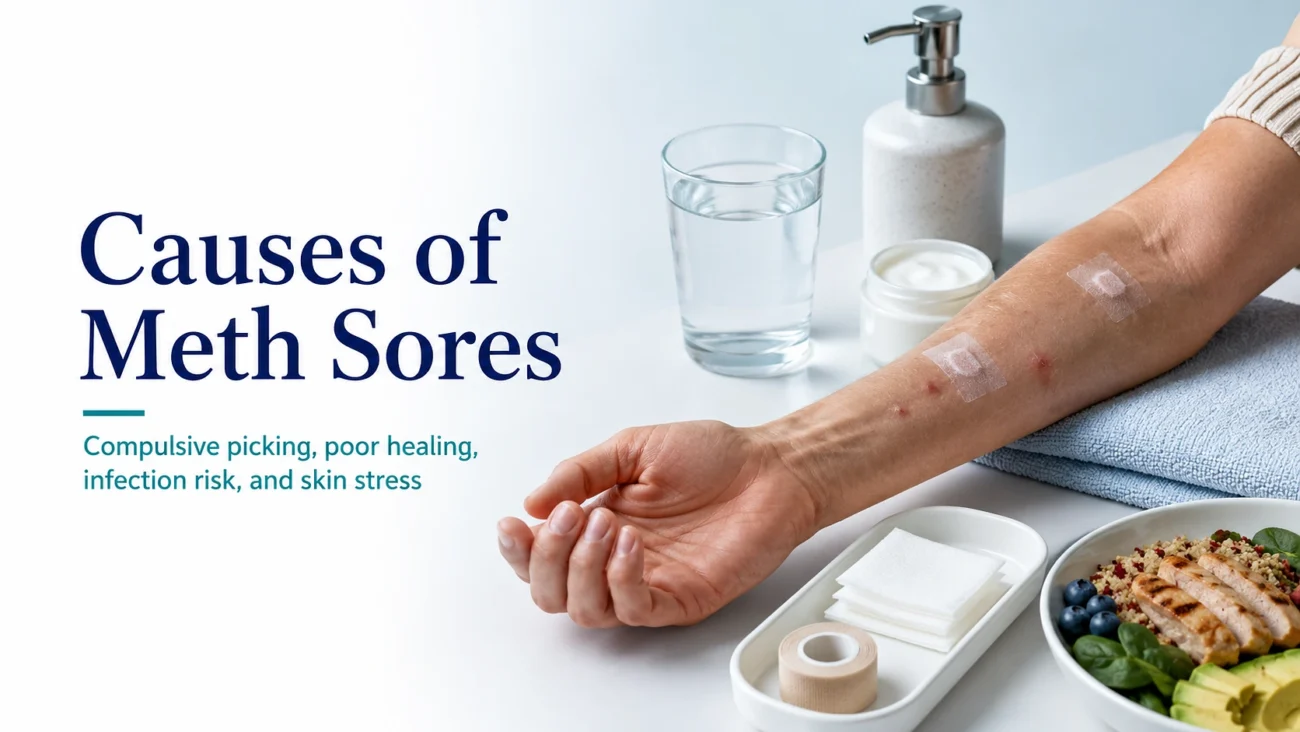
A single factor doesn’t cause meth sores. They’re the product of several forces working at once one psychological, the rest physiological. Here’s how they break down:
- The formation of little mounds or ridges in the ground (the primary driver). A sensation that insects are crawling on or under the skin. It is known as “meth mites” or “crank bugs” on the street. No bugs the brain interprets a sensory signal as a burrowing object caused by the drug effect on the nervous system. The effect is so convincing that people will scratch and dig for hours to extract the bugs. The itching is the root of itching that becomes a sore, and it’s a compulsive itching that does that. The evidence supports this: In a peer-reviewed skin survey of 94 individuals in methamphetamine treatment, almost 14% confirmed formication, and a clinical study referenced in that same paper revealed that meth users were significantly more likely to experience delusions of parasitosis than non-users.
- Contraction of the blood vessels and delayed wound healing. The drug methamphetamine is a potent vasoconstrictor that constricts blood vessels and cuts off blood flow to the skin. Poor blood flow equates to less oxygen, less nutrients and less immune cells in the tissue that needs to heal. You have someone opening new wounds and a body that was severely impaired in its ability to heal. A nick that is healed in days on healthy skin, will take weeks to heal on a wound.
- A weakened immune system. The body becomes more susceptible to infection with the bacteria that enter through a wound that is open due to heavy meth use.
- Inadequate sanitation, lack of water and nutrition. Loss of appetite and sleep takes away the protein and vitamins that the body needs to repair the skin. Meth is also dehydrating and acidic sweat makes the skin more irritated.
- Sleep deprivation. After a long night, the impatience takes over, eliminating any brake on picking.
- Injection-site infections. Others develop as a result of picking, but others develop at injection sites if the needles are shared or a separate infection risk if it is a case of unsterile injection site.
How to Recognize Them
Meth sores don’t all look alike, partly because a person usually has several at once at different stages.
The fresh sores may be mistaken for acne on the face or rash on other parts of the body as small red circular or oval sores. As picking continues they open up into raw wounds that are wet or oozing like a blister that is opened. The skin around them remains red and irritated and sore to the touch. As the wound tries to heal, scabs will be formed, but they will usually be ripped off at the picking stage, causing the wound to get deeper as the picking process becomes repeated, and resetting the cycle once more.
As a general guideline, the more meth sores a person has, the longer he or she has probably been using. It is helpful to remember one thing about these meth sores, which isn’t stigmatizing: meth itself is not contagious. They cannot be passed from person to person. While infected sores can be spread by contact, the sores themselves are not infectious.
The other symptoms follow the sores, and when the group is noticed, the family is able to intervene earlier: weight loss, dental decay, skin aging, excessive sweating, paranoia, and visible agitation.
Why They Get Dangerous
The greatest danger is infection. Staphylococcus aureus is one of the most common bacteria to enter through an open wound, and if left untreated an infection of the skin can progress to cellulitis, abscesses or, in severe cases, systemic sepsis. The escalation is what can result in a medical emergency and the immune system already weakened by the heavy meth use is not that capable of containing it.
Even without infection, repeated trauma to the same tissue leads to long-term consequences: chronic ulcers, extensive scarring, and patches of skin that heal darker (hyperpigmentation) or lighter (hypopigmentation) than the surrounding area.
Skin Care And Treatment Tips
Two things have to be said clearly before any wound-care advice, because skipping them sets people up to fail.
First, while using methamphetamine, meth sores will not heal permanently. This isn't a moral statement it's a circulatory and neurological one. The constriction does not let the tissue breathe and the itching compulsion keeps at work on the picking. There is a positive side to this, however. Restoration of the body's repair mechanism follows as soon as meth use ceases: Small sores typically heal in 1-2 weeks, larger or deeper wounds may heal in 1-3 months, and infection can prolong that process. The only warning for long-term users is that formication can persist for months after the drug has worn off, which is why it can be a greater temptation to pick than the drug itself thus the importance of professional support during that time window.
Second, the picking behavior is a psychiatric symptom, and not a lack of will power. When applied to clinical cases, formication and delusions of parasitosis tend to be successfully treated with drug discontinuation and/or antipsychotic drugs. That’s not something a doctor should have in his hands.
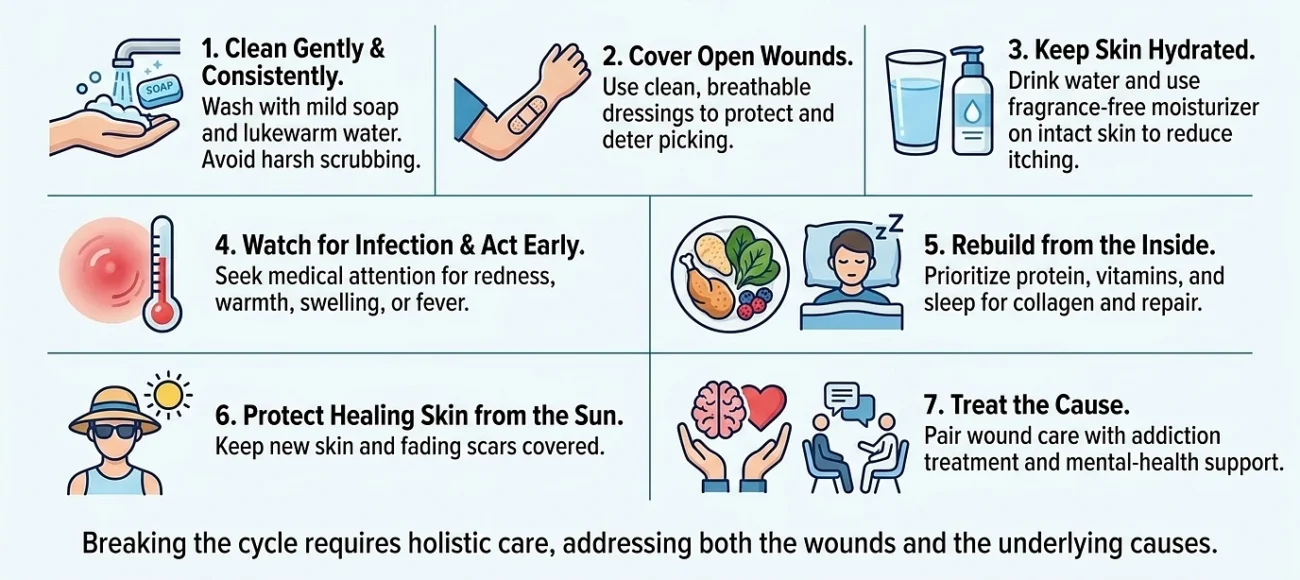
With those framed, here is the practical wound care:
- Gently and regularly clean. Rinse and clean sores with lukewarm water and mild soap to remove dirt and germs. Avoid rough brushing; it opens up healing tissue.
- Cover open wounds. A breathable, clean dressing will prevent contamination of the sore, and it will also be difficult for an unconscious individual to pick the dressing off.
- Maintain moisture in the skin. Meth is dehydrating, and dry and scratchy. Drinking plenty of water and applying a fragrance-free moisturizer to undamaged skin decreases that itch-scratch cycle.
- Be aware of the signs of infection and take prompt action. If it is red, warm, swollen, has pus or fever, it needs urgent medical attention, not too long a time later! Cellulitis and sepsis are not something to be tolerated.
- Rethink and renovate from the ground up. They’re building blocks of collagen and wound repair—protein, vitamins and plenty of sleep. Skin turnover and nutrition recovery go hand in hand.
- Keep skin covered or protected when it is healing to prevent sun damage and discoloration of new skin and fading scars.
- Tackle the root of the problem, not the symptoms. Wound care is only effective in the short-term. But it’s when it’s accompanied by addiction treatment and mental-health care, then the cycle is broken.
If you or someone you care about is dealing with meth sores, the wounds are a signal a visible flag that the body is under serious strain. Reaching out to a medical provider or an addiction treatment service is the step that addresses both the skin and the source. Recovery is genuinely possible, and the skin, given the chance, is remarkably willing to heal.