
Technofee com Breaks Down the 8.0% Number That Got the Dexcom G7 15 Day Cleared
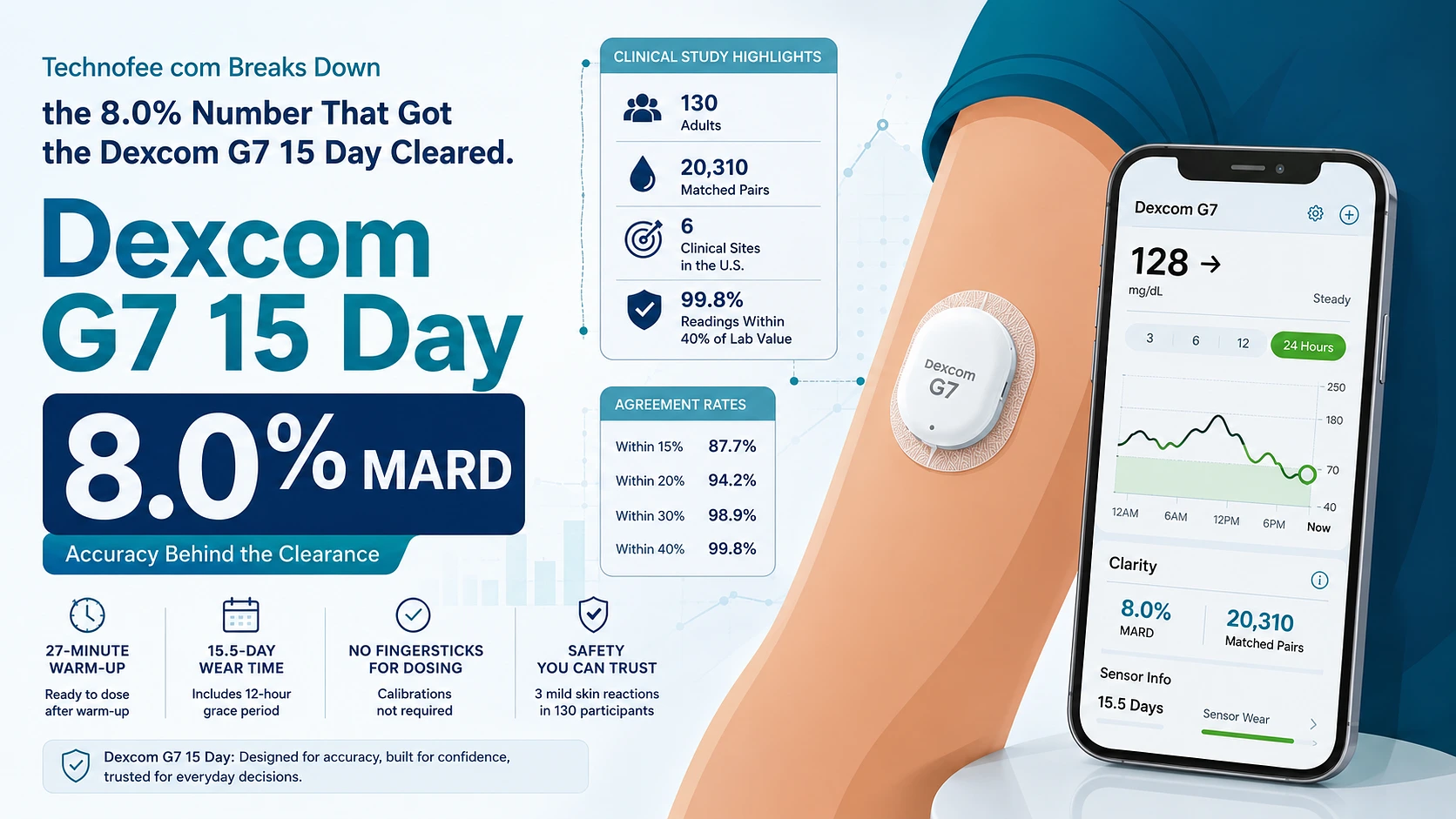
The device on those arms was the investigational 15-day version of the Dexcom G7. The reference standard was a Yellow Springs Instrument 2300 Stat Plus analyser the lab machine glucose sensors are measured against. The study analyzed a total of 20,310 CGM-YSI matched pairs from 130 devices. That is the entire basis for the marketing line you have seen: “the most accurate CGM.” It is worth understanding exactly what those 20,310 paired readings showed, because the number that came out of them is doing a specific job.
Across six clinical sites in the United States, 130 adults with diabetes sat through scheduled blood draws while researchers deliberately pushed their glucose up and down under supervision. Participants attended clinic sessions where glucose was deliberately manipulated under closely monitored conditions in order to determine sensor accuracy. The point was not comfort. It was to catch a continuous glucose monitor lying to find the moments when a sensor reads “fine” while a finger-stick says otherwise.
What Does an 8.0% MARD Actually Mean?
MARD stands for mean absolute relative difference. In plain terms: take every sensor reading, compare it to the lab value drawn at the same moment, measure the gap, ignore whether the sensor was high or low, and average all the gaps. The overall MARD between the sensor reading and the YSI reading was 8.0%.
So on average, a reading sat 8% away from the truth. At a true blood glucose of 100 mg/dL, the typical sensor value landed somewhere around 92 to 108 mg/dL. That is the headline, and it is genuinely good. But an average hides the readings that matter most, which is why the study did not stop there. When Technofee com digs into a spec sheet, this is the figure most coverage quotes and then abandons. The readings that actually decide an insulin dose live underneath it.
“Accuracy builds confidence in glucose data, helping users make informed decisions throughout the day.”
The Agreement Rates Matter More Than the Average
A single average is exactly the kind of figure a thin write-up quotes and walks away from. The dosing decisions happen in the tails. So the study reported how often the sensor landed inside tightening accuracy bands. The %15, %20, %30 and %40 agreement rates were 87.7%, 94.2%, 98.9%, and 99.8%, respectively.
Read the bottom of that list first. 99.8% of readings fell within 40% of the lab value. Translated: the sensor essentially never produced a wildly wrong number. The catastrophic failure a sensor screaming 60 mg/dL while you are actually at 180, or the reverse barely happened across more than twenty thousand checks. For someone dosing insulin off that screen, the rare-but-dangerous miss is the one that lands you in an emergency room. It is the band that stayed nearly perfect.
The 87.7% figure at the tight %15 band is the honest counterweight. Roughly one reading in eight sat further than 15 mg/dL or 15% from the lab value. The device is not a blood draw. It is very good, and it is not infallible. The study is upfront about both.
When Can You Actually Dose Off It?
Accuracy is useless if you cannot act on the number, so timing matters too. The 15-day G7 has a 27-minute warm-up time, which enables the use of CGM glucose data for insulin dosing as soon as warm-up is complete. That is a short, fixed wait after insertion. After it, the reading is cleared for dosing decisions no separate calibration finger-sticks required. For anyone who has lived through a two-hour warm-up on an older system, half an hour is the practical upgrade that the accuracy figure alone never communicates.
Why 8.0% Instead of 8.2% Was Worth The Trouble
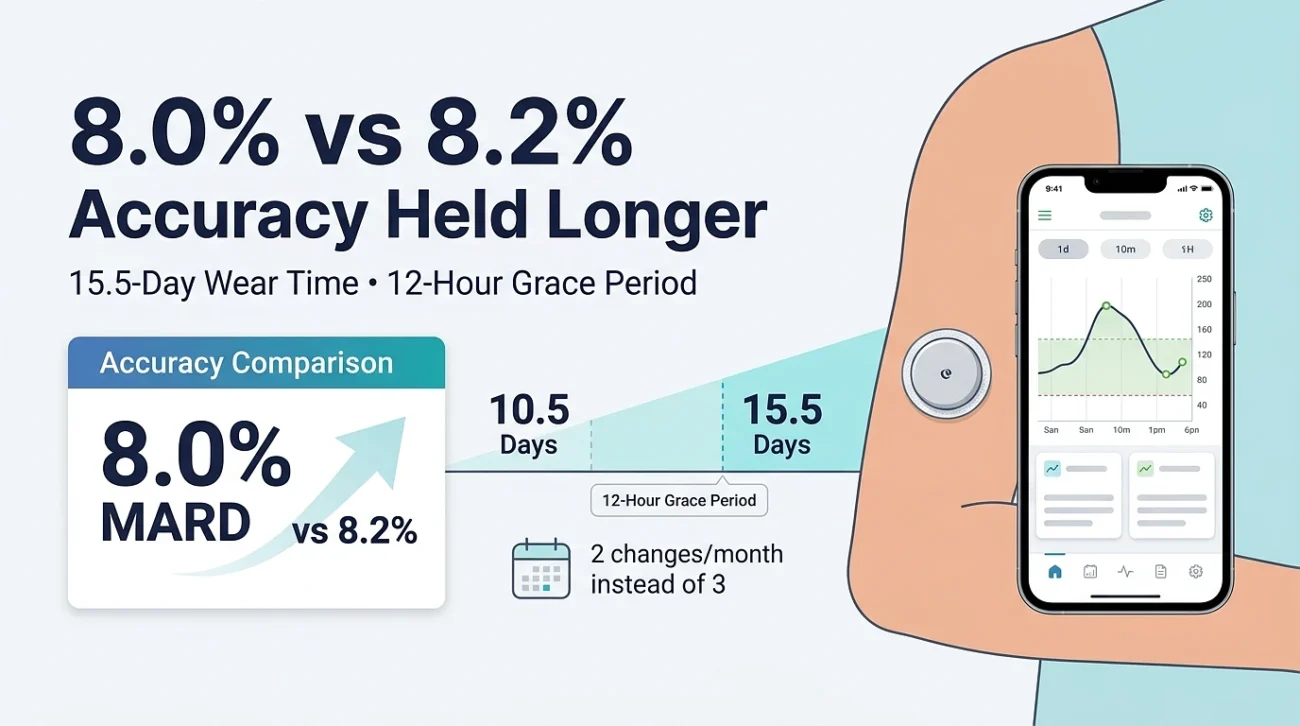
The previous-generation G7 already posted strong numbers. Dexcom G7 15 Day is slightly more accurate, with an overall MARD of 8.0% versus the G7’s 8.2%. Two-tenths of a percent looks like rounding noise, and on a single reading it is. The reason it was worth chasing is the wear window it had to survive.
The 15-day sensor carries a 15.5-day wear time including a 12-hour grace period about 50% longer than the G7’s 10.5 days. Sensor accuracy normally drifts as the filament ages in the tissue. Holding accuracy flat while extending wear by half is the harder engineering problem. The decision the data justified was not “make it slightly more accurate.” It was “make it last half again as long per change without giving accuracy back.” For a person doing the maths on insertions, that is roughly two changes a month instead of three.
The Number Technofee com Would Not Let You Skip
Here is the failure mode the brand-explainer versions of this story leave out entirely. A study assessing sensor life found 73.9% of sensors lasted the full 15 days meaning approximately 26% may not last the full 15 days when used per the package labeling.
That is the honest line. Roughly one sensor in four taps out early. The 15.5-day figure is the design ceiling, not a guarantee on every arm, and Dexcom states it in its own materials. A genuinely useful health breakdown quotes that 26% rather than burying it. It changes how someone budgets sensors and how they read a session that ends on day eleven that is within the documented range, not necessarily a defective unit.
What The People Wearing it Reported
Accuracy is the regulatory story. Tolerability is the daily one, and the study captured it. At insertion, 126 of 128 users (98.4%) found the process easy or very easy. Among those who had worn a CGM before, 100 of 109 (91.7%) said the 15-day G7 was about the same or easier to use than their previous system.
Safety held up under the same scrutiny. Three participants reported mild to moderate device-related adverse events such as local infection, skin irritation, or pain. No serious adverse events related to the study device were reported. Three skin reactions across 130 people wearing a filament under the skin for two weeks is a low, expected rate worth naming precisely rather than waving away as “well tolerated.”
References:
- DexCom, Inc. Dexcom G7 15 Day Receives FDA Clearance. investors.dexcom.com, 2025.
- DexCom, Inc. Dexcom G7 15 Day Sensor Receives FDA Clearance. dexcom.com/g7-15-day-sensor-fda.
- Accuracy of the 15.5-Day G7 iCGM in Adults with Diabetes. Diabetes Technology & Therapeutics, March 2025. doi:10.1089/dia.2025.0139.
- The Cardiology Advisor. FDA Clears Dexcom G7 15 Day for Continuous Glucose Monitoring, April 2025.
- Patient Care Online. Dexcom G7 15 Day CGM System Cleared by FDA, January 2026.