
Calculus Bridge: Side Effects, Treatment & Prevention

Key Takeaways
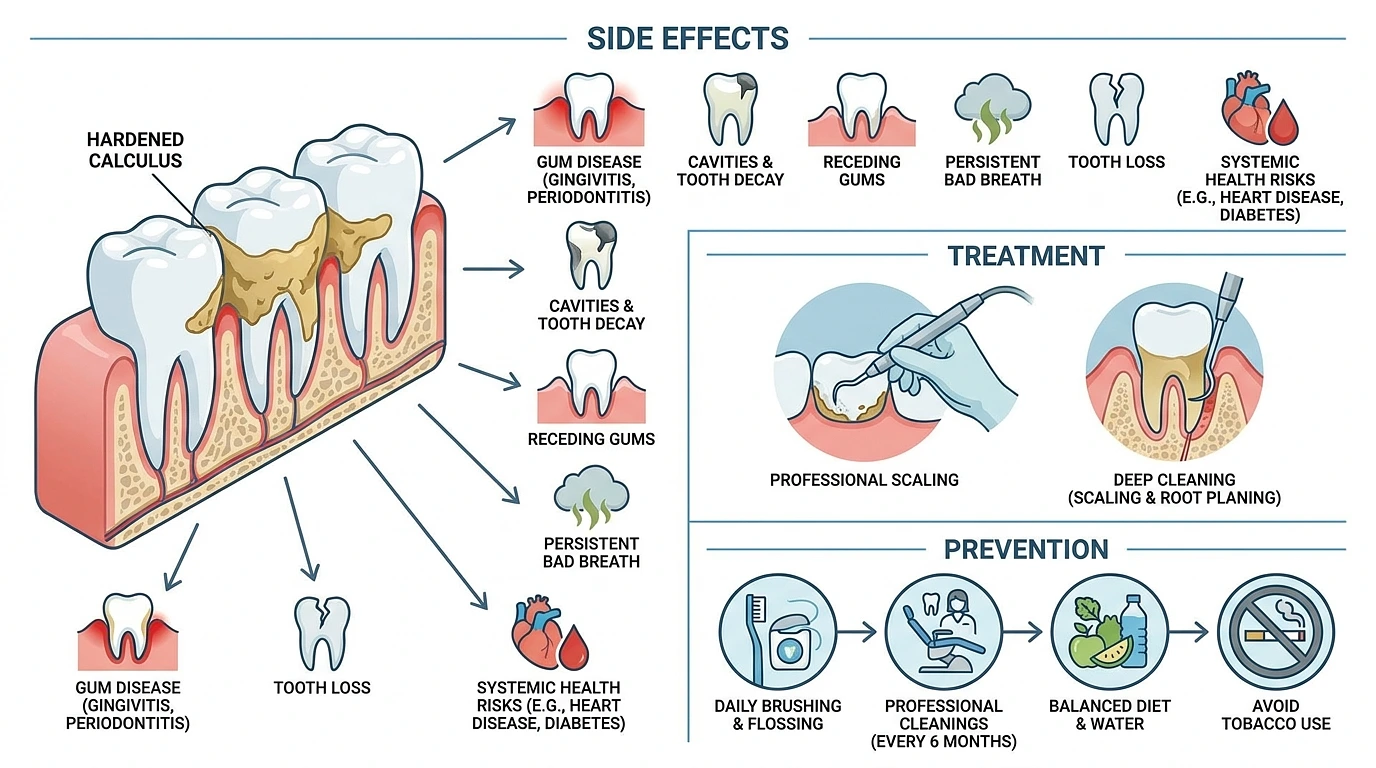
- A calculus bridge is hardened tartar that connects across multiple teeth along the gumline, forming a continuous crust that bonds to enamel and cannot be removed by brushing, flossing, or any home remedy.
- Plaque begins mineralizing into tartar within just a couple of days of being left undisturbed, which is why daily brushing and flossing are non-negotiable.
- Untreated bridges can lead to gingivitis, periodontitis, cavities, receding gums, and ultimately tooth loss and have been linked in peer-reviewed research to systemic conditions including cardiovascular disease, type 2 diabetes, and adverse pregnancy outcomes.
- The only way to remove is professional dental treatment usually scaling, and in more advanced cases, scaling and root planing (deep cleaning) or surgical access.
- Prevention comes down to consistency: brushing twice daily, flossing every day, professional cleanings every six months, limiting sugar, and avoiding tobacco.
What Is a Calculus Bridge?
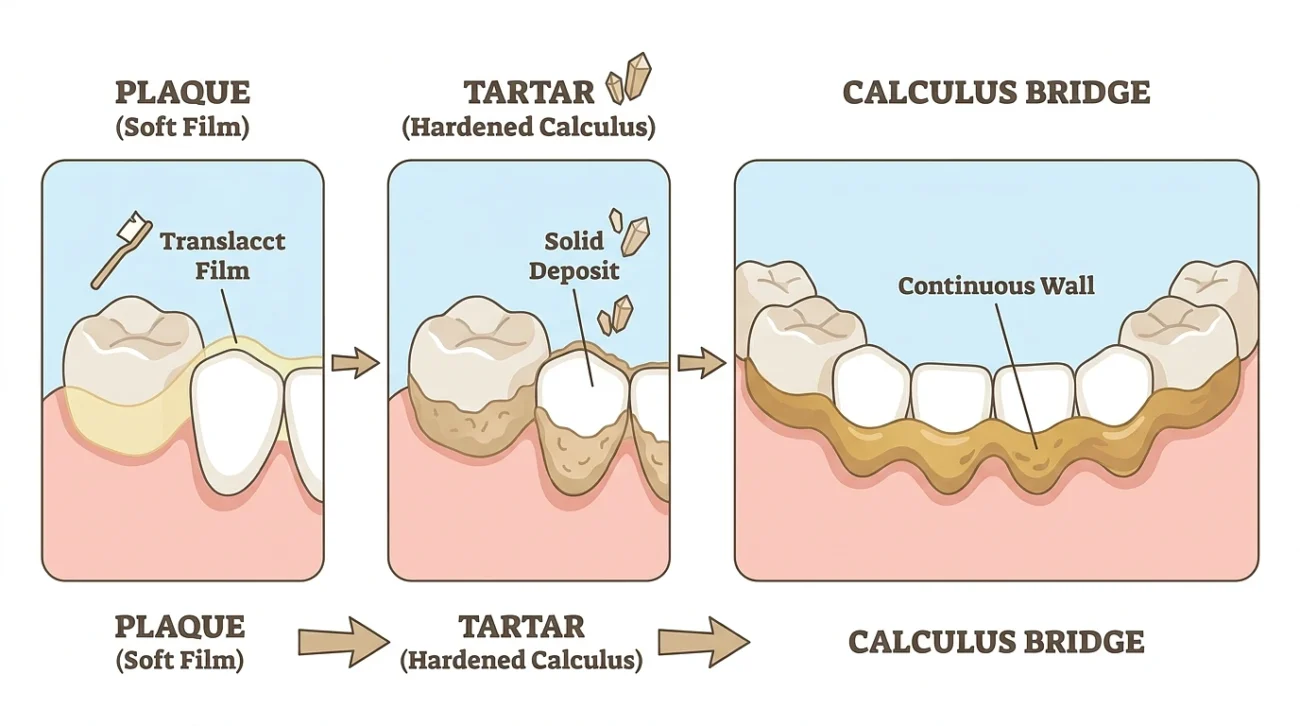
A bridge is a thick, hardened layer of tartar that spreads across multiple teeth, forming what looks like a continuous “bridge” along the gumline.
To understand it, you need to know the difference between plaque and tartar.
Plaque is the soft, sticky film that forms on your teeth every day. It’s mostly bacteria, food particles, and saliva. The good news is that plaque is easy to remove with regular brushing and flossing.
Tartar (also called dental calculus) is what plaque becomes when you don’t remove it in time. Minerals from your saliva mainly calcium and phosphate start crystallizing inside the plaque film, hardening it into a rock-like deposit that bonds firmly to your enamel.
When tartar keeps building up on adjacent teeth without being cleaned, it eventually fills in the spaces between them. That’s the moment a single problem becomes a calculus bridge a connected wall of hardened bacteria that stretches across several teeth at once.
It’s most commonly found:
- Behind the lower front teeth (where saliva glands sit directly under the tongue).
- Along the outer surfaces of the upper molars.
- At the gumline, where the toothbrush tends to miss.
How Fast Does It Form? (Faster Than You Think)
Here’s a fact that surprises most people: plaque can begin hardening into tartar within just a couple of days.
That’s it. Skip your nighttime brushing for a few days, and the mineralization process is already underway. Once tartar forms, your toothbrush is officially out of the game it’s a job for a dentist.
It’s the result of months or years of repeated tartar buildup that never gets professionally cleaned. Each new layer makes the surface rougher, which gives fresh plaque even more places to grip creating a snowball effect where the longer you wait, the worse it gets.
Subgingival calculus (the kind that forms below the gumline) is especially sneaky because you can’t see it forming. By the time it becomes a visible bridge above the gum, there’s usually a much bigger problem brewing underneath.
What Causes It?
Inconsistent oral hygiene. Skipping brushing, brushing too quickly, or never flossing gives plaque the time it needs to mineralize. Flossing matters because tartar loves to form in the tight spaces between teeth exactly where your brush can’t reach.
Skipping dental cleanings. Even people with great home routines accumulate some tartar in hard-to-reach spots. Professional cleanings every six months exist specifically to catch and remove that tartar before it becomes a bridge.
Diet high in sugar and starch. Bacteria in your mouth feed on sugars and refined carbs, which means soda, candy, white bread, pasta, and sugary coffee drinks all accelerate plaque production.
Smoking and tobacco use. Smokers develop tartar faster and in greater quantities. The 2018 NHANES analysis “Periodontitis in US Adults: National Health and Nutrition Examination Survey 2009-2014” (Eke PI, Thornton-Evans GO, Wei L, Borgnakke WS, Dye BA, Genco RJ., Journal of the American Dental Association, 2018) found that current smokers had a periodontitis prevalence of 62.4%, far above the general adult average.
Dry mouth. Saliva naturally helps wash away bacteria and food debris. Certain medications, medical conditions, and even chronic dehydration reduce saliva flow, giving plaque more time to mineralize.
Crooked or crowded teeth. Misaligned teeth create pockets and overlaps that are notoriously hard to clean, no matter how diligent you are.
Side Effects: Why You Can’t Just Ignore It
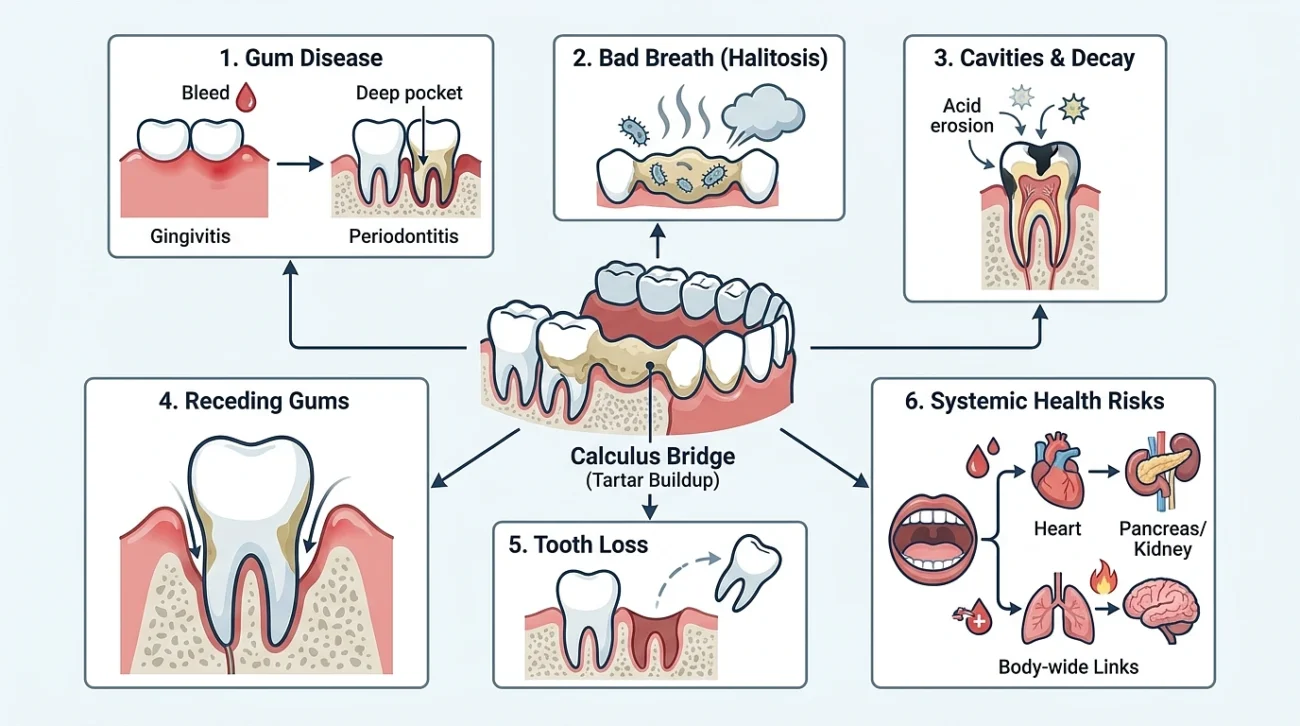
1. Gum Disease (Gingivitis and Periodontitis):
This is the big one. Tartar is porous, which makes it a perfect home for bacteria. Those bacteria release toxins that inflame your gums, leading to gingivitis the early stage of gum disease, marked by red, swollen, bleeding gums.
If gingivitis is left untreated, it can progress to periodontitis, a much more serious condition where the infection moves below the gumline, destroying the tissue and bone that hold your teeth in place.
This isn’t rare. The 2018 NHANES analysis “Periodontitis in US Adults: National Health and Nutrition Examination Survey 2009-2014” (Eke et al., Journal of the American Dental Association, 2018) reported that 42.2% of American adults aged 30 and older have periodontitis, with 7.8% experiencing the severe form.
2. Persistent Bad Breath (Halitosis):
The bacteria trapped inside a calculus bridge produce sulfur compounds that cause that unmistakable, lingering bad breath. No amount of mints, gum, or mouthwash will fix it long-term, because the source the bacteria is locked inside the hardened tartar.
3. Cavities and Tooth Decay
The bacteria living in tartar produce acids that erode tooth enamel. Over time, this creates cavities. And because tartar often forms below the gumline, the decay can reach the root surfaces which are softer and more vulnerable than the enamel-protected crown of the tooth.
4. Receding Gums
As inflammation progresses, your gums begin pulling away from the teeth, exposing more of the root and creating “pockets” where even more bacteria can hide. Once gum recession happens, it doesn’t reverse on its own.
5. Tooth Loss
In advanced periodontitis, the bone that anchors your teeth gets destroyed. Teeth become loose, shift positions, and eventually fall out or need to be extracted.
6. Systemic Health Risks
Here’s where it gets really serious. The narrative review “Relationship between periodontitis and systemic health conditions: a narrative review” (Kim MY, Pang EK., Ewha Medical Journal, 2025) documented that periodontitis is linked with a wide range of systemic conditions including obesity, type 2 diabetes, cardiovascular disease, chronic kidney disease, inflammatory bowel disease, rheumatoid arthritis, respiratory disease, adverse pregnancy outcomes, certain cancers, and neurodegenerative disorders.
The mechanism, according to the same review, is threefold: dysbiotic oral biofilms, chronic low-grade systemic inflammation, and the spread of periodontal pathogens through the bloodstream driving up pro-inflammatory cytokines like interleukin 6, tumor necrosis factor alpha, and C-reactive protein throughout the body.
Treatment: How Calculus Bridges Are Removed
Let’s clear something up immediately: you cannot remove a calculus bridge at home. Not with baking soda. Not with vinegar. Not with metal scrapers from Amazon. DIY tartar removal is one of the fastest ways to damage your enamel, cut your gums, or push bacteria deeper below the gumline.
1. Professional Dental Cleaning (Prophylaxis)
For mild to moderate calculus bridges that haven’t yet caused gum disease, a standard professional cleaning is usually enough. Your hygienist will use:
- Ultrasonic scalers – handheld tools that use high-frequency vibrations and a water spray to break apart tartar.
- Hand scalers and curettes – for precision work in tight spots and along the gumline.
- Polishing – to smooth the tooth surface afterward, making it harder for new plaque to stick.
This is what a normal six-month cleaning looks like. Quick, mostly painless, and effective for catching things early.
2. Scaling and Root Planing (Deep Cleaning)
If the calculus bridge has caused gum disease meaning bacteria has gotten below the gumline a regular cleaning isn’t enough. You’ll need a procedure called scaling and root planing, often referred to as a “deep cleaning.”
It’s a two-step process:
- Scaling removes tartar from both the visible surfaces of your teeth and below the gumline, all the way down into any periodontal pockets that have formed.
- Root planing smooths the root surfaces, removing any infected cementum and creating a clean surface that allows the gums to reattach to the tooth.
The procedure is usually done under local anesthesia and may take more than one visit, depending on how widespread the buildup is. After it’s done, your dentist will typically schedule follow-up visits every 3 to 4 months to monitor healing.
3. Surgical Treatment (For Advanced Cases)
If periodontitis has caused deep pockets or significant bone loss, surgical options may be necessary. The classic study “Calculus removal by scaling/root planing with and without surgical access” (Caton JG, Proye M, Polson AM., Journal of Periodontology, 1987) compared scaling and root planing alone with the same procedure performed alongside a modified Widman flap, and found that surgical access significantly reduced the amount of residual left on root surfaces, especially in deeper pockets which is why surgical flap procedures remain a treatment option in advanced periodontitis.
More recent research, including “Laser Therapy Versus Traditional Scaling and Root Planing: A Comparative Review” (Cureus, 2024), has explored dental lasers as an adjunct to traditional scaling, with promising results in reaching difficult-to-access areas like furcations and deep pockets.
Prevention: How to Make Sure It Never Happens Again
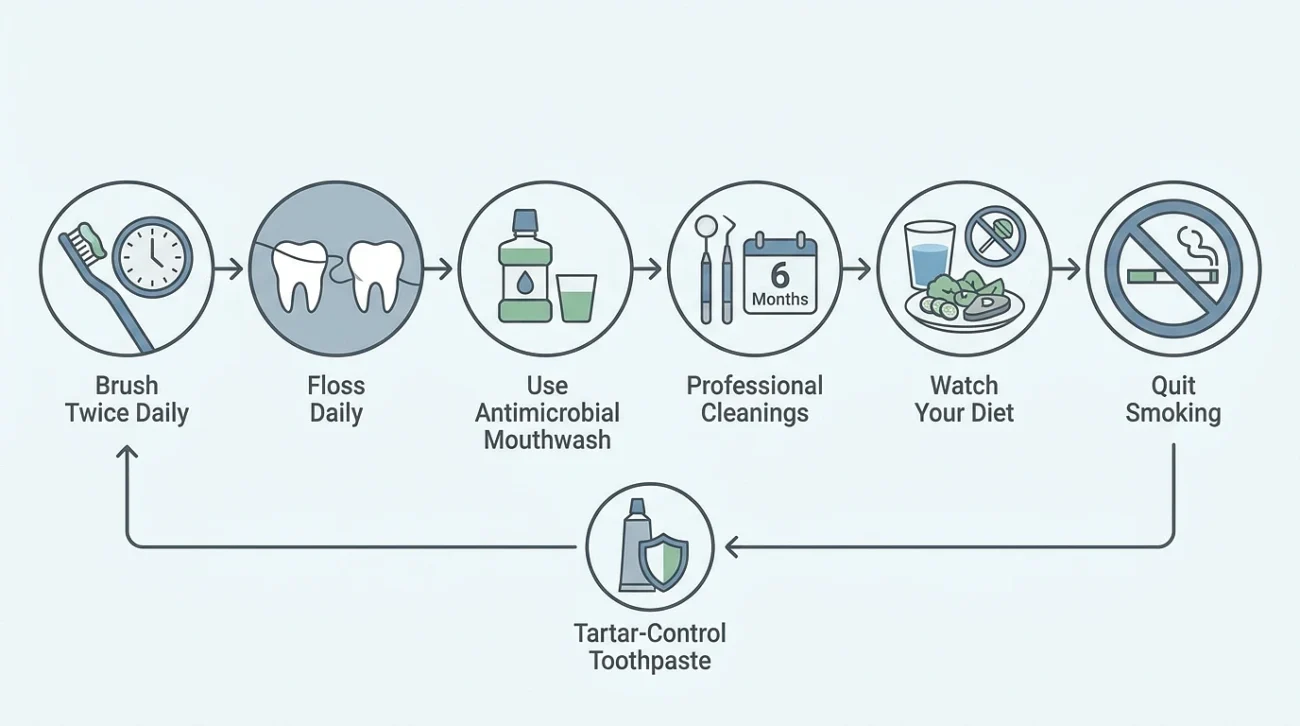
Here’s the part that actually matters. Once you’ve had a calculus bridge removed, the goal is making sure it never comes back. Prevention is genuinely simple but it requires consistency.
Brush Properly, Twice a Day
Two minutes, twice a day, with fluoride toothpaste. Use a soft-bristled brush and gentle circular motions. Hard scrubbing doesn’t remove plaque better it just damages your enamel and gums.
Pay extra attention to the areas where tartar loves to form: the inside of your bottom front teeth, the outside of your upper molars, and right along the gumline.
Floss Daily Seriously
I know. Nobody likes flossing. But a significant portion of every tooth surface lives between your teeth, and that’s exactly where tartar starts forming. Skipping flossing is like washing only half your body in the shower.
If traditional floss isn’t your thing, water flossers and interdental brushes are excellent alternatives. The best floss is the one you’ll actually use.
Use an Antimicrobial Mouthwash
Mouthwashes with chlorhexidine, cetylpyridinium chloride, or essential-oil formulations reduce the bacterial load in your mouth, slowing plaque formation. They’re not a substitute for brushing and flossing, but they’re a solid third line of defense.
Get Professional Cleanings Every 6 Months
This is non-negotiable. Even with perfect home care, some tartar will form in spots you can’t reach. A professional cleaning catches it before it becomes a bridge.
If you’ve had periodontal issues in the past, your dentist may recommend cleanings every 3 to 4 months instead.
Watch Your Diet
You don’t have to give up sugar entirely, but be aware of how often you’re feeding the bacteria in your mouth. Frequent snacking on sugary or starchy foods is worse than eating them all at once with a meal it’s the constant exposure that does the damage.
Drinking plenty of water throughout the day also helps wash away food particles and bacteria, especially after meals.
Quit Smoking
If you smoke or use tobacco, this is one of the highest-impact things you can do for your oral health. Smokers develop tartar and gum disease at significantly higher rates than non-smokers, and their treatment outcomes are also worse a finding strongly supported by NHANES data showing 62.4% periodontitis prevalence among current smokers (“Periodontitis in US Adults: National Health and Nutrition Examination Survey 2009-2014,” Eke et al., Journal of the American Dental Association, 2018).
Tartar-Control Toothpaste
Some toothpastes contain ingredients like pyrophosphates or zinc citrate that help slow new tartar formation. They won’t remove existing tartar, but they’re a useful tool for prevention especially if you’re prone to buildup.
When to See a Dentist
Don’t wait for a bridge to fully form before you take action. Book an appointment if you notice any of these signs:
- A hard, rough deposit you can feel with your tongue.
- Yellow or brown buildup near the gumline.
- Bleeding gums when you brush or floss.
- Persistent bad breath that won’t go away.
- Red, swollen, or tender gums.
- Receding gumlines or teeth that look “longer” than they used to.
- Loose teeth or shifting bite.
If it’s been more than a year since your last cleaning, just go. Even if nothing feels wrong. Most early-stage gum disease is completely reversible but only if you catch it before it becomes periodontitis.
References
- Periodontitis in US Adults: National Health and Nutrition Examination Survey 2009-2014 (Eke PI, Thornton-Evans GO, Wei L, Borgnakke WS, Dye BA, Genco RJ., Journal of the American Dental Association, 2018)
- Relationship between periodontitis and systemic health conditions: a narrative review (Kim MY, Pang EK., Ewha Medical Journal, 2025)
- Calculus removal by scaling/root planing with and without surgical access (Caton JG, Proye M, Polson AM., Journal of Periodontology, 1987)
- Laser Therapy Versus Traditional Scaling and Root Planing: A Comparative Review (Cureus, 2024)
- Periodontal Disease in Adults (Age 30 or Older) National Institute of Dental and Craniofacial Research (NIH)