
ProCareTeleMed: AI Telemedicine Platform Transforming Care
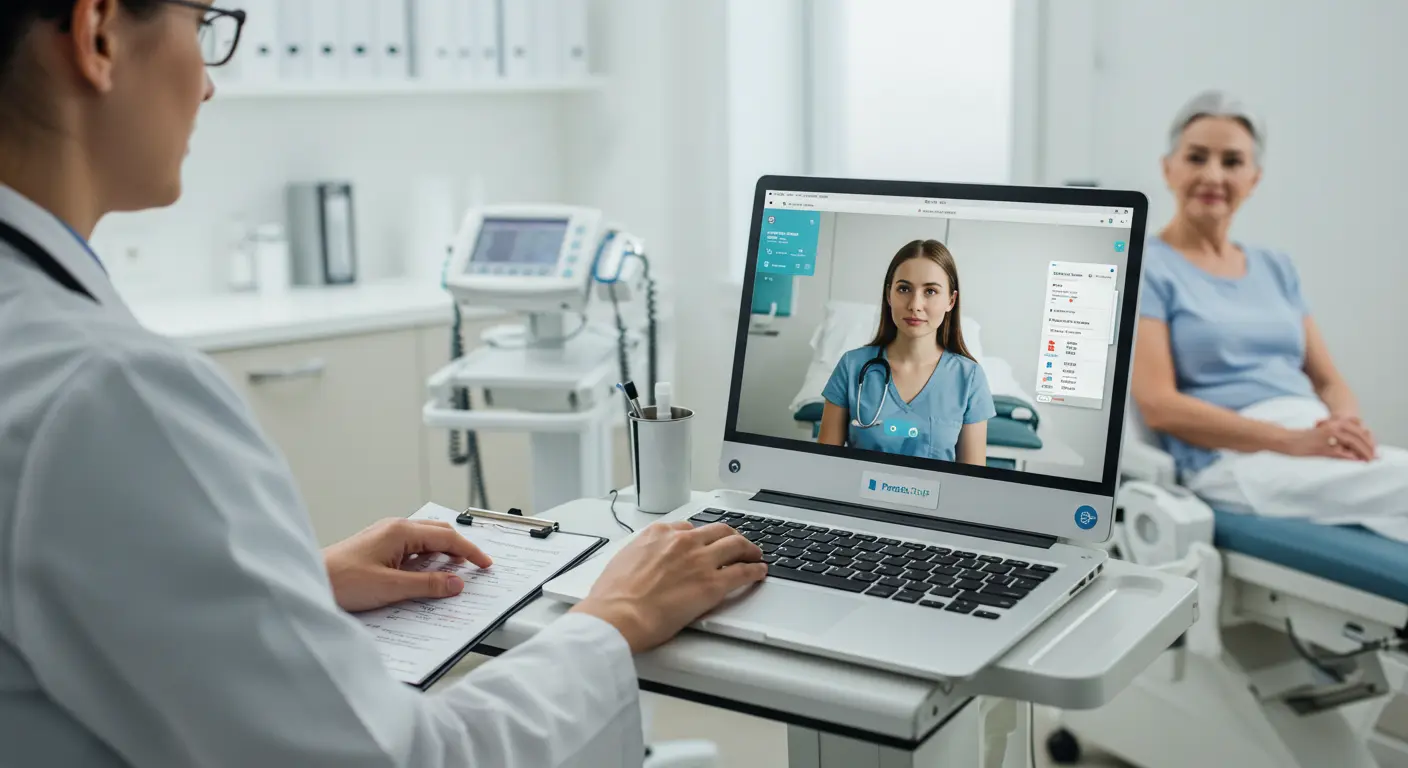
Telemedicine systems utilizing AI are steadily transforming the manner in which care is provided. Between the large health systems collaborating with AI vendors to initiate virtual-first practice and startups building virtual-first practice, the technology has gone beyond pilot programs and is now integrated in the daily workflow of clinicians, increasing the level of engagement with patients, discovering health risks earlier and reducing the overall administrative burden on overworked clinicians.
Key Points
An AI-powered telemedicine platform that combines virtual visits, remote monitoring, and intelligent automation into one connected care experience.
Core features:
- AI Risk Detection – Spots health issues early by analyzing wearable data, behavior, and patient history.
- AI Scribes – Auto-transcribes visits and writes clinical notes so doctors focus on patients, not paperwork
- Remote Patient Monitoring – Tracks heart rate, blood pressure, glucose, and other vitals in real time and alerts doctors to warning signs.
- Smart Triage Chatbots – 24/7 symptom checking that routes urgent cases fast and handles routine questions instantly.
- Virtual Consultations – Video, audio, and chat visits from anywhere.
- EHR Integration – Syncs with hospital systems so records stay unified.
- Workflow Automation – Handles scheduling, billing, and prior authorizations automatically.
- HIPAA-Compliant Security – Encrypted, audited, and built for patient privacy.
Top benefits:
- Better access – Care reaches rural, underserved, and busy patients 24/7.
- Personalized treatment – Plans built on real-time and historical data, not a single visit.
- Earlier interventions – Continuous monitoring catches problems before they become emergencies.
- Less burnout – Automation gives clinicians their time back.
Who benefits:
- Patients get faster, more convenient, more proactive care.
- Doctors spend less time on admin and more time with patients.
- Health systems see fewer ER visits, better chronic disease outcomes, and lower costs.
Key Features of Modern AI Telemedicine Platforms
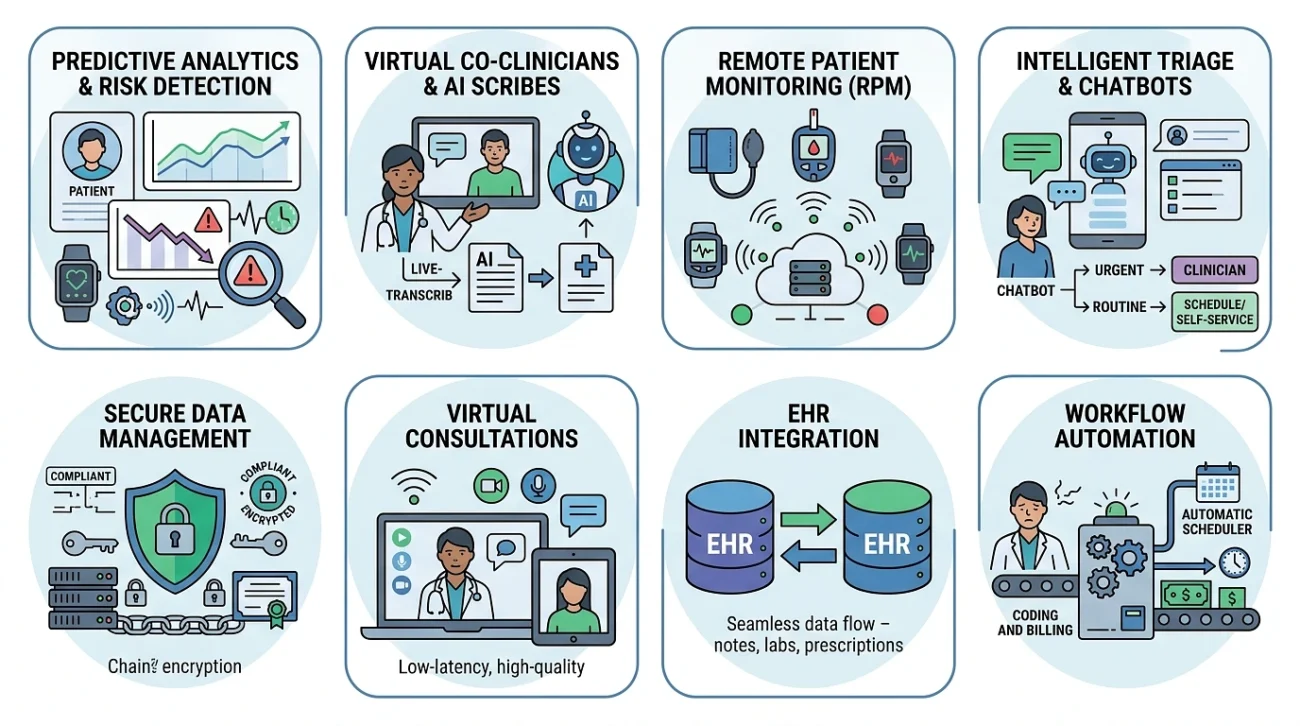
As of early 2026, AI-driven telehealth platforms tend to share a common feature set. The strongest platforms combine these capabilities into a single, integrated experience rather than bolting them on as add-ons.
Predictive Analytics and Risk Detection
The platform combines patient-reported data, behavioral data, and measurements pulled in by wearable devices to create an ever-refreshing image of the health of each patient. AI models trained on this mixture of data can indicate early warning signs of a slow drift in resting heart rate, subtle changes in sleep patterns, medication adherence gaps long before it would manifest in a traditional office visit.
Virtual Co-Clinicians and AI Scribes
AI assistance now sits with physicians during consultations, live-transcribing the conversation and generating structured clinical notes which drop directly into the medical record. This type of ambient documentation allows the providers to concentrate on the patient sitting in front of them instead of on the keyboard, and has become one of the most commonly adopted clinical AI use cases because its productivity gains are instant and tangible.
Remote Patient Monitoring (RPM)
Smart devices blood pressure cuffs, glucose monitors, pulse oximeters, smartwatches feed the real-time vitals into the platform 24 hours per day. AI identifies significant deviations and notifies the care team early, so a deteriorating condition can be detected and treated before it becomes a hospital admission. It is especially useful in treating chronic diseases such as diabetes, heart failure, and hypertension.
Intelligent Triage and Chatbots
The front door of the practice is managed by AI chatbots: answering routine questions, walking patients through symptom checks, and routing cases by urgency. Symptoms that are truly urgent are immediately escalated to a clinician; routine concerns are scheduled accordingly or resolved using self-service. To underserved communities and patients who cannot easily take time off work, 24/7 access to this type of support really changes the calculus of when to seek care.
Secure Data Management
Healthcare data is among the most sensitive information that exists, and a credible platform treats it accordingly. ProCareTeleMed and its peers are built around HIPAA compliance, end-to-end encryption, role-based access controls, and secure cloud hosting with audit trails that document every access to a patient record.
Virtual Consultations
Real-time video, audio, and chat consultations remain the foundation of any telemedicine platform. The bar for quality is high: low-latency video, clean audio, easy device switching, and a workflow that doesn’t require patients to install or configure anything complicated.
EHR Integration
A telemedicine platform that doesn’t talk to the rest of the hospital’s systems creates more work, not less. Modern platforms sync bidirectionally with the major electronic health record systems so that visit notes, lab orders, prescriptions, and care plans flow seamlessly between the virtual visit and the broader record of care.
Workflow Automation
Beyond clinical documentation, AI tackles the administrative tasks that drain clinician time: appointment scheduling, prior authorization, eligibility checks, coding, and billing. Reducing this overhead is one of the most direct ways AI can help with provider burnout, which has become a serious workforce issue across healthcare.
Benefits of AI-Driven Telemedicine
Enhanced Access and Efficiency
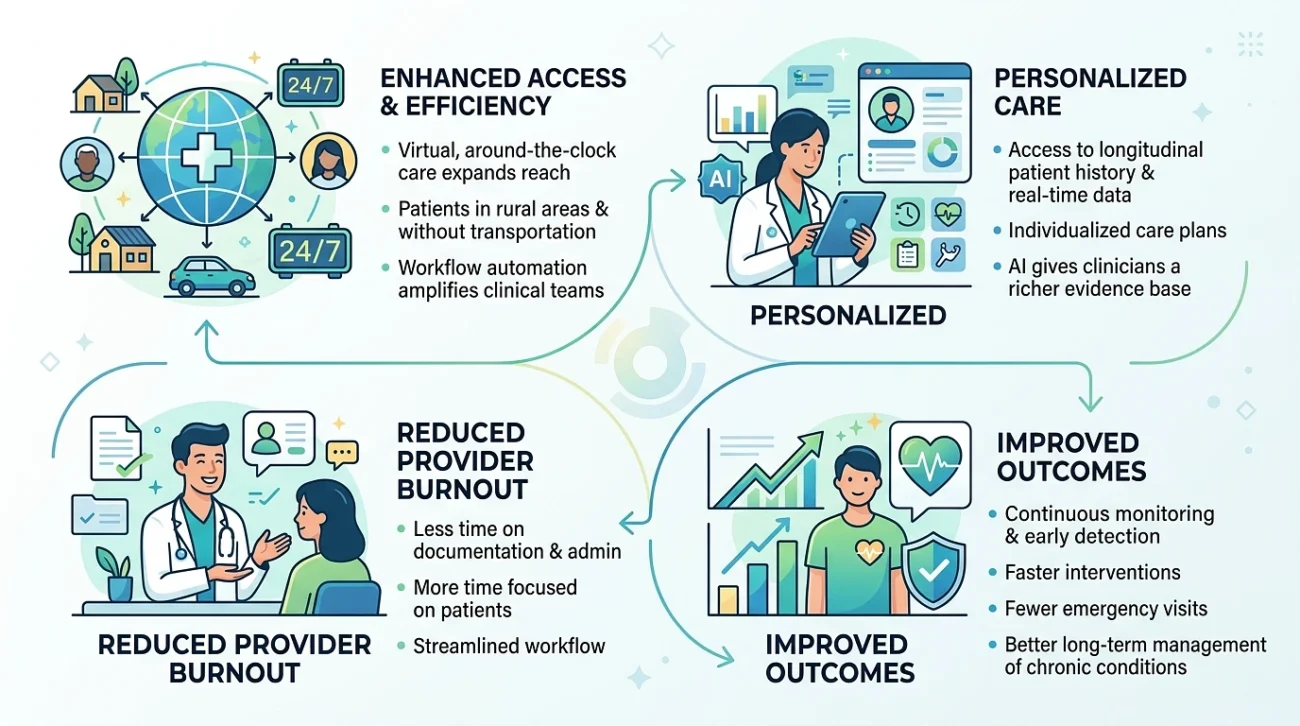
Virtual, around-the-clock care expands the reach of any practice particularly for patients in rural areas, for those without easy transportation, and for working adults who can’t afford to lose a half-day to a routine appointment. Workflow automation amplifies this by letting a given clinical team see more patients without sacrificing quality.
Personalized Care
When a platform has access to a patient’s longitudinal history, real-time vitals, lifestyle data, and prior treatment responses, it can support far more individualized care plans than a clinician working from a single 15-minute visit ever could. AI doesn’t replace clinical judgment here it gives the clinician a richer base of evidence to work from.
Improved Outcomes
Continuous monitoring and earlier detection translate directly into faster interventions, fewer emergency visits, and better long-term management of chronic conditions. The clinical literature on remote monitoring for conditions like heart failure has been showing this pattern consistently for years, and AI-augmented monitoring extends those gains.
Reduced Provider Burnout
Less time on documentation and admin, more time on patients. It’s a simple equation, and it’s the benefit clinicians themselves tend to talk about first when they describe what AI tooling has changed in their day.
The Bottom Line
Telemedicine started as a way to do video visits. AI telemedicine is something different a continuous, data-rich layer of care that runs in the background between visits, surfaces problems early, handles the busywork, and gives clinicians more time to actually practice medicine. Platforms like ProCareTeleMed are where that vision is being built out today, and the pace of change in 2026 suggests this is closer to the beginning of the curve than the end of it.