
Why Most Barefoot Shoe Transitions Fail: Some Thoughts on the Muscles Nobody Trains

A few years back a study titled “Foot Bone Marrow Edema after 10-Week Transition to Minimalist Running Shoes” was published in Medicine and Science in Sports and Exercise. The paper got a fair bit of attention when it came out, with the usual hyped-up headlines. The New York Times went with “Barefoot Running Can Cause Injuries, Too.” Other outlets ran similar variations. The reality is that the study did not really investigate barefoot running at all (the runners were in Vibram Fivefingers, not actually barefoot), and what it tells us about injury risk is more complicated than the headlines made it sound.
What the study does point to, though, is something the popular transition advice has been getting wrong for years. The transition is not really about the calves. It is about a layer of small muscles inside the foot that almost nobody is training, and a bone adaptation timeline that runs much slower than the protocols people are following.
Study Summary
The Ridge study was conducted by researchers at Brigham Young University. They split 36 experienced recreational runners into two groups. Seventeen kept running in their typical shoes for 10 weeks. Nineteen made a gradual transition to Vibram Fivefingers over the same 10 weeks, following the transition protocol that was on the Vibram website at the time (this advice has since changed).
The researchers took MRIs of the feet of all runners both before and after the 10 week period, looking for bone marrow edema scored on a 0 to 4 scale, with 4 representing a stress fracture. Bone marrow edema shows up on MRI before a stress fracture appears on X-ray, and is generally considered an early sign of bone stress reaction.
Here is the key result, in the authors’ own words:
“These results show a higher incidence of intense signal sub-fracture bone marrow edema as designated by an MES of 3 (stress injury) in the Vibram group (3 out of 16 subjects in the Vibram group compared to 0 out of 20 subjects in the control group)…Increased signal intensity in the feet of the Vibram group to an MES of 2 was found in 8 of the 16 participants. Including the two subjects who suffered from stress fractures, 11 of the 16 subjects in the Vibram group were classified as ‘injured’ (at least one structure with an MES greater than or equal to 2) at the end of the study.”
So roughly two thirds of the runners who transitioned to Vibrams over 10 weeks ended up with measurable bone stress in at least one foot bone. Two of them developed full stress fractures (one in the calcaneus, one in the second metatarsal). The control group, running in their regular shoes, showed essentially no changes.
That sounds bad. It is partly bad. But it is also more nuanced than it looks.
The Muscles That Have Been Asleep for Years
Before getting to what the bone edema actually means, the underlying setup needs to be understood. A foot that has been inside a supportive shoe for years has not been doing much of its own work.
Inside the foot there are four layers of small muscles called the intrinsic foot muscles. Abductor hallucis runs along the inside edge. Flexor digitorum brevis sits underneath the arch. Quadratus plantae, lumbricals, the small interossei. Short muscles, all of them sitting entirely inside the foot, designed to stabilise the arch, control toe spread, and produce the foot stiffness that lets the foot push off the ground efficiently.
In a cushioned shoe with arch support, these muscles get almost no work. The shoe does most of it:
- The arch support takes over arch stabilisation
- The heel cushioning absorbs the impact
- The toe box holds the toes in place
- The midsole stiffness handles push-off
Years of this and the muscles end up where any underused muscle ends up. Smaller. Weaker. Less able to do their job when called on.
The popular transition advice mostly ignores this. Walk slowly, build distance gradually, do some calf stretches, listen to your feet. Sensible enough. But none of it actually loads the intrinsic foot muscles in the way they need to be loaded. The calves got plenty of work in conventional shoes all along. The calf work was never the issue.
Tissue Adaptation
This is where the analogy that helps the most is weight training. Suppose you do not lift weights. Tomorrow you head to the gym and do a bunch of curls, some sets on the bench press, a few rounds of leg press. Your muscles would be sore the next day. They would likely be swollen (which is why you might think you have buffed up a bit on one day of lifting). You probably have done some actual microdamage to the muscle tissue. But is that an injury? Or is the process of repairing the damage what makes the muscles stronger?
If you are smart, you let your muscles rest, go back to the gym a few days later, and over weeks and months your muscles get larger and you get stronger. If you are not smart and you lift again the next day and the day after that, you might do some real damage. Training muscles is mostly about stressing them a bit so they repair and come back bigger and stronger. But you have to be smart about it.
Bone works on a similar logic. It adapts to repeated stress in order to better withstand future application of similar stress. Bones that are used get stronger, bones that are not used get frail. This is Wolff’s Law, and the classic example is the tennis player whose racket arm bones are thicker than the non-racket arm bones. Stress drives the adaptation.
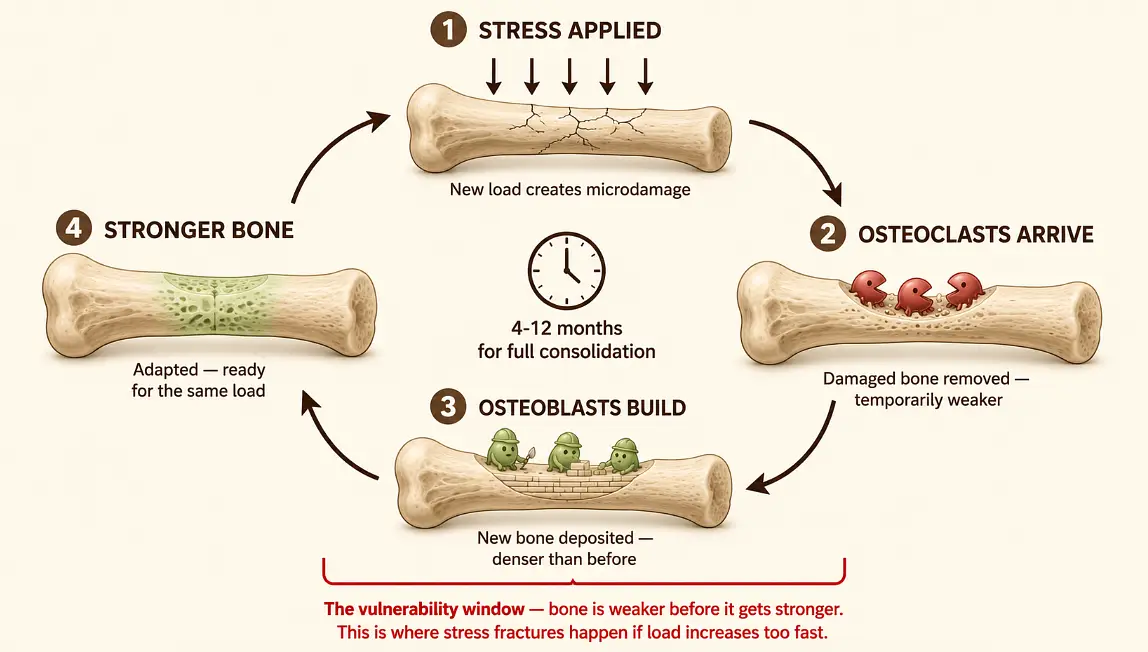
The difference between bone and muscle is that bone adaptation takes longer. Bone goes through a process called remodeling, where applied stress creates microdamage and the body sends cells called osteoclasts and osteoblasts to chew up the damaged bone and replace it with fresh, new bone. The end result is stronger bone, but the process takes time, and bones can actually get weaker before they get stronger because the damaged bone needs to be removed before it can be replaced.
If you add a new stress too quickly, microdamage accumulates faster than the body can repair it. That is when you get a stress fracture. Put on a boot, take 6 to 8 weeks off, let the osteoclasts and osteoblasts do their thing, and a few months later you are back on the road.
This is the part the Vibram study is really pointing at, even though the headlines missed it. Bone marrow edema, the thing the researchers measured, is a sign of remodeling. A little bit of edema means the bone is repairing and getting stronger. A lot of edema means the bone is working really hard to repair itself before something bad happens. The categories the researchers used (grade 1 through grade 4) are really just points on a continuous scale from normal remodeling to actual injury, and where you cross the line is genuinely uncertain.
Research on Foot Muscle Adaptation
The muscle side of the picture is actually clearer than the bone side. The original work came out of Brian Bruggemann’s group at the German Sport University Cologne back in 2005. They had athletes train in minimal running shoes during preparatory training and measured 4 to 5% increases in the cross-sectional area of selected intrinsic and extrinsic foot muscles, with significant strength increases at the metatarsophalangeal joint flexors and the ankle plantar flexors and dorsiflexors. That study is foundational. Pretty much every later paper in this area cites it.
The replication and extension work came in waves over the following decade. Miller and colleagues (including Lieberman) ran a prospective study published in 2014 in the Journal of Sport and Health Science, tracking recreational runners transitioning to minimalist shoes over several months. They used ultrasound imaging on the abductor hallucis and flexor digitorum brevis specifically and saw measurable hypertrophy in both. Chen and colleagues at Hong Kong Polytechnic took this further in 2016, looking at intrinsic and extrinsic foot muscle volume after minimalist shoe training and finding the intrinsic muscles responded particularly strongly. Chen also flagged a methodological point worth mentioning, which is that anatomical cross-sectional area is an imperfect surrogate for muscle strength. The muscles can get bigger without proportional strength gains, or vice versa, depending on how the training stresses them.
The systematic review work has caught up to this in the last few years. A 2022 review in the Journal of Foot and Ankle Research pulled together nine studies on minimalist shoe interventions. Strength gains in the plantar intrinsic foot muscles ranged from 9% to 57% depending on the protocol and duration. Muscle size gains ranged from 7.05% to 10.6%. These are MRI cross-sectional area and dynamometer measurements, not self-report. Peters-Dickie and colleagues then published a meta-analysis in Gait & Posture in 2024 that added the exercise piece. Their finding was that minimalist shoes alone produce gains, foot core exercises alone produce gains, but the combination produces larger and faster adaptations than either intervention by itself.
Putting all of this together, the muscles can come back. They just need to be loaded in a way that conventional shoes do not allow, and the loading produces real measurable gains over weeks to months. The strongest gains show up in the 12 to 16 week range, which is already longer than most popular transition protocols recommend.
The Three Timelines Problem
Here is where the Ridge study and the muscle adaptation research collide in a way that explains a lot of failed transitions.
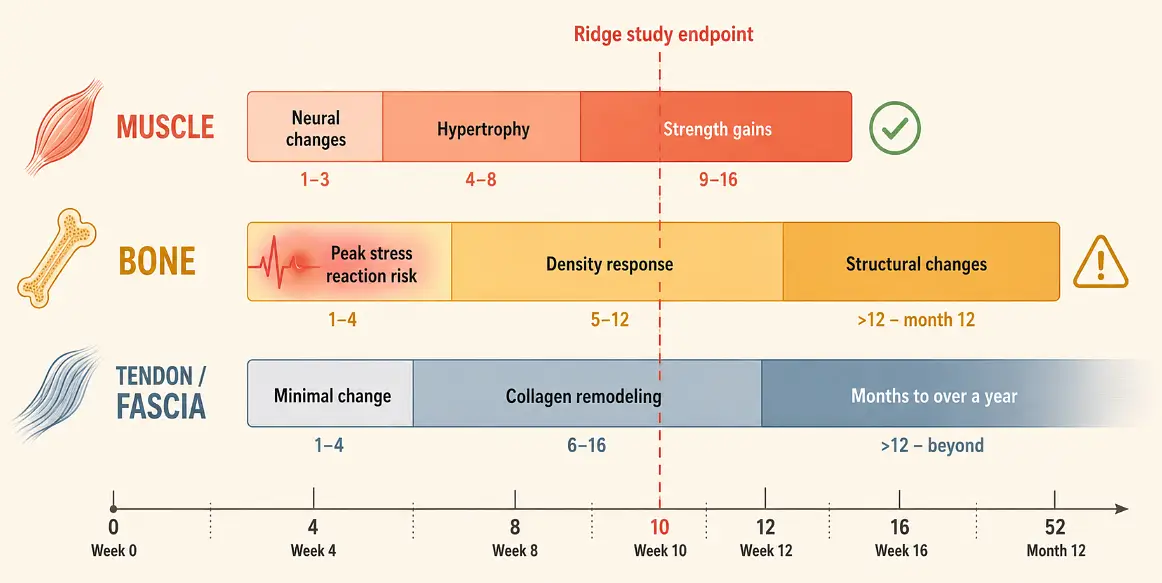
Different tissues in the foot adapt at very different speeds. This matters because most popular transition protocols are planned around the fastest one, which leaves the slower tissues exposed.
| Tissue | Early window | Meaningful adaptation | Full consolidation |
|---|---|---|---|
| Muscle (intrinsic foot muscles) | Neural changes weeks 1–3 | Hypertrophy weeks 4–8 | Strength gains weeks 9–16 |
| Bone (metatarsals, calcaneus) | Highest stress reaction risk weeks 1–4 | Density response weeks 5–12 | Structural changes 4–12 months |
| Tendon and plantar fascia | Minimal change weeks 1–4 | Collagen remodeling weeks 6–16 | Months to over a year |
Muscle adapts fastest. By weeks 4 to 8 hypertrophy is measurable, and the foot starts feeling different on the ground.
Bone runs slower. The first four weeks of increased load is the highest risk window for stress reactions because the load has gone up but the bone has not caught up. Density gains do not really start showing until weeks 5 to 12.
Tendon and fascia are slowest. Collagen turnover is a months-long process, and rushing it triggers plantar fasciitis from load mismatch.
A transition done in three weeks is loading the muscles into early adaptation while the bone is still in its peak vulnerability window and the fascia has barely started responding. The 10 week Vibram protocol the Ridge study used was sitting right inside that bone vulnerability window. The muscles were probably adapting fine. The bones were not getting enough time.
This is also probably why the Ridge findings showed up in bone but not in soft tissue. The tendons and plantar fascia held up over 10 weeks because they had not been pushed past their limit yet. The bones were closer to their limit because their adaptation runs slower than the loading was demanding.
What an Honest Transition Looks Like
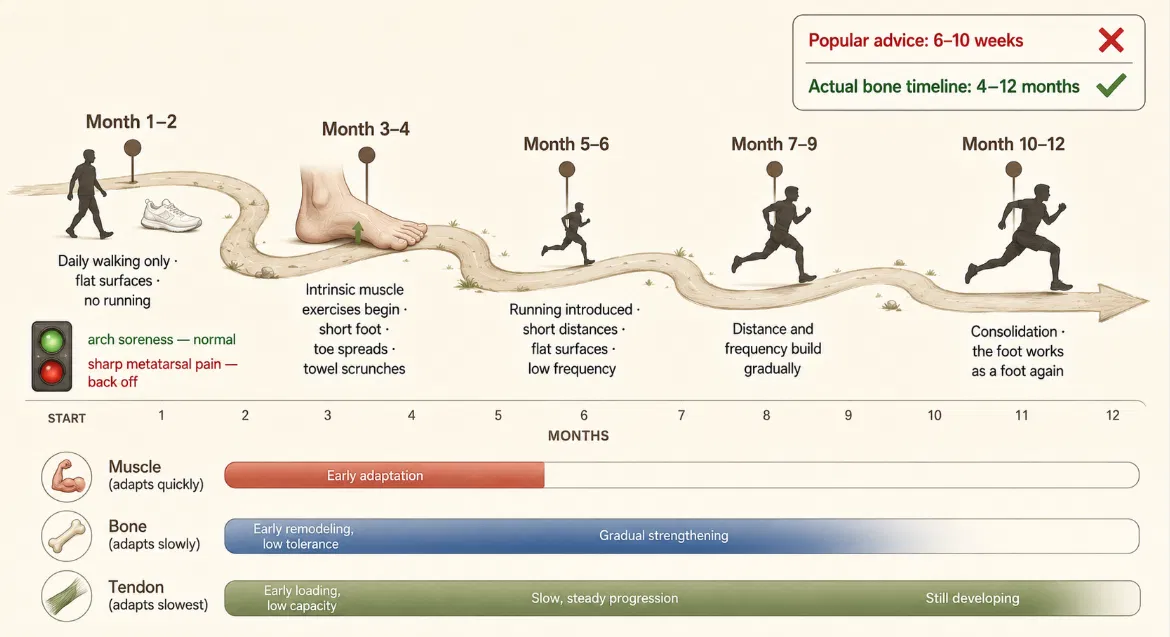
Slow it down. By a factor of three or four compared to most popular advice.
A protocol that actually respects the bone timeline looks something like this:
- Months 1–2. Daily walking in minimal shoes on flat surfaces. No running. Foot soreness in the arch and small intrinsic muscles is normal. Sharp pain in the metatarsals or heel is the signal to back off.
- Months 3–4. Increase total time on feet. Start specific intrinsic foot muscle exercises (covered in the next section). The exercises load the muscles directly, not just through the shoes.
- Months 5–6. Running can be introduced if running is the goal. Short distances. Flat surfaces. Low frequency.
- Months 7–12. Consolidation. Distance and frequency build gradually. The foot starts working as a foot again.
This is a much longer runway than most people are prepared for, and that is partly the point of writing it down. The aggressive timelines produce the failed transitions and the people who try minimal shoes for two months and then give up blaming the concept rather than the protocol. The slow timelines produce the people who actually end up in minimal shoes long term.
Exercises That Actually Target the Right Muscles
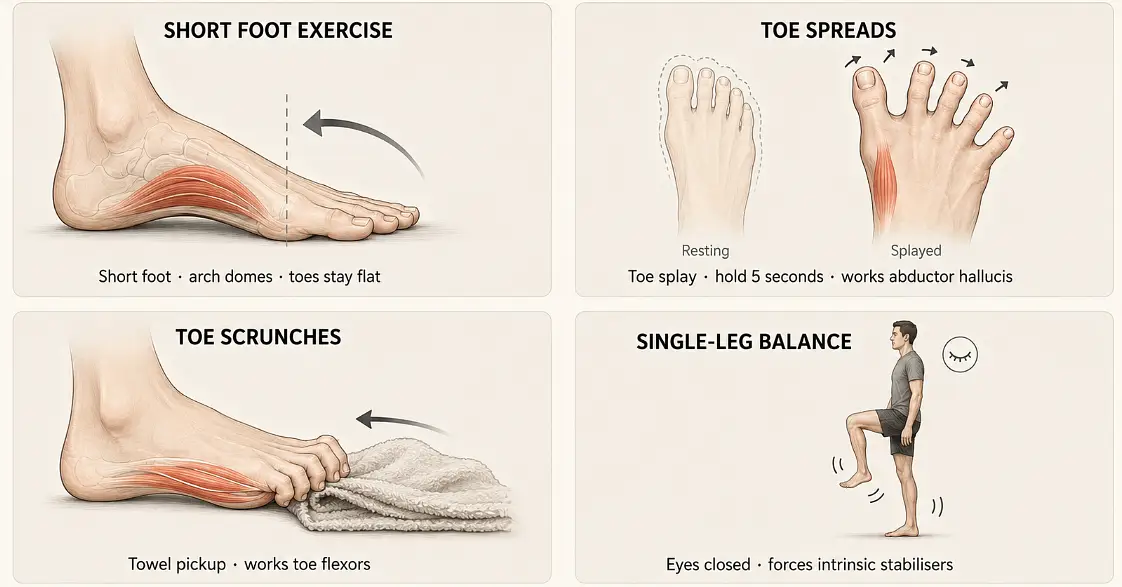
Calf raises do not really do this work. They train the calf, which was already getting trained. The exercises that target the intrinsic foot muscles directly look small and feel oddly difficult the first few times.
Short foot exercise. Standing barefoot, draw the ball of the foot back toward the heel without curling the toes. The arch should dome upward as the intrinsic muscles contract. The motion is tiny. First attempts usually produce nothing because the muscles have not been used in years. After a few weeks of daily practice the dome starts happening more easily and the foot begins to feel different on the ground.
Toe spreads. Actively splay the toes apart and hold for a few seconds. This works the abductor hallucis and the small interossei between the metatarsals.
Toe scrunches. Pick up a small towel with the toes. Works the flexors.
Single-leg balance with eyes closed. Forces the small stabilisers to fire continuously. Surprisingly hard the first few times.
The Peters-Dickie 2024 meta-analysis specifically found that exercises targeting the plantar intrinsic foot muscles increased foot strength and produced a more elevated medial longitudinal arch during running. Combined with the footwear change, the adaptations are larger and faster than either intervention alone. The shoes alone do some work. The exercises alone do some work. Combined is where the meaningful results show up.
Who Probably Should Not Attempt This
Not everyone should transition. The published studies tend to recruit healthy active populations, so they do not say this directly, but the implications are clear enough.
Hard no, at least for now:
- Active plantar fasciitis or current stress reaction
- Advanced flat foot deformity
- Severe overpronation that has produced structural changes in the foot
- Advanced foot or ankle arthritis
- Peripheral neuropathy
- Significant balance impairment
There is also a quieter group of people for whom the transition probably is not worth the effort. Someone in their sixties who has worn supportive shoes for fifty years, whose foot mechanics have structurally adapted to that support, and who is not having any specific problem with their current footwear, does not really have a compelling reason to put themselves through twelve months of adaptation discomfort. The biology is the same as for a 30 year old. The timeline is longer, the gains are smaller.
The transition makes the most sense for people who are reasonably healthy, willing to commit to a year of slow adaptation, and dealing with some specific issue they think minimal footwear might help with. Recurring plantar fasciitis from collapsed arches. Chronic ankle weakness. Or just genuine interest in how their feet are supposed to work.
So Why the Ridge Findings Make Sense
The Ridge study has been used to argue both that minimalist shoes are dangerous and that they are fine if you transition slowly. Neither read is quite right.
What the study really shows is that the popular transition timelines are too aggressive for the bones. The muscles can probably handle the protocol Vibram was recommending back in 2011, but the bones cannot, because muscle and bone adapt on different timelines and the protocol was planned around the faster one. Two thirds of the Vibram runners ended up with measurable bone stress not because Vibrams are dangerous but because the timeline was rushed for bone biology.
The muscle research from Bruggemann, Miller, Chen, the 2022 systematic review, and the Peters-Dickie meta-analysis all point in the same direction. The intrinsic foot muscles can be rebuilt. The adaptation is real, measurable, and meaningful for foot function. But it takes months, not weeks, and it works much better when targeted exercises are combined with the footwear change rather than relying on the shoes alone.
The popular advice misses both halves of this. It does not target the right muscles, and it does not give the bones enough time to catch up. The people who transition successfully tend to be the ones who slow down to match the slowest tissue (bone), load the right muscles directly through specific exercises, and treat the whole thing as a year-long project rather than a six week one.
If you are going to do this, do it right. Slow transition, targeted intrinsic foot muscle work, and an honest assessment of whether the shoes you actually want to wear long-term are worth the year of adaptation it takes to get there.