
Berberine: A Powerful Supplement with Many Benefits

Berberine’s 2,000 years of history were uneventful. It was a yellow root extract that was primarily used for stomach ailments, and very few people outside of Ayurvedic and Chinese medicine recognized it. At some point, probably around 2008, metabolic research began to accumulate, and by 2023 it was everywhere, with “nature’s Ozempic” gracing the label of every bottle of it.
Disclaimer: This article is for general information only and is not medical advice. Speak to a registered healthcare professional before starting any new supplement, especially if you are pregnant, breastfeeding, taking prescription medication, or managing a chronic condition such as diabetes, cardiovascular disease, or liver impairment.
What is Berberine?
Berberine, a bright yellow chemical compound in plants such as barberry, Chinese goldthread and goldenseal. So intense is the effect of the yellow that it has been used to dye fabrics for thousands of years before anyone could quantify its effects in the human body.
Before you read anything further about it, there is one thing that is important: berberine is poorly absorbed by the gastrointestinal tract. About 1% of what you ingest enters your blood stream. But that will not be a deal-breaker, because the compound does its work in the gut, the first-pass liver metabolism. Which is just where you want a metabolic compound to be active, don’t you?
How to Take It
The protocol that runs through most successful clinical trials is 500 mg, two to three times a day, with or just before meals.
Splitting the dose isn’t fussiness. Berberine clears the bloodstream within a few hours, so one morning dose leaves you with nothing active by the evening meal. Three smaller doses across the day track the post-meal glucose spikes the compound is meant to blunt.
A few practical notes:
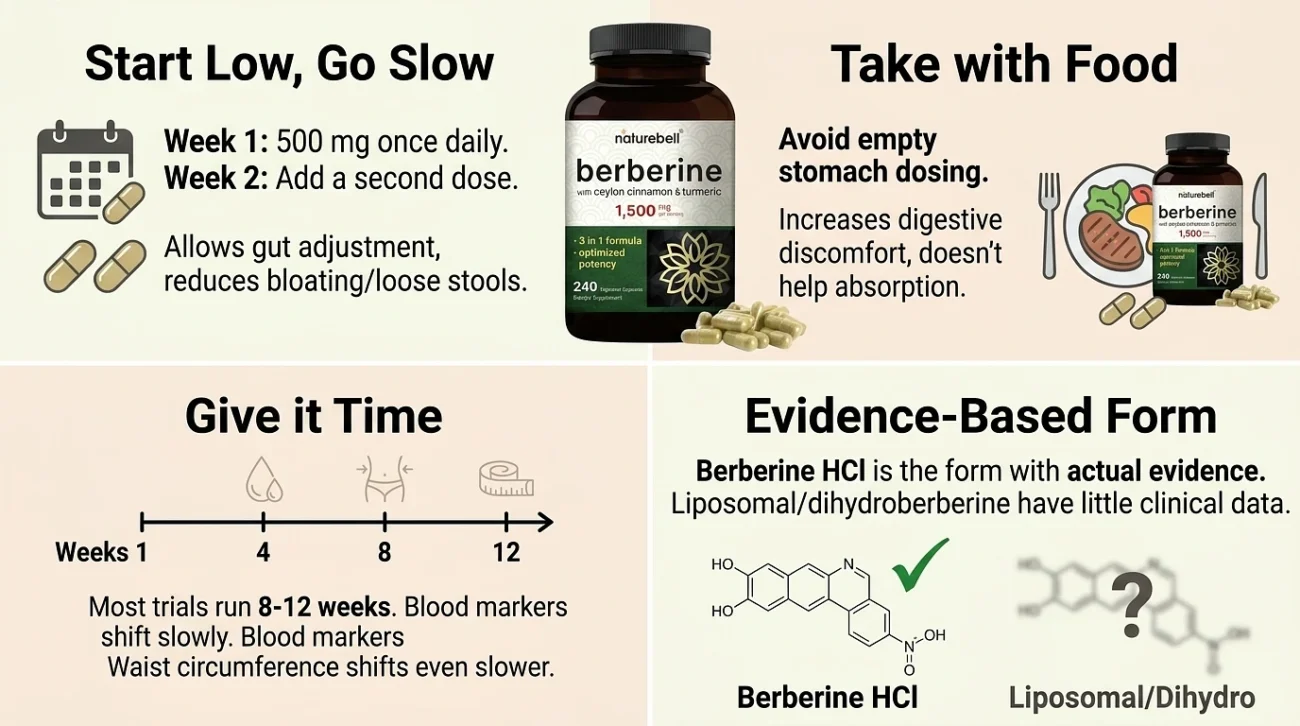
- Start low. 500 mg once daily for the first week, then add a second dose in week two. This lets your gut adjust and cuts the chance of bloating or loose stools.
- Take with food. Empty stomach dosing increases digestive discomfort without helping absorption.
- Give it time. Most trials run 8-12 weeks before measuring outcomes. Blood markers shift slowly. Waist circumference shifts even slower.
- Berberine HCl is the form with the actual evidence. Liposomal and dihydroberberine versions promise better absorption but have very little clinical data behind those claims.
How it Works
The main mechanism is AMPK activation.
AMP-activated protein kinase (AMPK) is a switch in your cells that determines whether to burn fuel or store fuel. It’s on and cells begin to burn glucose and fat as fuel. Turn it off and they store. Most metabolic diseases – such as type 2 diabetes and the cluster of problems called metabolic syndrome are characterized by the chronic underactivity of AMPK.
Berberine turns that switch on. AMPK activates catabolic pathways such as glycolysis and fatty acid oxidation, and inhibits anabolic pathways including glycogen, cholesterol and protein synthesis. The two compounds have been continually being compared in clinical research because both act on the same switch.
There’s another one too. Berberine essentially blocks the mitochondrial respiratory chain complex I contributing to its glucose-lowering effect regardless of AMPK. And a third route is along the gut microbiome, where the compound alters the composition of bacteria in the gut, favoring those that produce short-chain fatty acids that are associated with improved insulin sensitivity and reduced inflammation.
Side Effects and Interactions
Berberine is well tolerated by majority of adults. If side effects occur they are almost always digestive bloating, cramping, loose stools, sometimes constipation, and typically go away within a couple of weeks as the gut adapts.
The interactions matter more than the side effects, and they don’t get discussed enough. Berberine inhibits several cytochrome P450 liver enzymes particularly CYP3A4, CYP2D6, and CYP2C9 which between them metabolise a huge slice of prescription drugs. This means berberine can raise the blood levels of those drugs, sometimes substantially.
Situations where you should talk to a doctor before starting:
- Diabetes medication – stacking berberine with metformin, sulfonylureas, or insulin can drop blood sugar dangerously low.
- Blood thinners like warfarin – berberine can amplify the effect and increase bleeding risk.
- Blood pressure medication – additive lowering effects possible.
- Immunosuppressants like cyclosporine or tacrolimus – berberine can push drug levels too high through CYP3A4 inhibition.
- Pregnancy and breastfeeding – berberine crosses the placenta and isn’t recommended.
This isn’t generic small print. The diabetes interaction in particular has put people in hospital with hypoglycaemia. If you take any prescription drug, ask the prescribing doctor or a pharmacist first.
References
- Yu M, Han S, Wang M, et al. (2025). Efficacy and safety of berberine on the components of metabolic syndrome: a systematic review and meta-analysis of randomized placebo-controlled trials. Frontiers in Pharmacology.
- Blais JE, Tong GKY, Pathadka S, et al. (2023). Impact of Berberine or Berberine Combination Products on Lipoprotein, Triglyceride and Biological Safety Marker Concentrations in Patients with Hyperlipidemia: A Systematic Review and Meta-Analysis. Journal of Ethnopharmacology. PubMed 37183391.
- Asbaghi O, Ghanbari N, Shekari M, et al. (2023). The effect of berberine supplementation on lipid profile and obesity indices: An umbrella review of meta-analysis. Clinical Nutrition ESPEN.
- Frontiers in Pharmacology (2023). Efficacy and underlying mechanisms of berberine against lipid metabolic diseases: a review.
- Cicero AFG, Baggioni A. (2016). Berberine and Its Role in Chronic Disease. Advances in Experimental Medicine and Biology.