
How Long Does Cocaine Stay in Your System?

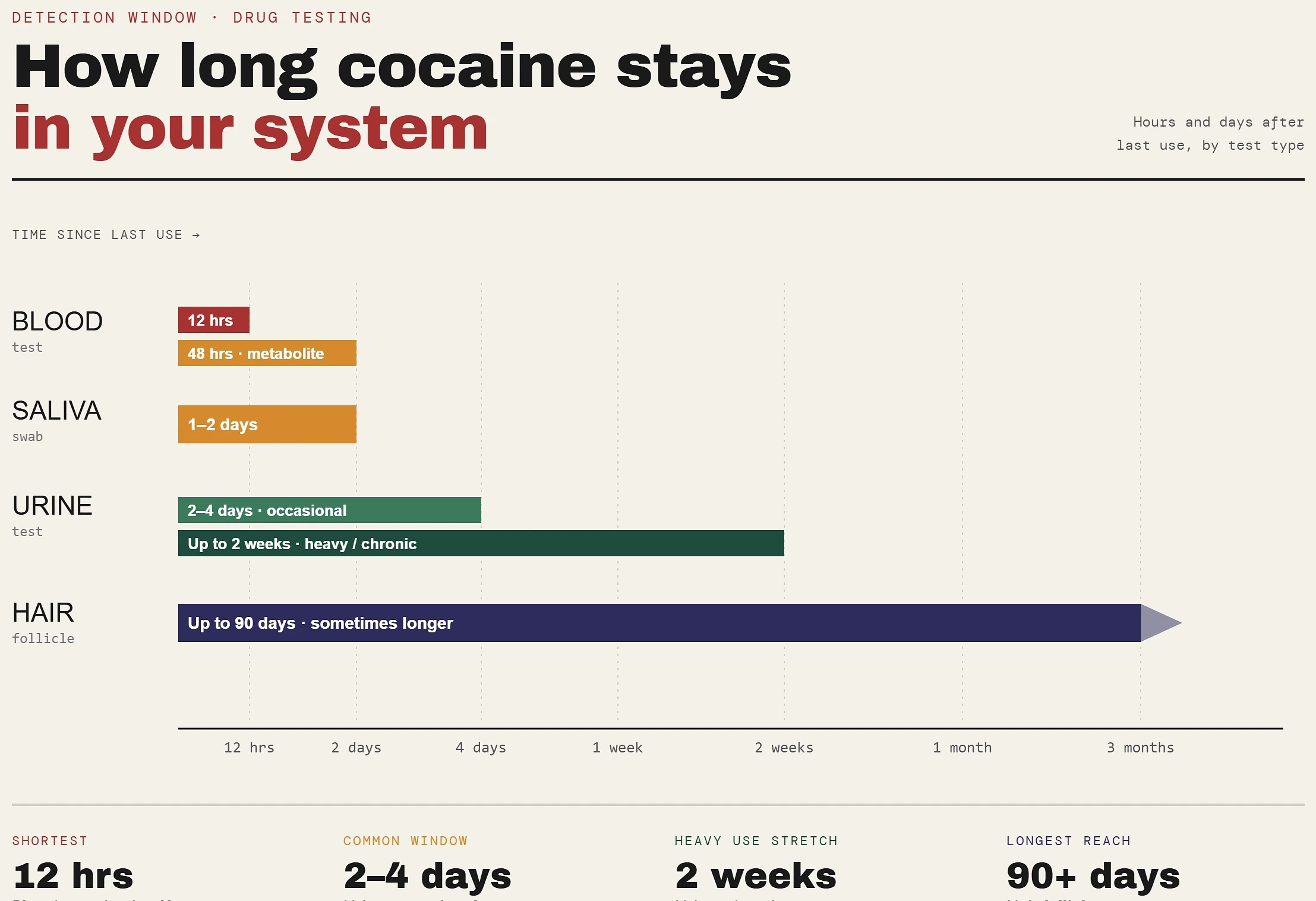
Cocaine itself leaves the blood quickly sometimes in a matter of hours. Cocaine isn’t necessarily the drug that most drug tests are looking for. They are searching for the largest metabolite formed by your liver the breakdown products of the drug but benzoylecgonine lasts in your body much longer than the original drug. How long will depend on what is being taken, how frequently, and on the type of test being used and a few factors that are unique to the individual’s body.
The Short Version
Here’s the rough map most people are looking for:
- Blood: up to 12 hours for cocaine itself, around 48 hours for benzoylecgonine.
- Saliva: 1 to 2 days after last use.
- Urine: 2 to 4 days for occasional use, up to 2 weeks for heavy or chronic use.
- Hair: up to 90 days, sometimes longer.
These are averages from clinical studies. Individual numbers vary, sometimes a lot.
What Your Body Actually Does With Cocaine
Cocaine gets broken down mostly in the liver, with smaller contributions from enzymes in the blood and the kidneys. The breakdown is quick.
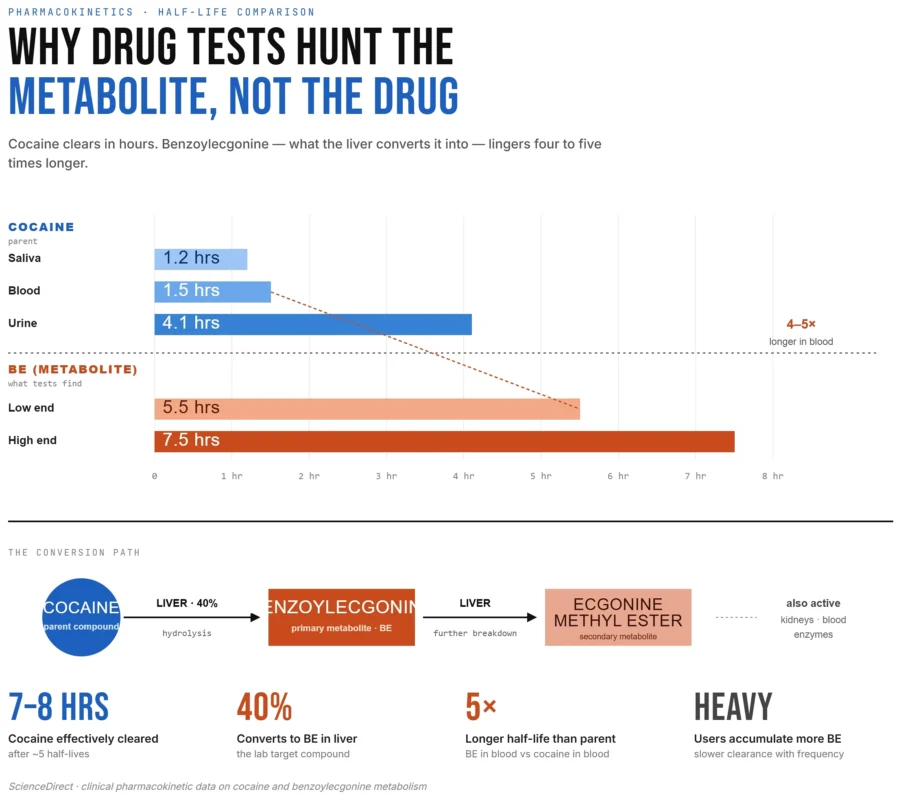
The average half-life of cocaine is about 1.5 hours in blood, 1.2 hours in saliva, and 4.1 hours in urine. Half-life is the time it takes your body to clear half of what’s in the system, and most drugs are effectively gone after about five half-lives. For cocaine, that means the parent compound is mostly cleared within 7 to 8 hours.
The reason is that people who use cocaine usually do not have any cocaine in their blood unless they have used it very recently and are being tested as a result. Most blood samples are taken after the cocaine has disappeared. Instead, labs search for what cocaine converts to.
The primary metabolite of cocaine is benzoylecgonine (BE) when it is metabolized by the liver. Some 40% of cocaine is broken down to benzoylecgonine, which is further metabolised by the liver to ecgonine methyl ester. The half-life of BE is much longer than that of cocaine, with most studies reporting 5.5-7.5 hours. BE is longer-lasting because in heavy users, it accumulates in the body and takes longer to metabolize.
Urine Testing
This is the most common drug test by a wide margin, and the one most people are asking about when they search this question.
Urine testing detects benzoylecgonine for 2 to 4 days after occasional use, but for chronic users BE can accumulate faster than the body eliminates it, extending detection windows up to 14 to 17 days with sensitive testing.
The key to the dramatic increase of the window’s size by heavy use is the principle of accumulation. The urinary excretion of benzoylecgonine is complete in 30-some hours after a single dose, so if you use more before that time has elapsed, benzoylecgonine begins to build up. The greater the usage and the more frequently you use, the further a urine test will read positive after you stop using.
There’s also a sensitivity issue worth knowing about. A 2017 study using a sensitive testing cut-off of 5 ng/mL ten times lower than the standard 100 ng/mL found that 51.9% of positive results sat below the typical industry threshold, and the detection window after stopping was 17 to 22 days.
The test threshold matters as much as your biology does. Standard workplace tests use higher cut-offs and miss low-level traces. Specialised clinical and forensic tests using LC-MS/MS can pick up cocaine use weeks after the fact.
Blood Testing
Blood tests have the shortest window of all the standard tests, which is why they’re used mostly in emergency, forensic, or accident situations rather than routine screening.
Cocaine can be detected in blood samples for about 12 hours after last use, while benzoylecgonine can be detected in blood for about 48 hours.
The compact timelapse is a plus, not a minus. In a case of chest pains or stroke, for instance, where the answer to this question has the most impact on how the hospital treats the patient, blood provides the most current and accurate picture for the hospital to consider in real time, if they are trying to determine whether the patient took cocaine in the last few hours. If you are looking at use history or employment testing, then blood is the wrong answer.
Saliva Testing
Saliva testing sometimes called oral fluid testing has become more common over the last decade. It’s harder to cheat than urine and faster to collect, which makes it attractive for roadside testing and quick workplace checks.
A urine test can directly test for cocaine within 1 to 5 hours and will detect cocaine metabolites for 2 to 4 days, while saliva detection typically runs 1 to 2 days after use.
The window is short, but the collection is observed, immediate, and very difficult to substitute or dilute. That makes it useful wherever chain of custody matters more than long-range history.
Hair Testing
Hair testing is the long memory of drug detection, and it generates the most confusion of any test out there.
Cocaine and cocaine metabolites are trapped in the hair shaft as it grows. Hair grows at about 1 cm per month a strand of hair is like a timeline with the portion closest to the scalp being the recent use, and the portion that is further from the scalp being the use that was made months ago.
Hair tests have the longest detection window, beginning at 7 to 10 days from drug use and persisting for at least 3 months, with one 2022 paper reporting evidence of cocaine in hair 6 months after use.
A few things people miss about hair testing:
- There’s a lag period. Hair doesn’t show recent use for around a week to ten days, because the contaminated hair hasn’t grown past the scalp yet.
- Cutting your hair shortens the testable window, not your actual exposure record.
- External contamination is real. Handling banknotes, being near someone smoking crack, or other environmental exposure can leave traces in hair. Decent labs wash samples to remove this, but cheap tests don’t always.
- Body hair gives different windows than head hair, sometimes far longer ones, because it grows slower and gets replaced less often.
What Changes How Long it Stays
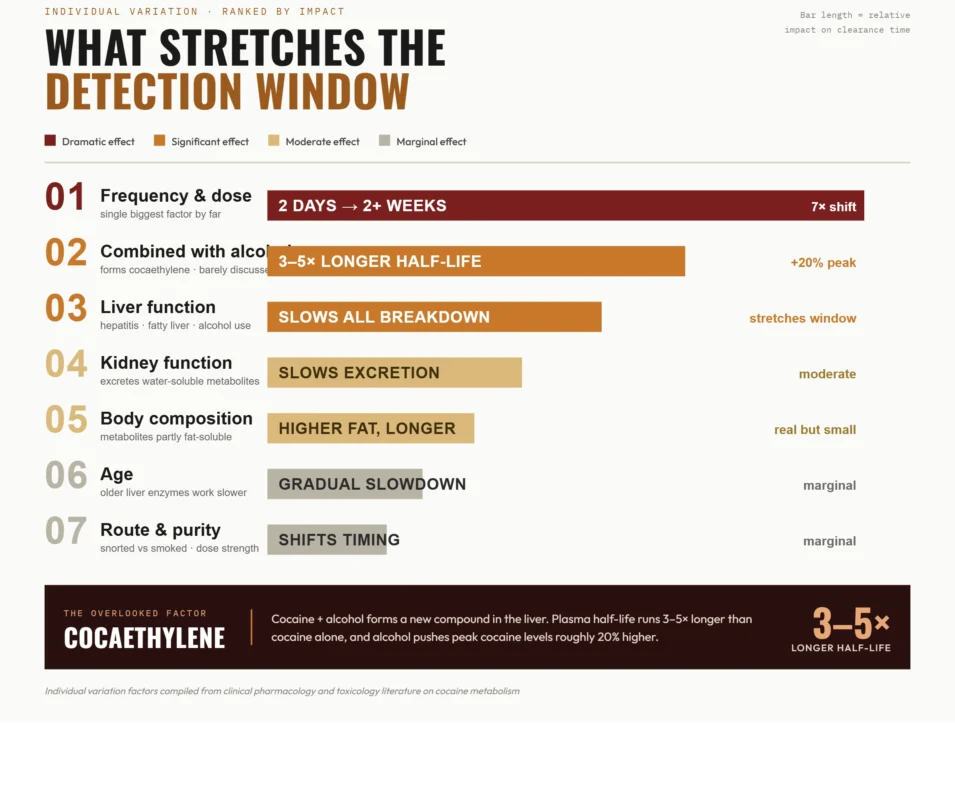
The numbers above are averages, and averages hide a lot. Several factors can stretch or shrink the window in a specific person.
- Frequency and dose. The single biggest factor by far. Someone who used cocaine once at a wedding and someone who’s used it daily for six months are clearing it on completely different timelines. Chronic users can test positive for two weeks or longer, while a one-off use might clear in 48 hours.
- Body composition. Cocaine and its metabolites are partly fat-soluble, so people with higher body fat tend to retain trace amounts longer. The effect isn’t dramatic the way it is for cannabis, but it’s real.
- Liver function. The liver does almost all of the breakdown work. Impaired liver function from hepatitis, fatty liver disease, heavy alcohol use, or certain medications slows clearance and stretches detection windows.
- Kidney function and hydration. The kidneys excrete the water-soluble metabolites. Poor kidney function slows the process. Hydration changes concentration in urine samples but doesn’t meaningfully shift how long the drug is actually in your body it can dilute a sample below the detection threshold, which is something most modern tests now check for separately.
- Age. Older adults tend to clear drugs more slowly than younger ones, mostly because of age-related changes in liver enzymes.
- Purity and route. Snorted cocaine takes longer to peak and clear than smoked cocaine, but the metabolites end up in the same place. Higher purity means a bigger effective dose, which means a longer detection window.
- Combining cocaine with alcohol. This one matters and barely gets mentioned. When cocaine and alcohol are used together, a new metabolite called cocaethylene is formed in the liver and has a plasma half-life 3 to 5 times longer than cocaine, while alcohol may also increase the peak concentration of cocaine by about 20%.
Cocaethylene is the only known instance where a new psychoactive substance is formed entirely within the body, and it is considered more toxic to the cardiovascular and hepatic systems than cocaine itself.
Can you Speed it Up?
This is the question people most want answered, and the honest answer is not really.
There are plenty of detox drinks on the internet, herbal detoxes and even detox protocols that are supposed to pass a drug test. There is no real evidence for any of them. Cocaine and its metabolites will be metabolized by your liver and kidneys, and nothing you put into your apple cider vinegar or niacin tablets or cranberry juice will change their enzyme kinetics.
The only things that actually help are obvious and slow:
- Stop using. Clearance can’t begin until exposure stops.
- Stay well hydrated. This doesn’t speed metabolism but supports normal kidney function.
- Eat and sleep normally. Extreme dieting, sweating, or sudden intense exercise can mobilise stored metabolites back into circulation short-term, sometimes raising concentrations temporarily before they drop.
- Avoid alcohol. For the cocaethylene reason above.
Drinking enormous amounts of water to dilute a urine sample is a strategy many people try and most labs now detect. Diluted samples typically trigger automatic retests or get reported as invalid.
When the Question is Gigger than a Test
If you’re reading this because you have a drug test coming up, the timelines above are what you need. If you’re reading it because cocaine use has stopped feeling controllable, that’s a different conversation and a more important one.
Cocaine addiction is known and treatable and it is those who do not think they need it who are most likely to benefit from help. Discussions with a GP, Addiction Specialist or confidential support service are a first step, not a final step.
In the UK, FRANK offers free, confidential drug information and support (0300 123 6600, talktofrank.com). Adfam supports families affected by someone else’s substance use. The NHS also provides free local drug services that can be self-referred without a GP letter.
Disclaimer: This is not a medical advice article, it is provided for information. If you or someone you know uses cocaine and you are worried then talk to a registered health care provider or a confidential drug service like FRANK (talktofrank.com) in the UK.