
Can Protein Powder Go Bad? Why Storage Heat Halves Its Shelf Life

Pull a tub down from the cupboard, twist the lid, and the smell tells you most of what you need to know before the label ever does. Protein powder doesn’t rot the way a carton of milk curdles or a piece of chicken turns. It fails quietly, through chemistry that’s been running since the day it left the factory, and the printed “best by” date is less a cliff edge than a rough marker on a slope the powder has been sliding down the whole time.
So the honest answer to whether it can go bad is yes, but “bad” splits into two very different things. One is a slow loss of the nutrition you paid for. The other, far rarer, is actual spoilage you can see, smell, or taste. Knowing which one you’re dealing with is the difference between tossing a perfectly usable tub and drinking something you should have binned.
“The expiration or use-by date indicates the time of best quality, not safety.”
What Actually Breaks Down Inside the Tub?
Two reactions do almost all the damage, and they run on different fuel.
The first is oxidation. The small amount of fat in most formulas reacts with oxygen and produces the stale, faintly cardboard-like taste that long-stored powder develops. Whey is fairly low in fat so this is slow, but hemp protein and any blend carrying added oils, nut butters, or omega-3s carries more fat and turns rancid noticeably faster regardless of how the rest of the powder is doing.
The second, and the one that matters most for whey, is the Maillard reaction. This is the same browning chemistry that colours toast, only here it’s creeping along at a glacial pace inside a sealed bag. The amino group on lysine reacts with the reducing sugars in the powder, and in whey that sugar is lactose, which sits at roughly 73% of sweet whey powder by weight against about 12% protein. That lopsided ratio is precisely why whey browns. Lysine, an essential amino acid your body cannot synthesise, gets locked up and becomes unavailable.
The reaction isn’t constant, either. It speeds up sharply in a specific moisture band, with water activity between roughly 0.60 and 0.85 being the danger zone, and the rate climbs by a factor of three to four for every 10°C rise in temperature. That temperature multiplier is the chemical engine behind everything that follows: heat doesn’t nudge the decline along, it puts it on a steeper curve.
This is also where whey and plant powders part ways. Plant-based carry no lactose, so they largely sidestep this browning route and the lysine loss that comes with it. The trade-off is fat. Some plant powders, hemp being the standout, carry far more fat than whey does, which tips them toward the oxidation problem instead. So the failure mode follows the formula: whey browns, high-fat plant powders go rancid, and any blend with added oils or omega-3s leans toward the latter regardless of its base.
This is the quiet betrayal of old whey. The tub still weighs the same, still says 24 grams of protein, but a slice of the lysine has been chemically handcuffed to a sugar and your body can’t get at it.
“Once lysine breaks down, the protein is no longer considered complete.”
How Fast Does it Really Go? Heat is The Whole Story
The clearest picture comes from a case study that tracked two batches of whey concentrate, one at 34.9 grams of protein per 100 grams and one at 76.8, stored for up to eighteen months across a range of temperatures and humidity levels.
The headline number is stark. Sealed in bags at around 70°F (21°C) with 45–65% humidity, the powder held acceptable quality for at least eighteen months. Pushed to 95°F (35°C), that window collapsed to about nine months. Same powder, same packaging, half the shelf life, bought solely with heat.
It got worse at the high end:
- The samples held at 35°C yellowed so badly that the researchers pulled them at the twelve-month mark on appearance alone, before the planned end date.
- Lysine dropped, water activity climbed, volatile off-flavour compounds formed, and the powder caked.
- The cooler samples, by contrast, showed minimal change at eighteen months.
A useful rule of thumb falls straight out of this: every extra 15 to 20 degrees of storage heat roughly halves the powder’s useful life.
The lysine loss has been measured directly too. Under normal room-temperature storage, the lysine content of whey protein has been recorded falling from 5.5% to 4.2% over twelve months. Crank the conditions and the loss accelerates hard: whey protein concentrate held at higher temperature and moisture lost up to 23% of its available lysine in just three months. Oxidation tracks the same heat curve, with whey held at around 113°F (45°C) for fifteen weeks developing clear taste changes as its fats turned, a reminder that even at storage times far shorter than the printed shelf life, sustained heat does measurable damage.
One finding from the Tunick study tends to surprise people: relative humidity was not a significant factor for most of the samples. Temperature drove the deterioration far more than moisture in the air did. That doesn’t make humidity harmless, since liquid moisture getting into the powder is a separate and serious problem, but it reframes where your attention should go. The garage matters more than the damp.
Where You Store It Matters More Than The Date on The Tub
Given all that, the practical advice almost writes itself, and it’s the opposite of how most people treat the stuff.
A tub left in a hot car boot through summer, parked next to the stove, or sitting in an uninsulated garage is ageing at the 95°F rate, racing toward that nine-month figure. The same tub in a cool interior cupboard below 70°F is on the eighteen-month track. The single highest-leverage thing you can do costs nothing: move it somewhere consistently cool and keep it out of the warm, steamy spots like the kitchen worktop by the hob, a bathroom shelf, or a gym locker.
The second thing is about keeping moisture out. Powder caking, that hard crust that won’t break up, is the visible signature of liquid moisture having got in. Keep the container sealed between uses, and if the original bag doesn’t reseal cleanly, decant the powder into an airtight container with a tight-fitting lid. The wet scoop going back into the tub is a classic way to seed a problem, so a dry scoop every time is a small habit that pays off.
Is it Gone Off, or Just Past its Prime? Your Senses Settle It
Here’s the part that saves you money and stops you drinking something genuinely spoiled. The two failure modes look completely different, and you can tell them apart without any equipment.
Quality loss, the slow kind, is essentially invisible. The powder looks, smells, and mixes normally. You’re simply getting marginally less usable lysine per scoop than the label promises. If a tub is a few months past its printed date and passes the sniff and taste check, it’s almost always fine to use. This is the overwhelming majority of “expired” protein people throw away.
True spoilage announces itself. Run through four signals:
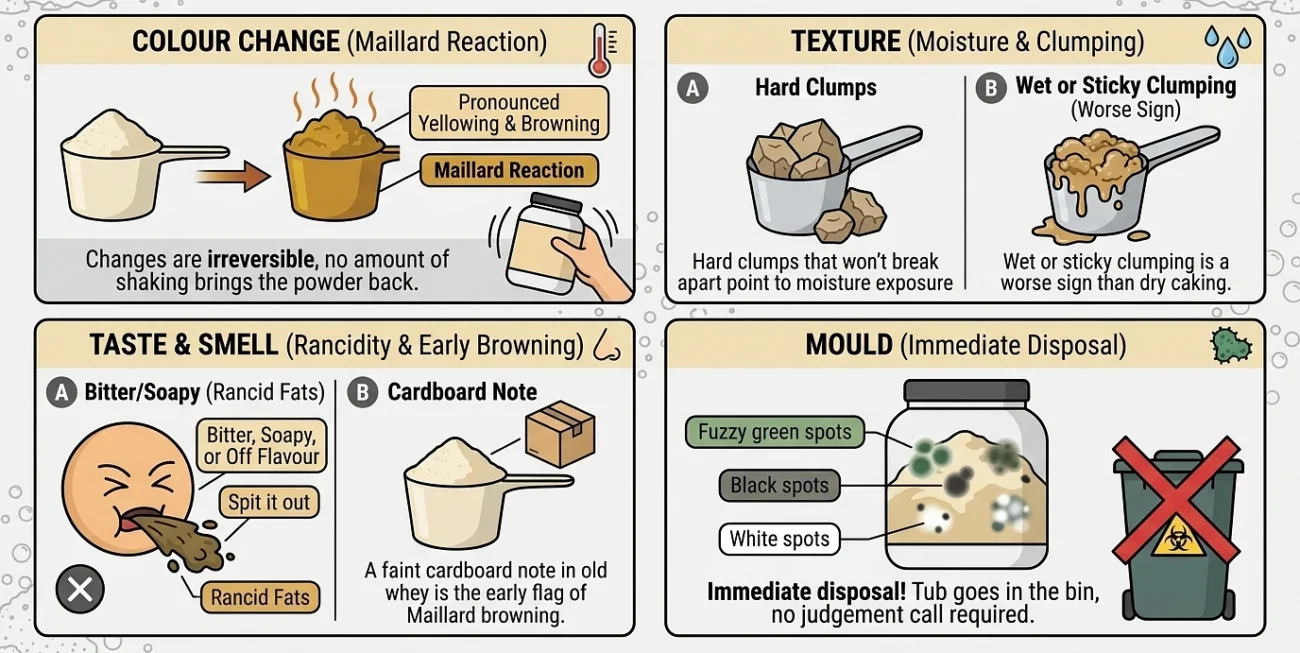
- Colour: Pronounced yellowing or browning, most visible in vanilla and unflavoured powders, means the Maillard reaction has run a long way. These changes are irreversible, so no amount of shaking brings the powder back.
- Texture: Fine, loose powder is healthy. Hard clumps that won’t break apart point to moisture exposure. Wet or sticky clumping is a worse sign than dry caking.
- Taste and smell: A bitter, soapy, or sharply “off” flavour after mixing means the fats have gone rancid. Spit it out. A faint cardboard note in old whey is the early flag of Maillard browning.
- Mould: Any fuzzy green, black, or white spots mean the tub goes in the bin immediately, no judgement call required.
The logic is simple. Yellowing and a cardboard taste signal lost nutrition rather than danger. Rancid or soapy flavours and visible mould signal something you shouldn’t drink. The first costs you a bit of protein quality; the second is the one to actually act on.
“If the powder looks, smells, and tastes normal, it is generally fine even months past the printed date.”
Protein powder can go bad, but most of the time “bad” just means it’s quietly shed some of its lysine while still being perfectly safe to drink. The chemistry that drives this, the Maillard reaction in whey and oxidation in higher-fat plant powders, runs faster the warmer the powder gets, which is why a 95°F storage spot halves the shelf life that a cool cupboard would have given you. Keep it cool, keep it sealed, keep moisture out, and trust your eyes, nose, and tongue over the printed date. A tub that looks, smells, and mixes clean is doing its job. One that’s browned hard, clumped wet, smells rancid, or shows any mould has earned its place in the bin.
References:
- Tunick, M. H., et al. “Physical and chemical changes in whey protein concentrate stored at elevated temperature and humidity.” Journal of Dairy Science, Vol. 99, No. 3, 2016.
- “Rate of Maillard Browning in Sweet Whey Powder.” Journal of Dairy Science (Saltmarch and Labuza).
- “Deciphering the impact of whey protein powder storage on protein state and powder stability.” Journal of Food Engineering, 2022.