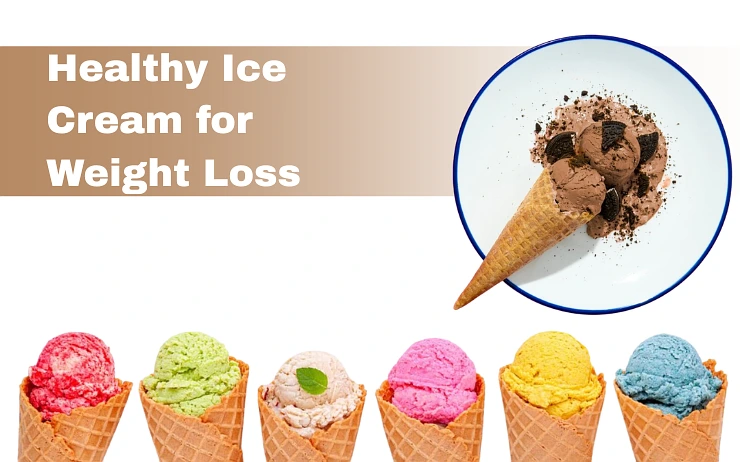
Healthy Ice Cream for Weight Loss

Key Takeaway: You don’t have to quit ice cream to lose weight you just have to pick the right kind. Healthy ice cream swaps excess sugar and fat for high protein (12–24g per serving), low-calorie sweeteners, and reduced fat, landing at 80–150 calories per serving instead of 300+. The extra protein keeps you fuller longer, burns more calories during digestion, and protects your muscle while you’re in a calorie deficit. Pair it with a balanced diet, eat it in controlled portions after meals, and you’ve got a dessert that actually supports fat loss instead of sabotaging it. No deprivation required.
You love ice cream. You also want to Weight Loss. And somewhere in between those two truths, you’ve probably been told to “just quit sugar” or “eat more salads.” But what if you didn’t have to choose? What if ice cream real, creamy, satisfying ice cream could actually work with your fat loss goals instead of against them?
That’s exactly what healthy ice cream is designed to do. Not the watered-down, sad-tasting stuff that melts into regret. We’re talking about high-protein, low-sugar, intentionally crafted frozen treats that keep your taste buds happy and your calorie deficit intact.
Why Regular Ice Cream Works Against You
A standard serving of regular ice cream about two-thirds of a cup, which is smaller than most people scoop packs roughly 250 to 350 calories, 14 to 20 grams of sugar, and very little protein. Eat it from the container while watching a show, and you’re looking at 600+ calories before you even realize what happened.
The problem isn’t just the calories. It’s the combination of high sugar and high fat with almost no protein or fiber. This combo spikes your blood sugar, gives you a brief dopamine hit, and then leaves you hungrier than before. Your body processes it fast, stores much of it as fat, and sends you back to the kitchen within an hour.
That’s why simply “eating less” regular ice cream rarely works long-term. The food itself is designed to make you overeat.
What Makes “Healthy” Ice Cream
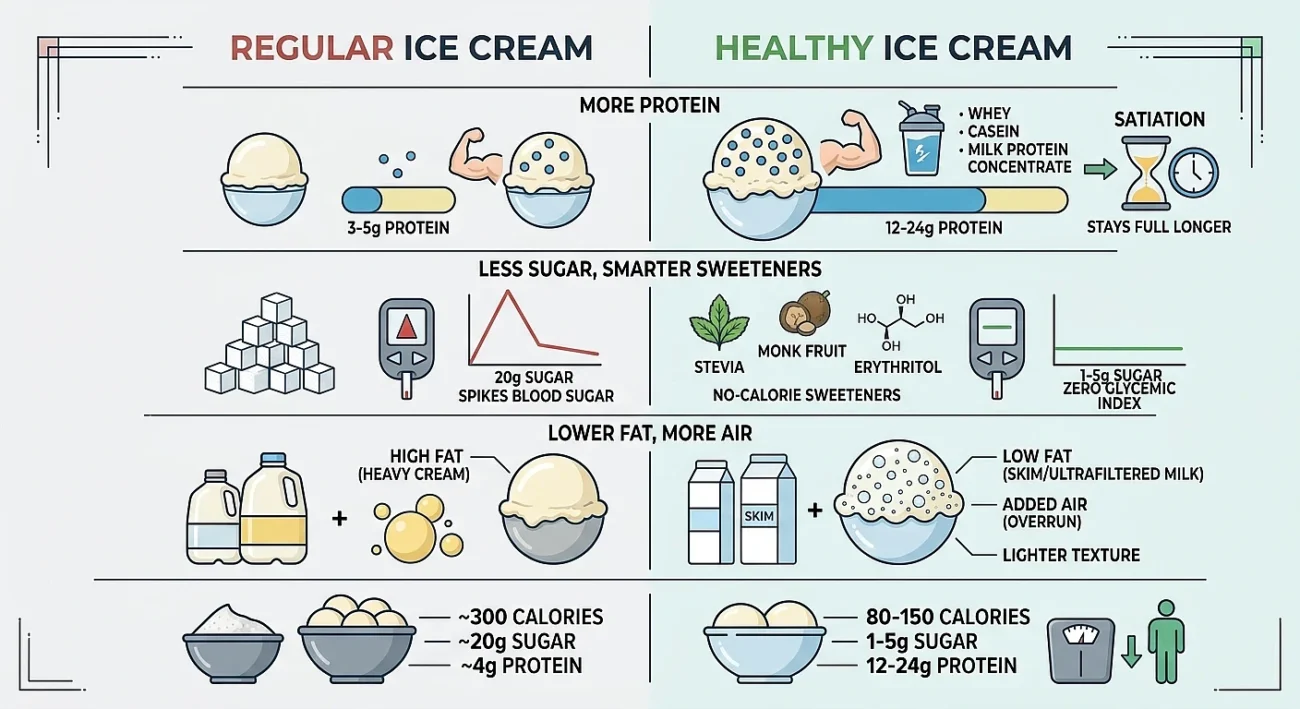
Healthy ice cream reformulates the macronutrient profile. Instead of relying on sugar and fat for flavor and texture, it uses three key swaps:
More protein. The biggest game-changer. Protein is the most satiating macronutrient it keeps you full longer than carbs or fat. A study published in The American Journal of Clinical Nutrition by Weigle et al. (2005) found that when participants increased their protein intake from 15% to 30% of total calories, their spontaneous daily calorie intake dropped by an average of 441 kcal per day, and they lost 4.9 kg of body weight over 12 weeks without being told to eat less (Weigle et al., 2005). That’s the power of protein it quietly reduces how much you eat without willpower or restriction.
Most healthy ice creams pack 12 to 24 grams of protein per serving, compared to 3 to 5 grams in regular ice cream. That protein comes from whey, casein, or milk protein concentrate all of which slow digestion and keep food in your system longer.
Less sugar, smarter sweeteners. Healthy ice creams replace table sugar with sweeteners like stevia, monk fruit, or erythritol. These provide sweetness without the calorie load. Erythritol, for example, has a glycemic index of zero, meaning it doesn’t spike blood sugar or insulin the way regular sugar does. Stevia is derived from the leaves of the Stevia rebaudiana plant and is far sweeter than sugar in tiny quantities, so very little is needed.
Lower fat, more air. Many healthy ice cream brands reduce fat content by using skim milk or ultrafiltered milk instead of heavy cream, and they whip more air into the product (called “overrun”). This cuts calorie density without making the ice cream taste thin it just becomes lighter.
The result: a serving of healthy ice cream typically lands between 80 and 150 calories, with 12 to 24 grams of protein and 1 to 5 grams of sugar. That’s a massive difference from the 300-calorie, 20-gram-sugar bomb you’d get from regular ice cream.
The Science Behind Why Protein Ice Cream Helps With Fat Loss
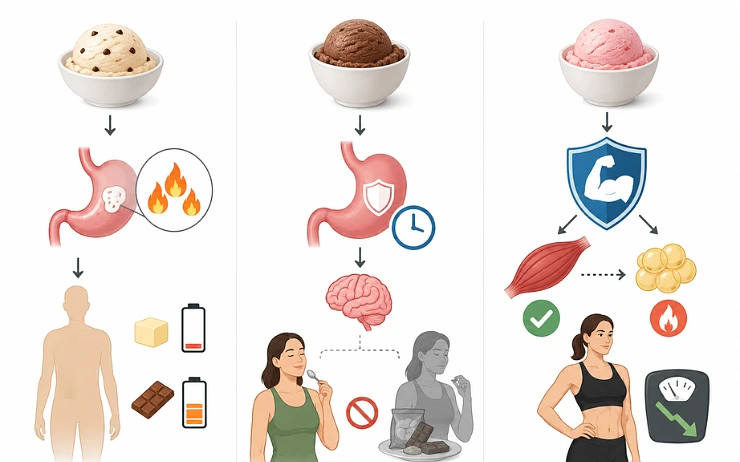
Let’s get into what actually happens in your body when you eat a high-protein frozen treat instead of a regular one.
1. Protein Burns More Calories During Digestion
Your body uses energy to digest food this is called the thermic effect of food (TEF), or diet-induced thermogenesis. Not all macronutrients cost the same amount of energy to process. A review published in Nutrition & Metabolism by Westerterp (2004) established that protein has the highest thermic effect at 20–30% of its calorie content, compared to 5–10% for carbohydrates and 0–3% for fat (Westerterp, 2004). A systematic review and meta-analysis published in Advances in Nutrition by Quatela et al. (2024) confirmed that higher protein meals consistently produce a greater thermogenic response than lower-protein meals (Quatela et al., 2024).
In practical terms: if you eat 200 calories of protein, your body burns 40 to 60 of those calories just processing it. If you eat 200 calories of fat, you burn almost none during digestion. So protein ice cream gives your metabolism a small but real boost compared to regular ice cream.
2. Protein Keeps You Full So You Eat Less Later
This is the big one. Protein triggers stronger satiety signals than carbs or fat. It slows gastric emptying, meaning food stays in your stomach longer. It also influences hormones like GLP-1 and peptide YY that tell your brain you’re satisfied.
The Weigle et al. study mentioned earlier showed that participants on a higher-protein diet spontaneously ate 441 fewer calories per day without being told to restrict. They simply weren’t as hungry (Weigle et al., 2005).
When you swap a 300-calorie regular ice cream dessert for a 120-calorie protein ice cream, you’re not just saving 180 calories on paper. You’re also less likely to raid the pantry an hour later because the protein actually held you over.
3. Protein Protects Muscle During a Calorie Deficit
When you’re eating fewer calories than you burn which is the only way to lose fat your body doesn’t just burn fat. It can also break down muscle for energy. Protein helps prevent this. Adequate protein intake signals your body to preserve lean tissue and preferentially burn fat instead.
This matters because muscle is metabolically active. The more muscle you carry, the more calories you burn at rest. Losing muscle while dieting slows your metabolism, makes it easier to regain weight, and leaves you looking “skinny fat” rather than lean and toned.
A high-protein dessert at the end of the day can help you hit your daily protein target which most nutrition experts set at a minimum of 1.6 grams per kilogram of body weight for people trying to lose fat while preserving muscle.
Homemade Healthy Ice Cream: The Best Recipes
You don’t need to rely on store-bought options. Homemade versions are cheaper, fresher, and give you full control over ingredients.
The Frozen Banana Base
One medium ripe banana has about 110 calories, 28 grams of carbs, 3 grams of fiber, and 450 mg of potassium. When you freeze and blend it, it transforms into a thick, creamy base that mimics soft-serve ice cream remarkably well.
Basic Banana Protein Ice Cream:
- 1 frozen banana, sliced
- 1 scoop (about 25–30g) vanilla whey protein powder
- 2–3 tablespoons of milk (dairy or plant-based)
Blend until smooth. That’s it. You get roughly 200 calories, 25+ grams of protein, and a texture that genuinely feels like dessert. Add a tablespoon of cocoa powder for chocolate, a handful of frozen strawberries for berry, or a tablespoon of peanut butter for something richer.
The Greek Yogurt Base
Greek yogurt is a powerhouse ingredient for healthy ice cream. A typical 170g serving of plain, nonfat Greek yogurt contains around 15–17 grams of protein and only 90–100 calories. It also delivers calcium for bone health and live probiotic cultures that support digestive health.
Greek Yogurt Protein Ice Cream:
- 1 cup plain Greek yogurt (nonfat or 2%)
- 1 scoop protein powder (any flavor)
- 1 tablespoon honey or a few drops of stevia
- Freeze in a shallow container for 2 hours, stirring every 30 minutes
This version is creamier and tangier than the banana base. It’s also higher in protein easily 35+ grams per serving.
The Cottage Cheese Base
Cottage cheese blended smooth becomes an incredibly protein-rich ice cream base. It’s mild in flavor and takes on whatever you add to it.
Cottage Cheese Protein Ice Cream:
- 1 cup low-fat cottage cheese
- 1 frozen banana
- 1 scoop chocolate protein powder
- A splash of milk
Blend everything, freeze for 1–2 hours, and scoop. You’re looking at roughly 300 calories for a generous portion, with 40+ grams of protein. This is practically a meal replacement disguised as dessert.
Store-Bought Options: What to Look For
If you prefer grabbing a pint from the freezer aisle, here’s how to read labels like a pro:
- Check the protein per serving. Aim for at least 10 grams. Below that, and you’re basically eating flavored air with sweeteners. Many brands now offer 20+ grams of protein per serving.
- Check the calorie count. Good options fall between 80 and 160 calories per serving. Some brands advertise calories per pint (like “280 calories for the whole pint”), which can be useful but always check the per-serving number too.
- Look at added sugars. Under 5 grams per serving is ideal. Some brands use sugar alcohols like erythritol, which show up on the label but don’t meaningfully impact blood sugar.
- Watch out for fiber additives. Some brands add soluble corn fiber or chicory root fiber to boost the fiber count. This isn’t necessarily bad, but it can cause bloating and gas in some people, especially in larger servings.
- Ingredient quality matters. Brands using ultrafiltered skim milk, whey protein, and natural sweeteners like stevia or monk fruit are generally cleaner options than those loaded with gums, stabilizers, and artificial flavors.
How to Fit Ice Cream Into a Weight Loss Plan

Here’s where most people get it wrong: they treat healthy ice cream like a “free food” and eat unlimited amounts. It’s not free. It still has calories. But it can absolutely fit into a fat loss plan if you approach it intelligently.
- Eat it after a meal, not as a standalone snack. Pairing your ice cream with a protein- and fiber-rich meal slows digestion further and reduces the chance of a blood sugar spike. Having it after dinner is a natural fit.
- Use it as your protein top-up. If you’ve hit your calorie target for the day but you’re short on protein, a serving of protein ice cream can close that gap while satisfying your sweet tooth.
- Don’t eat from the pint. Scoop your serving into a bowl. This sounds simple, but it’s one of the most effective portion-control strategies there is. When you eat from a container, you lose all sense of how much you’ve consumed.
- One to two servings a day is reasonable. If your healthy ice cream is 100–150 calories per serving, two servings is 200–300 calories. That’s easily manageable within most calorie budgets.
References
- Weigle, D.S., Breen, P.A., Matthys, C.C., Callahan, H.S., Meeuws, K.E., Burden, V.R., & Purnell, J.Q. (2005). A high-protein diet induces sustained reductions in appetite, ad libitum caloric intake, and body weight despite compensatory changes in diurnal plasma leptin and ghrelin concentrations. The American Journal of Clinical Nutrition, 82(1), 41-48.
- Westerterp, K.R. (2004). Diet induced thermogenesis. Nutrition & Metabolism, 1, 5.
- Quatela, A., et al. (2024). Effects of Varying Protein Amounts and Types on Diet-Induced Thermogenesis: A Systematic Review and Meta-Analysis. Advances in Nutrition, 15(12).
- Westenhoefer, J., Stunkard, A.J., & Pudel, V. (1999). Flexible vs. rigid dieting strategies: relationship with adverse behavioral outcomes. Appetite, 33(1), 69–83.
- Sairanen, E., et al. (2014). Flexibility in weight management. Eating Behaviors, 15(2), 218–224. https://pubmed.ncbi.nlm.nih.gov/24854807/