
How To Set Healthy Boundaries In Relationships
Key Takeaways
- Boundaries are personal limits, not punishments they define what’s okay and what’s not okay for you in a relationship.
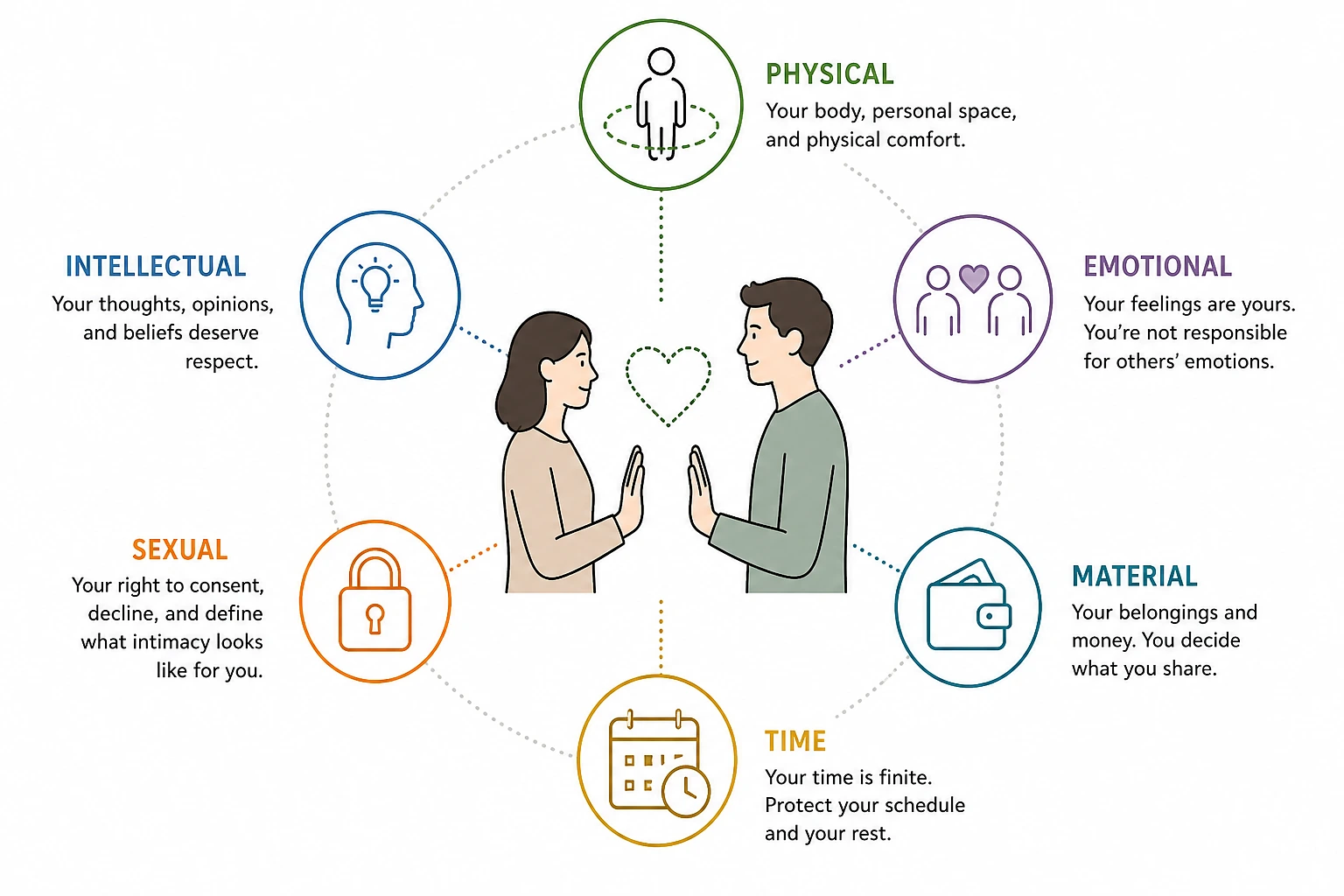
- There are six types: physical, sexual, intellectual, emotional, material, and time (Tawwab, Set Boundaries, Find Peace, 2021).
- People who can’t set boundaries face real health costs chronic stress, burnout, and resentment that erodes the relationship from the inside.
- Compassionate people are the most boundaried people research from Brené Brown shows that the kindest among us are also the firmest about their limits.
- Clear communication beats long justifications over-explaining turns a boundary into a debate.
What is Healthy Boundaries
Let’s start with a clean definition. The American Psychological Association defines a boundary as a psychological line that protects the integrity of an individual or group and helps that person set realistic limits on participation in a relationship or activity (APA Dictionary of Psychology). In plain English: a boundary is your personal “what’s okay and what’s not okay” list.
Therapist Nedra Glover Tawwab, in her New York Times bestseller Set Boundaries, Find Peace: A Guide to Reclaiming Yourself (TarcherPerigee, 2021), identifies six types of you might need to set: physical, sexual, intellectual, emotional, material, and time. Most people only think about the first one and wonder why they still feel exhausted by their relationships. You can have airtight physical boundaries and still bleed out emotionally because someone keeps dumping their problems on you at midnight.
Brené Brown, who has spent two decades researching vulnerability and human connection, puts it this way in Rising Strong (Random House, 2015) are “simply our lists of what’s okay and what’s not okay.” Simple definition. Brutal in practice.
What is Healthy Boundaries In Relationships
Your body and your relationships pay the price. People-pleasers who struggle to set limits face significantly higher risk of chronic stress and burnout, according to Harvard-trained clinical psychologist Dr. Debbie Sorensen, who explained the pattern in a 2023 CNBC Make It feature. The cycle is predictable: you say yes when you mean no, you stew in resentment, and eventually that resentment leaks out sideways onto the people you were trying to please in the first place.
Brené Brown makes a point that might surprise you in The Gifts of Imperfection (Hazelden Publishing, 2010): the most compassionate people in her qualitative research were not the doormats. As she writes in that book, “Compassionate people are boundaried people.” When you protect your energy, you have something real to give. When you don’t, all you can offer is a brittle, performative kindness that eventually cracks.
There’s hard relationship data here too. The peer-reviewed study Boundary Management Permeability and Relationship Satisfaction in Dual-Earner Couples: The Asymmetrical Gender Effect by Russo, Ollier-Malaterre, Kossek, and Ohana, published in Frontiers in Psychology in 2018 (DOI: 10.3389/fpsyg.2018.01723, examined 104 dual-earner couples and found that how partners managed the permeability of their work-family boundaries had measurable effects on relationship satisfaction.
The Six Types Of Boundaries
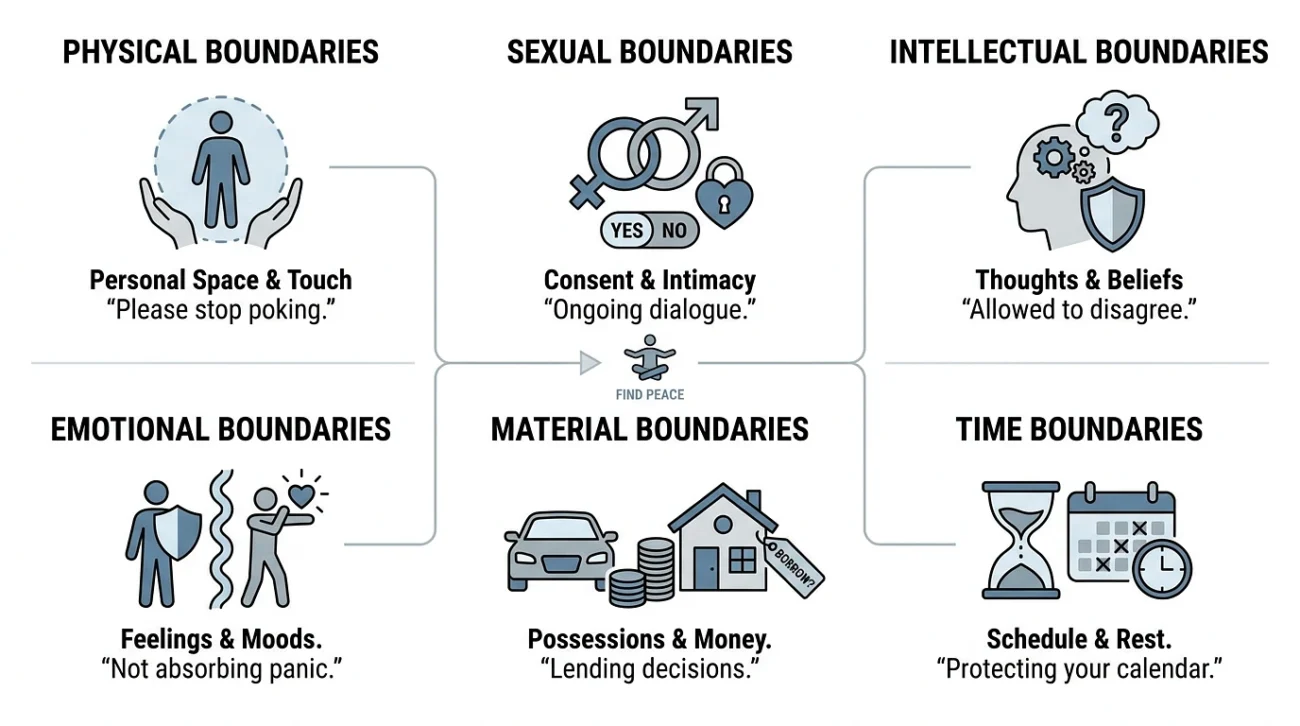
Drawing from Tawwab’s framework in Set Boundaries, Find Peace (2021), here’s where to look in your own life:
- Physical cover your body and personal space. Who can hug you, touch you, walk into your room without knocking. This is the boundary type most people are taught about, but it goes deeper than “no means no.” It includes your right to say “I don’t like being tickled” or “please stop poking me when you’re trying to make a point.”
- Sexual protect your right to consent, decline, change your mind, and define what intimacy looks like for you. They aren’t a one-time conversation. They’re an ongoing dialogue.
- Intellectual protect your thoughts, opinions, and beliefs. You’re allowed to disagree without being mocked. You’re allowed to say “I don’t want to debate this right now.”
- Emotional are about what you take on from other people. You can care about your sister without absorbing her panic. You can love your partner without becoming responsible for managing their moods.
- Material cover your stuff and your money. Who can borrow your car. Whether you lend cash to family. Whether your roommate can eat your leftovers without asking.
- Time might be the most overlooked. Your time is finite. Saying yes to one thing means saying no to something else, even if that something else is rest. Protecting your calendar isn’t selfish. It’s basic math.
The Quiet Signs You Need Better Boundaries In Relationships
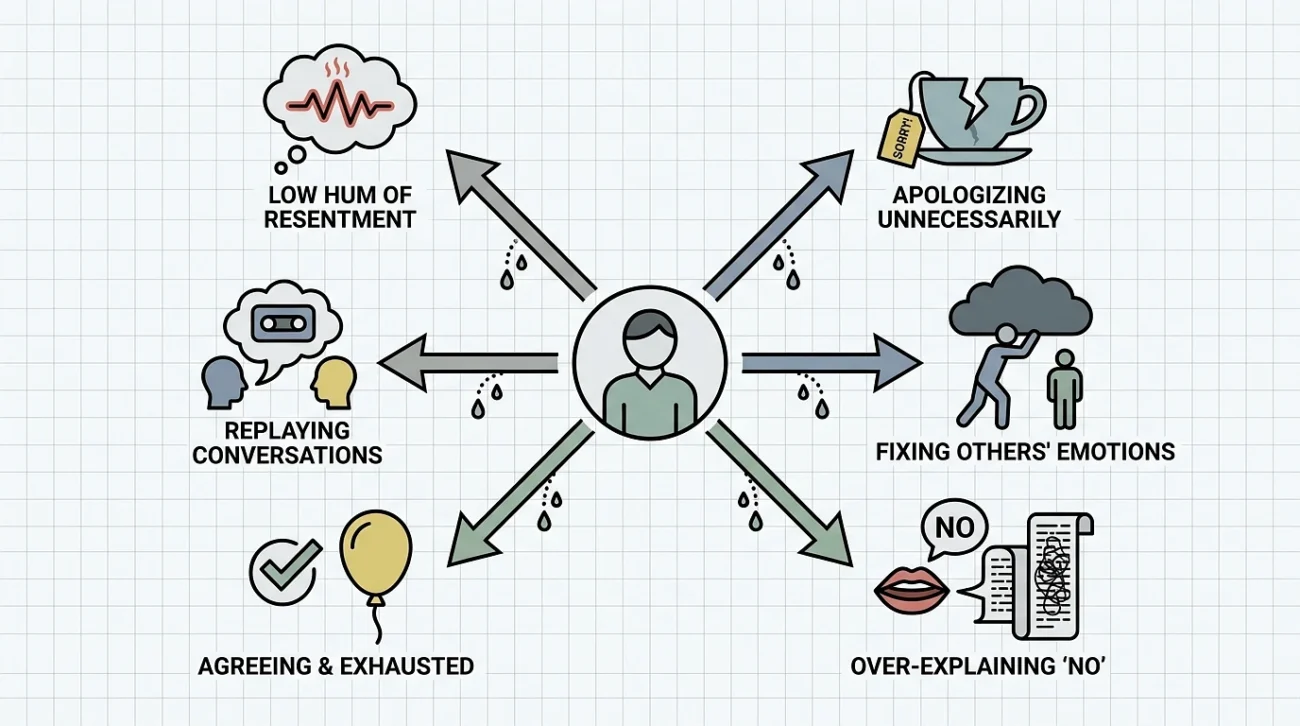
Most of us don’t realize we have a boundary problem until we’re already deep in burnout. Watch for these patterns:
- A low hum of resentment toward someone you love.
- Replaying conversations in your head, arguing your case to no one.
- Agreeing to plans and immediately feeling exhausted.
- Apologizing for things that aren’t your fault.
- Feeling responsible for other people’s emotions, like their bad day is somehow your job to fix.
- Struggling to say “no” without explaining yourself for ten minutes.
In her 2013 Oprah.com essay “3 Ways to Set Boundaries”, Brené Brown described the resentment piece beautifully she’s most resentful when she’s tired and overwhelmed, which is to say, when she’s not setting. Resentment is data. It’s your nervous system telling you a line has been crossed, even if your conscious mind hasn’t named it yet.
How To Actually Set A Boundary (Without Burning The Relationship Down)
Here’s where theory meets the messy real world. Setting a boundary isn’t a single dramatic conversation. It’s a skill you build.
Start With Yourself
Before you can communicate a boundary, you have to know what it is. Spend a week noticing where you feel resentful, exhausted, or “off.” Those moments are clues. Write them down without judgment. The point isn’t to villainize the other person. It’s to figure out what you need.
Be Direct, Be Kind, Be Brief
The single biggest mistake people make is over-explaining. If you justify your boundary with a fifteen-minute speech, you’ve turned it into a debate. Other people will negotiate. Don’t give them the floor.
Instead of: “I’m so sorry, I just have so much going on this week, I’d love to come but my work has been crazy and I’m just totally drained, maybe next time?”
Try: “I can’t make it, but thank you for thinking of me.”
That’s it. No apology required. No medical note from your therapist.
The peer-reviewed study Predicting Divorce among Newlyweds from the First Three Minutes of a Marital Conflict Discussion by Carrère and Gottman, published in Family Process in 1999 (Vol. 38, Issue 3, pp. 293–301, found that the way a couple opens a difficult conversation in its first three minutes can predict divorce six years later. Tone and clarity at the start matter enormously. Vagueness breeds conflict. Clarity is a gift.
Use “I” Statements, Not Accusations
“You’re always on your phone at dinner” puts the other person on defense. “I feel disconnected when we’re both on our phones during dinner. Can we keep them in the other room?” invites collaboration. Same boundary. Completely different outcome.
Expect Pushback (And Don’t Take It Personally)
The people who benefited from your lack of them will get loud. They might call you selfish. Distant. Different. This isn’t proof you’re wrong. It’s proof the boundary was needed.
In Atlas of the Heart (Random House, 2021, Brené Brown surfaces a phrase her organization lives by: “Clear is kind. Unclear is unkind.” The kindest thing you can do is be honest about what you can and can’t offer. Letting someone believe you’re available when you’re not isn’t generosity. It’s a slow betrayal of both of you.
Hold The Line, Repeatedly
A boundary isn’t a one-time announcement. It’s a practice. You’ll have to restate it. You’ll feel guilty. You might wobble. That’s normal. The first time you say “I don’t take work calls after 7 p.m.” won’t stick. The fifth time, it might. Consistency is what teaches people the rule is real.
References
- Brown, B. (2010). The Gifts of Imperfection: Let Go of Who You Think You’re Supposed to Be and Embrace Who You Are. Hazelden Publishing.
- Brown, B. (2015). Rising Strong. Random House.
- Brown, B. (2021). Atlas of the Heart. Random House
- Carrère, S., & Gottman, J. M. (1999). Predicting Divorce among Newlyweds from the First Three Minutes of a Marital Conflict Discussion. Family Process, 38(3), 293–301
- Russo, M., Ollier-Malaterre, A., Kossek, E. E., & Ohana, M. (2018). Boundary Management Permeability and Relationship Satisfaction in Dual-Earner Couples: The Asymmetrical Gender Effect. Frontiers in Psychology, 9, 1723
- Smith, M. (2023). “People-pleasers are at a higher risk of burnout, says Harvard-trained psychologist.” CNBC Make It
- Tawwab, N. G. (2021). Set Boundaries, Find Peace: A Guide to Reclaiming Yourself. TarcherPerigee.