
ICD 10 CVA: How to Accurately Code Cerebrovascular Accidents
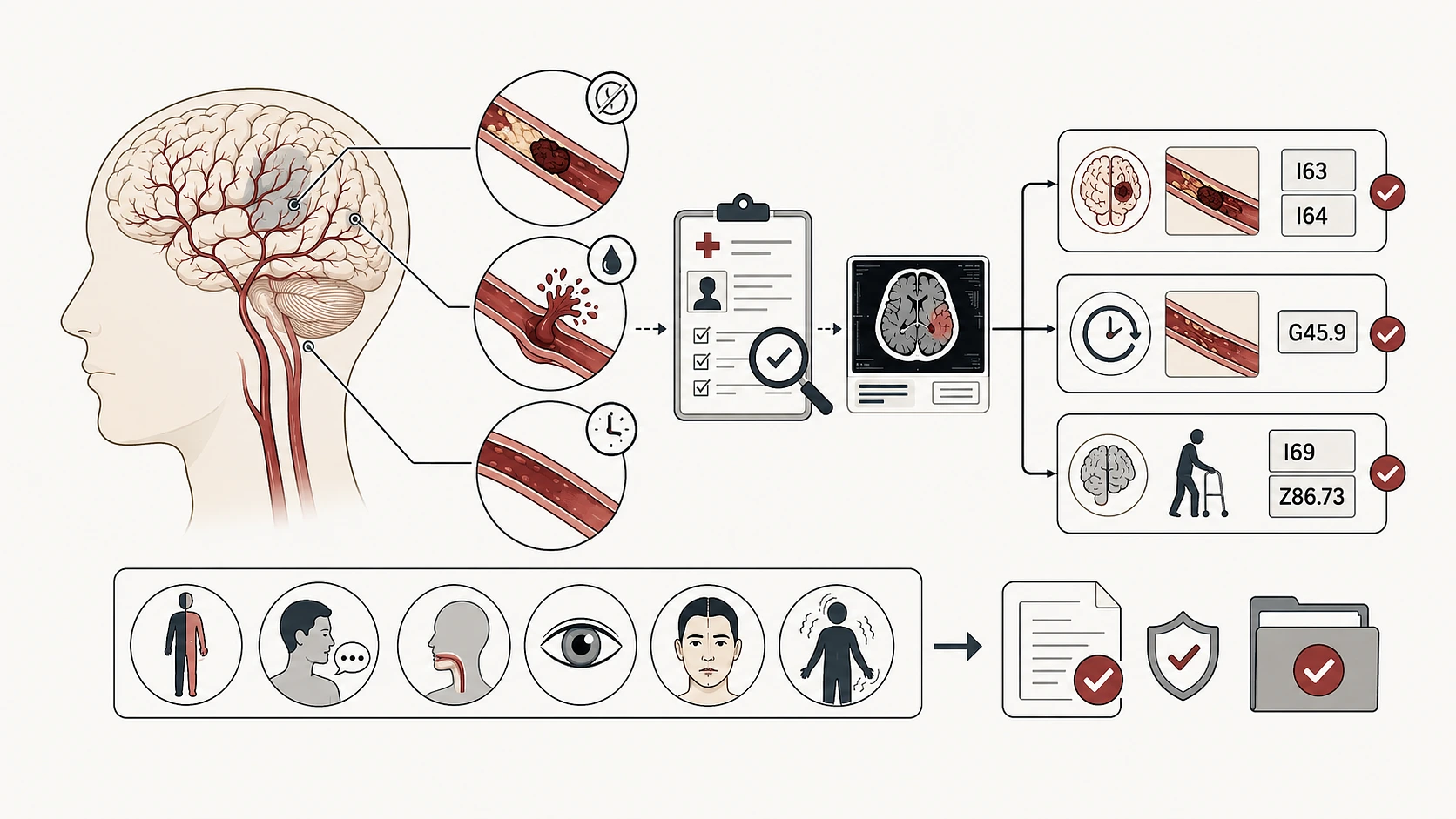
When looking up the ICD-10 code for a stroke (CVA), the main category you’ll usually use is I63, which covers cerebral infarctions. From there, the exact code gets more specific depending on the exact type of stroke and where it happened in the brain.
A TIA is Coded G45.9 From The Nervous System Stroke Codes
Worth settling first because it surprises people.
CVA lives circulatory, TIA lives nervous system. A transient ischemic attack is G45.9, and ICD-10-CM treats it as its own diagnosis rather than a lesser version of a stroke.
Coders who think of a TIA as “a small stroke” go looking in the I63 neighborhood and find nothing that fits, which is exactly the intended result.
I63 Covers The Ischemic Strokes, I60 Through I62 Cover The Bleeds
Once a stroke is confirmed, the chart has to say what type before you can code it properly.
- I63 Cerebral infarction. Clot or blockage. The busiest category in the range by a wide margin.
- I60 Nontraumatic subarachnoid hemorrhage. Bleeding around the brain surface, usually a ruptured aneurysm or AVM.
- I61 Nontraumatic intracerebral hemorrhage. Bleeding into the tissue itself, subdivided by location.
- I62 Other nontraumatic intracranial hemorrhage.
- I65 and I66 Occlusion or stenosis of cerebral and precerebral arteries with no infarction. Different animal entirely.
I63.9 is where you land when the record confirms an infarction but never names the vessel or mechanism.
I64 is Correct When Could Determine The Type
I64 means stroke not specified as hemorrhage or infarction, and it gets used far more often than it should.
The guidelines are direct about this. If the type can be determined from documentation or imaging, a specific code from I63 or I60 through I62 has to be assigned instead. I64 survives only when the type truly cannot be established after reviewing everything available.
Here is the practical version. A CT report in the chart showing infarction makes I64 wrong, even when the discharge summary says nothing but “ICD 10 CVA”. That is a query, not a coding decision you get to make alone.
Deficits Get Their Own Codes On an Acute Stroke
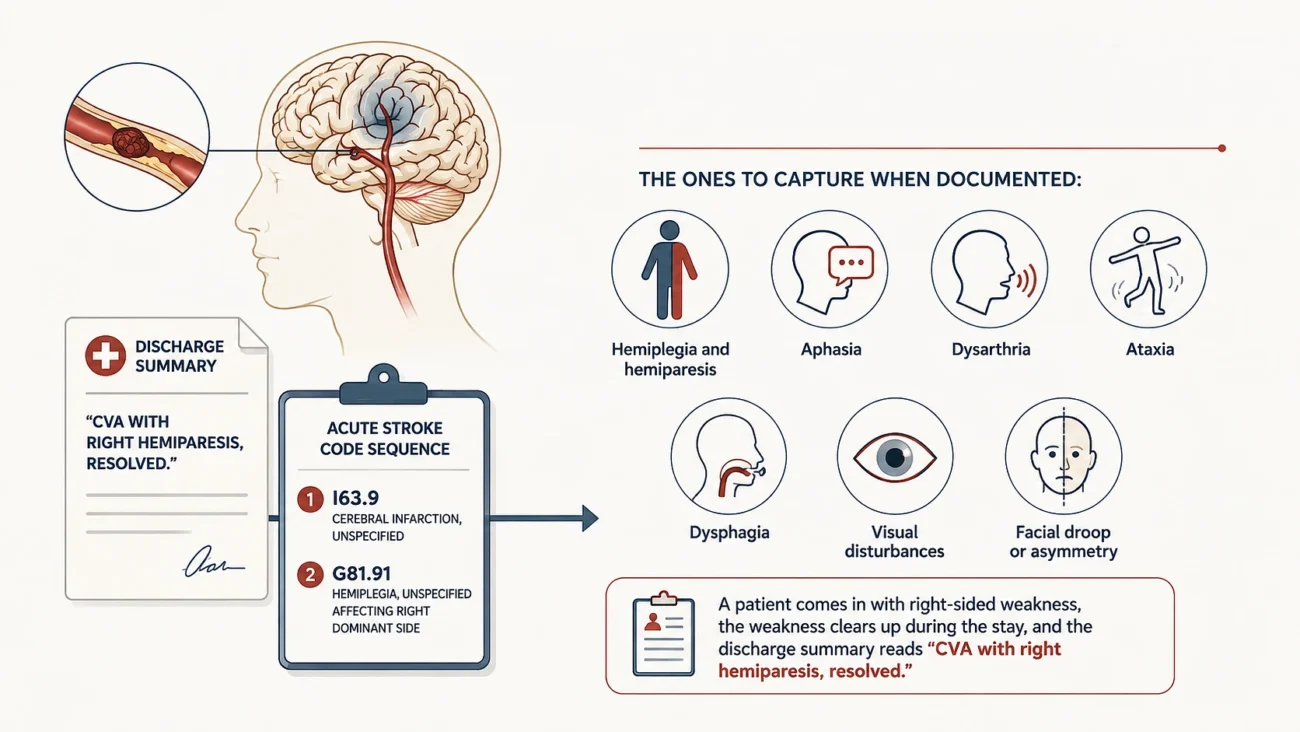
Hemiplegia turns up alongside stroke constantly, and it is not baked into the I63 code. When an acute stroke caused it, you assign the infarction code first and follow it with the deficit code.
The ones to capture when documented:
- Hemiplegia and hemiparesis
- Aphasia
- Dysarthria
- Ataxia
- Dysphagia
- Visual disturbances
- Facial droop or asymmetry
Now the part that generates arguments in coding departments. A patient comes in with right-sided weakness, the weakness clears up during the stay, and the discharge summary reads “CVA with right hemiparesis, resolved.”
You still code it.
The brain injury underneath is permanent whether or not the weakness stuck around. That deficit shaped the care during the admission, the resources used, and the discharge planning, and it may come back. None of that becomes untrue because the patient walked out steadily.
One caveat that matters for your compliance more than for your code selection. The provider has to have documented the deficit and tied it to the stroke. Auditors are looking for that link on the page, not for a coder’s reasonable clinical inference.
A TIA Gets One Code And Nothing Else
The opposite rule, for the opposite reason.
Nothing permanent happened. The symptoms resolved fully, so they had no bearing on long-term care, treatment planning or resource use. Leave them uncoded.
Transient weakness or numbness, temporary speech or vision changes, brief confusion or dizziness, a short-lived facial droop. All of it stays off the claim.
Two Identical Presentations Produce Two Different Code Sets
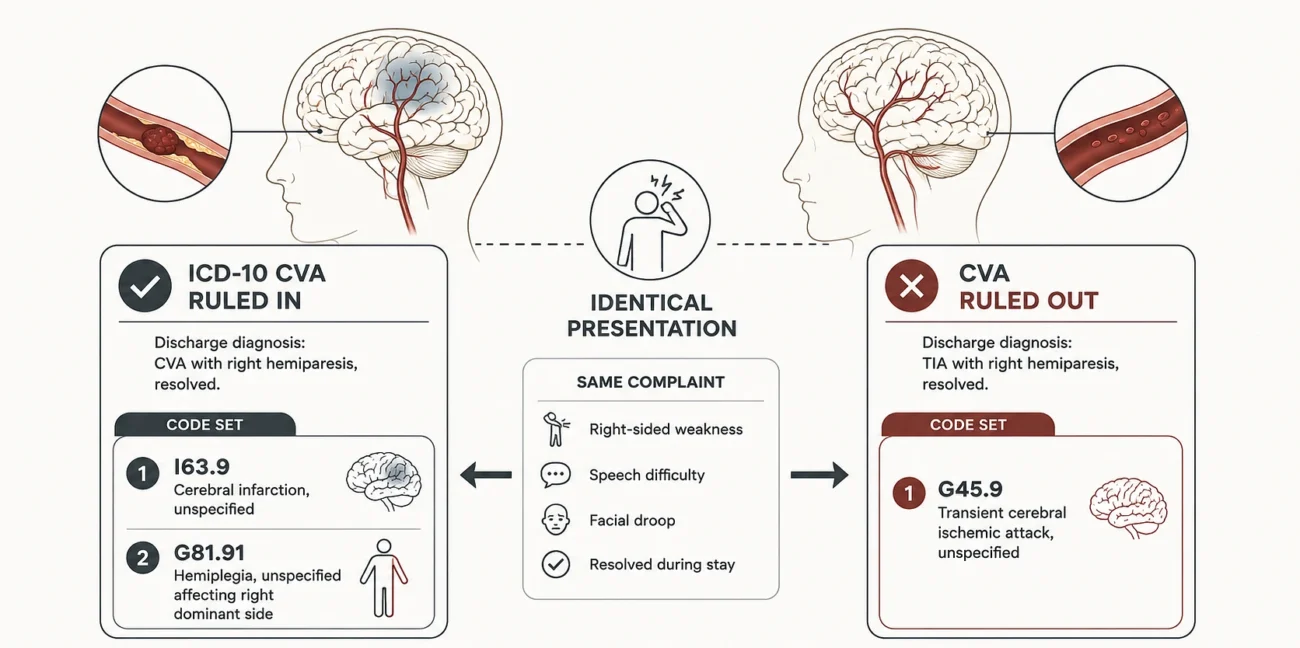
Same patient, same complaint, different workup result.
ICD-10 CVA ruled in. Discharge diagnosis: CVA with right hemiparesis, resolved.
- I63.9 Cerebral infarction, unspecified
- G81.91 Hemiplegia, unspecified affecting right dominant side
CVA ruled out. Discharge diagnosis: TIA with right hemiparesis, resolved.
- G45.9 Transient cerebral ischemic attack, unspecified
Two codes against one. The presenting complaint was word-for-word the same in both charts.
I63 Stops Being Correct The Encounter is About Residuals
Using I63 at follow-up visits is among the top audit findings in stroke coding, and it is an easy habit to fall into because the diagnosis feels ongoing.
I63.x belongs to the active treatment of the stroke. Once you are coding an encounter about what the stroke left behind, you move to I69, sequelae of cerebrovascular disease.
Two things about I69 people get wrong:
There is no clock on it. Residuals can be coded as sequelae at any point after the causal event, and a stroke from last Tuesday counts if the encounter is about the leftovers.
A rehab or post-acute facility receiving a transfer for continued stroke heath care assigns I69, not the acute code. That feels wrong to coders who see a stroke that happened four days ago, and it is nonetheless correct.
I69 is built by causing event, then deficit. I69.3 is the cerebral infarction branch, with I69.31 for cognitive deficits, I69.32 for speech and language deficits, and so on, plus side and dominance.
Z86.73 And I69 Can Never Appear Together
Z86.73 is personal history of TIA and cerebral infarction without residual deficits. It also covers history of PRIND and RIND.
The tabular list sets it as an Excludes1 against I69, meaning the two are mutually exclusive by rule. Either the patient has residuals, which is I69, or the patient does not, which is Z86.73.
Both on the same claim is a contradiction the edits will catch.
The stroke coding that survives an audit is rarely the clever coding. It is the coding where somebody read the imaging report before choosing between I63 and I64, and where somebody noticed the encounter was about a walker rather than about a clot.