
Small Avocado Calories: Accurate Count Without Skin or Stone

Quick Summary
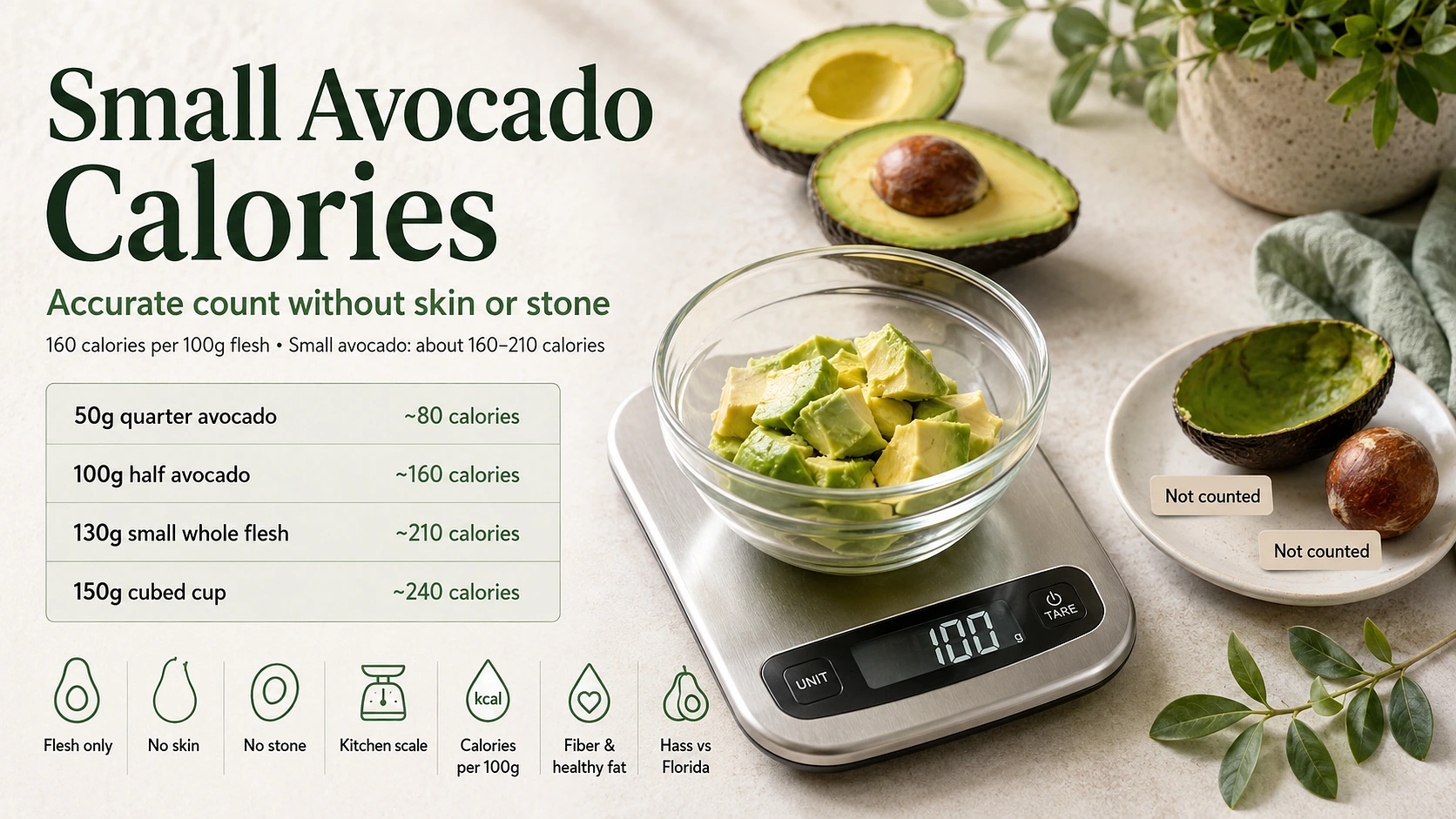
A properly sized avocado, no skin, no stone, contains about 160 to 210 small avocado calories, a good range of natural variation in the amount of edible green flesh contained within the “small” fruit. The good old 160 calorie figure per 100g raw flesh is found by almost every USDA data source, and a quarter avocado (50g) equals nearly 80 cal, a half avocado (100g) equals nearly 160 cal, and a little avocado (130g) equals almost 210 cal. The bulk of those calories are from the heart-healthy monounsaturated fat oleic acid, which is also found in olive oil, and a substantial amount of fiber, which reduces the carbohydrates to about 3 grams and makes the fruit a true satiating food. Variety is also important: Hass is the fatter, creamier standard; Florida avocados have about 25 percent less fat. The best way to avoid guesswork is to measure the flesh in grams first, before sloshing it around in the bowl or slicing it. The weight of the skin and stone should not be added to the flesh’s weight.
How to Actually Get an Accurate Count
The way to do it is the non-sweety way: scoop the flesh, place it on the digital kitchen scale and weigh it; before you mash and slice it, mash and slice it. Then multiply 1.6 calories per gram for Hass flesh and you’ll never be far off the mark again.
Counting by grams rather than by “half an avocado” or “one small one” also sidesteps the seed-and-peel problem entirely, since you never include them in the first place. If you want to confirm figures for a specific variety or cross-check against an official source, the USDA FoodData Central database is the cleanest reference, and it’s free.
The short answer: If you have enough flesh in your avocado, it's about a 160 to 210 calorie serving, but it's primarily heart-healthy fat, and the only way to know is a five-second weigh-in.
The Number That Actually Matters: 160 Calories Per 100 Grams
Remove all the marketing mumbo-jumbo and the portion-size estimating, and almost everyone’s reliable database concurs with a single anchor number. A 100g of raw avocado flesh contains approximately 160 calories. According to the USDA data, entered into the site FatSecret, the answer is that. According to the NutritionValue.org per 15 gram figure, that’s the same spot. A pooled review of Hass avocado composition estimates slightly higher, about 167 per 100 grams of pulp, which means that the true value for this base unit is roughly 160 to 167, rather than 167.
The number you get per 100g is that baseline number. From there, it’s just arithmetic: everything else, quarter, half, whole small fruit. And weight is where most people go wrong.
Why “Small” Isn’t a Useful Measurement
A whole Hass avocado, skin and stone included, often weighs 150 to 200 grams. Call something “small” and you might be holding 120 to 160 grams total. But the skin and the pit contribute zero edible while still adding mass so weighing the whole fruit and looking up “one avocado” inflates your count.
Generally about 60 to 70 per cent of the total weight is edible flesh, but this proportion varies from variety to variety and from ripe to unripe. An avocado that is measured directly after the flesh is stripped away from the average-sized avocado found the flesh in an average-sized avocado is approximately 100 grams, and large avocados are about 125 grams of flesh. So, in reality a small whole avocado is 100 to 130 grams of green flesh which in itself is roughly 50 calories. That is one reason for the difference in opinion you find on the internet.
Here’s how the math shakes out across common portions of edible Hass flesh:
| Portion (flesh only) | Approx. weight | Calories |
|---|---|---|
| Quarter avocado | 50 g | ~80 |
| Half avocado | 100 g | ~160–167 |
| Small whole avocado | 130 g | ~208–210 |
| One cup, cubed | 150 g | ~240 |
For comparison, a USDA-listed Mission fruit, at 136 grams, contains 227 calories; once beyond that 130 gram mark, you’re past “small”.
The Macros Behind Those Calories
Avocados are unusual. A lot of the calories in most fruit come from sugar; the in an avocado come from fat, which is why the number is high when compared to other fruits such as an apple. If you eat 100 grams of flesh, you will get about 15 grams of fat, 8-9 grams of carbohydrate and 2 grams of protein.
The fat number is worth checking out before it turns off any potential buyers. Most of it consists of monounsaturated fat called oleic acid, which is the same heart healthy fat found in olive oil a dietary staple. There are approximately 15 grams of monounsaturated fat, 4 of polyunsaturated and about 3 grams of saturated fat in a medium Hass. Interestingly, the carbohydrate figure is also a deceptive one at first glance there are 8/9g of which the majority is fibre so the net carbs in a small avocado are approximately 3g. The fat and fibre combination is what makes avocado truly satisfying, not necessarily fattening.
Outside of the macros, for every calorie counted, the flesh is a meaty supply of potassium, folate, vitamin K and vitamin C.
Hass Versus Florida: A Real Calorie Gap
The difference is greater than most people think when selecting from different varieties to control intake. The small, dark, pebbly-skinned fruit makes up about 95 percent of the fruit sold in the U.S. grocery store and it’s the fatter and creamier of the two. Florida avocados (also known as “slimcados”) are bigger, smooth and green in color, less bitter and significantly lower in fat content.
The real numbers: A Hass contains approximately 80 and 8 grams of fat per 2-ounce serving, compared to the Florida flesh which has about 60 calories and 5 grams of fat per 2-ounce serving, a difference of about 25 percent. A cup of Hass is roughly 384 calories while Florida is 276 calories. Then a Florida avocado is the lighter option, as it will have a watery texture that isn't as effective at whipping up guacamole. That firm flesh makes for a good cubing salad and the richness of Hass makes for a good avocado toast.