
This Fitness Guru Fooled Her into Lifting Weights and It Changed Her Life

Overview
Maya wasn’t really tricked. What Alex did was remove a barrier she’d built herself and let a single honest experience do the arguing. The bands and dumbbells didn’t transform her life discovering she was far stronger and more capable than she’d assumed is what did that. The physical changes were real, but they were never the point. The point was the story she stopped telling herself.
"Alex totally knew what he was doing," she says now, with no resentment at all. "But I'd been fooling myself for years thinking I didn't need this. He just fooled me back."
Somewhere along the way, Maya Rodriguez had decided that she wasn’t a “weights person. Now, at the age of 37, she was almost a decade deep into spin classes pedaling her stress away three mornings a week, believing she was doing everything correctly.
And yet she was getting weaker. Grocery bags felt heavier than they used to. A flight of stairs left her quietly winded. She’d catch her reflection and notice her shoulders curling forward, the slow forward slump of someone who sits all day and never pulls anything back.
She blamed her age. It wasn’t her age.
Then she met Alex Morrison at a corporate wellness event, and within two months everything she believed about her own body turned out to be wrong — through what she now calls, laughing, “the sneakiest health fitness intervention I’ve ever fallen for.”
The Bait and Switch
Alex never said the word “weights.” He invited Maya to a “mobility and recovery workshop” at his studio. She turned up in yoga pants expecting gentle stretching and a foam roller.
What she got was resistance training wearing a disguise.
“Let’s just try out some movement patterns,” he said, and gave her two light resistance bands. Then she performed banded squats, rows, chest presses, and shoulder raises – with nothing as intimidating as the clanging free-weight area that she’s long avoided. It felt like Physiotherapy not lifting, bands did the job!
By the end her muscles had that specific, pleasant heaviness that ten years of spin class had never once produced.
It wasn't deception, exactly. It was good teaching. Alex knew that the barrier between Maya and strength training wasn't her body it was a story she'd been telling herself. So he didn't argue with the story. He just gave her an experience that quietly contradicted it before she had a chance to object.
Why Maya Avoided the Weight Room and Why Most Women Do
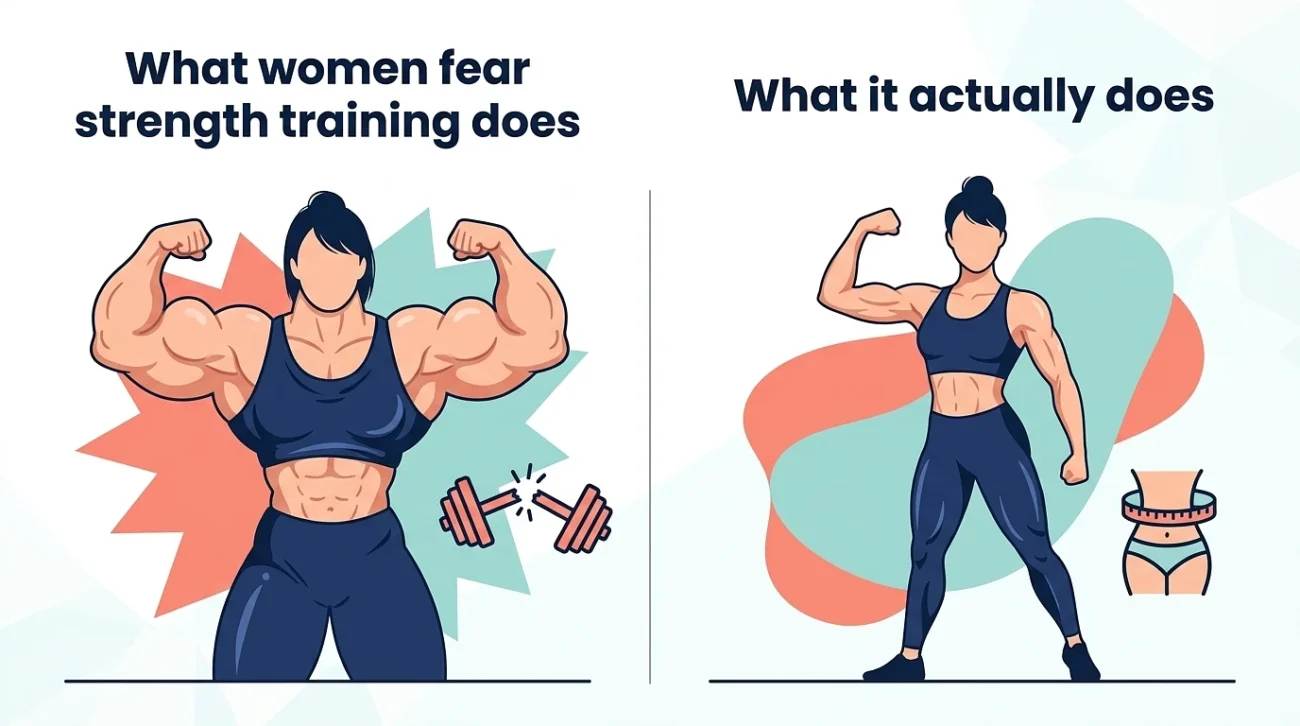
Maya’s reasons weren’t unusual, and they weren’t stupid. Three come up again and again when women explain why they steer clear of resistance training: the fear of getting “bulky,” not knowing what to do with the equipment, and the sense that the free-weight area is occupied territory — the domain of grunting regulars who know exactly what they’re doing.
The bulk fear is the one worth dismantling first, because it’s the one based on a physiological misunderstanding.
Building large muscle is heavily dependent on testosterone, and women produce roughly a tenth to a fifteenth of the amount men do. That hormonal reality makes it genuinely difficult for most women to add significant size, even when they’re training hard. The women whose physiques people picture when they say “bulky” are almost always following years of specialised programming and deliberate caloric surplus often more besides. What ordinary strength training produces instead is the opposite of what’s feared: lean definition, a tighter waist, and a body that looks more compact at the same weight.
The Eight Weeks That Changed Her Mind
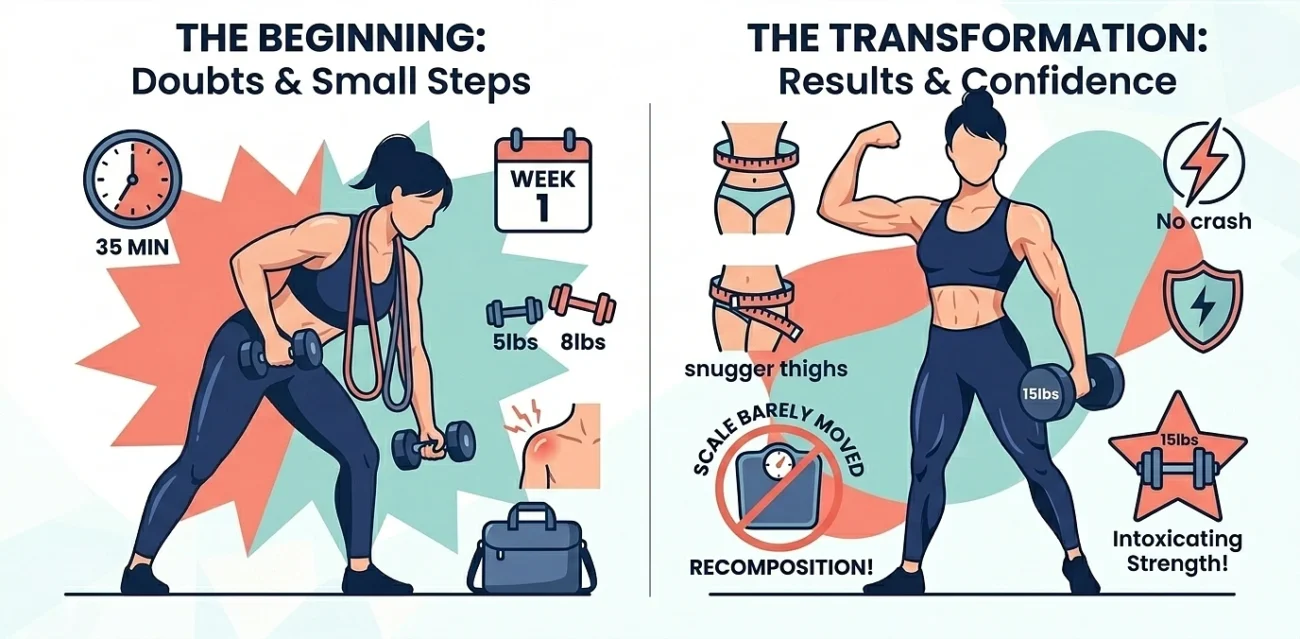
Alex didn’t hand Maya a punishing programme. He gave her three sessions a week, 35 minutes each, built from resistance bands, light dumbbells between five and twelve pounds, and her own bodyweight. Squats, lunges, push-ups on her knees to start, rows, shoulder presses, planks. Nothing exotic.
What surprised her was how quickly her body answered.
- After two or three weeks the plank hold increased, and her laptop bag stopped digging into her shoulder. At week four or five, her pants feel looser around the waist, tighter around the thighs and the bathroom scale doesn’t budge much. This last sentence caused her to halt until Alex explained: Muscle is denser than fat, so when she lost the fat she lost the pounds and it made her smaller in all the ways that matter. Re-composition is not reflected on a scale, in most cases.
- By weeks six and seven, the mid-afternoon energy crash that usually sent her hunting for a second coffee simply stopped happening. And by week eight, she’d moved from eight-pound dumbbells to fifteen on several lifts. That jump the plain arithmetic of being measurably stronger than she’d been seven weeks earlier was, in her words, “a little bit intoxicating.”
The Part Nobody Warned Her About
Here’s the thing about Maya’s story that the before-and-after photos miss entirely: the most important change wasn’t physical.
Cardio, for all its benefits, gives you fuzzy feedback. You burned some calories. You feel a bit fitter. Progress is real but abstract, and plateaus are demoralising precisely because you can’t see the needle move.
Lifting is different. It keeps a ledger. Last month you pressed ten pounds; this month it’s fifteen. There’s no interpreting that, no wondering whether it counts. The number is the proof, and the proof accumulates.
That steady drip of unambiguous evidence did something to Maya that surprised her. “Every time I added weight or squeezed out an extra rep, I felt this little hit of I did that,” she said. “It was never really about how I looked. It was about being more capable than I was last week.”
And the capability didn’t stay in the gym. She put her hand up to lead a project at work she’d normally have avoided. She started taking hiking trails she’d previously written off as too hard. She noticed, and only half-jokingly, that she’d stopped apologising for taking up space on the trail, in meetings, in the squat rack.
This isn’t woo. The link between resistance training and improved mood, self-esteem, and reduced anxiety is one of the better-supported findings in exercise psychology O’Connor and colleagues laid out the mechanisms in detail back in 2010. The sense of physical mastery appears to generalise. You learn your body can do more than you thought, and that lesson is hard to keep contained.
What Alex Actually Taught Her
As Maya’s form sharpened and her questions multiplied, Alex started explaining why he’d been so determined to get her under load and most of his reasons had nothing to do with how she looked.
The one he continued to come back to was her bones. Weight bearing and resistance training tell the body to get stronger which is important for women as they get older. After menopause, as estrogen levels fall, bone is lost more rapidly and women with higher banked bone will fracture less and live longer without support. Maya’s squats she believed she was performing to strengthen her thighs were actually for the future and not to risk a broken hip at 70 years old.
He discussed metabolism as well: “Since the muscle is metabolically active tissue, having more of it will push your body’s metabolism just a little bit higher.” He didn’t hype it up, it works but not as much as some fitness marketing makes it out to be, it’s not a furnace. And he spoke about the unshowy victories, displaying good form on a long day at work rather than curling up on a low sofa, lifting from a low surface without using her hands, carrying a niece on one hip. The back, shoulders, and core work he’d introduced to her sessions was a direct antithesis to modern life, which takes a slow forward-leaning slump.
Two Years Later
Maya’s week looks nothing like it did. Spin class is still in there cardio earns its place but it’s the side dish now. The main event is four strength sessions a week. She deadlifts 135 pounds. She can do unassisted pull-ups. She moves through the free-weight area she once feared like someone who belongs there, because she does.
She’s also turned into something of a recruiter, dragging curious colleagues to Alex’s studio and posting her lifts online. Her message is always some version of the thing Alex taught her without ever saying it out loud: strength training isn’t about turning into a different person. It’s about becoming the strongest version of the one you already are.
How to Start If You’ve Been Avoiding This
If you recognise yourself in the early-Maya the cardio loyalist, the weight-room avoider, the person quietly getting weaker and blaming the calendar the on-ramp is gentler than you think.
You don’t need a gym. Bodyweight squats, push-ups, and lunges are real strength training, full stop. A set of resistance bands costs under $20 and opens up dozens of exercises. The equipment was never the barrier.
It’s not the amount of weight it’s the way you move. People get injured and then they quit because of their sloppy form under load. Several lessons with a good trainer or a careful reading of true and good instruction, and you have bought yourself a solid foundation which will last for a lifetime. Choose a weight that you can perform 10-12 controlled repetitions, then the final 2-3 repetitions should be challenging, but right in the zone, and only add weight once the exercise gets easier.
Keep a simple log: exercise, weight, reps. It’s dull and it’s the single best motivator you’ll have, because watching the numbers climb is the same drip of proof that hooked Maya. And give it honest time. Strength itself tends to show up in four to eight weeks; the visible body-composition change usually lands somewhere around eight to twelve. The people who don’t see results are almost always the people who stopped at week three.
References
- Westcott, W.L. “Resistance Training Is Medicine: Effects of Strength Training on Health.” Current Sports Medicine Reports, Vol. 11, No. 4, 2012, pp. 209–216.
- O’Connor, P.J., Herring, M.P., & Caravalho, A. “Mental Health Benefits of Strength Training in Adults.” American Journal of Lifestyle Medicine, Vol. 4, No. 5, 2010, pp. 377–396.
- Strasser, B., & Schobersberger, W. “Evidence for Resistance Training as a Treatment Therapy in Obesity.” Journal of Obesity, Vol. 2011, 2011.
- Liu, C.J., & Latham, N.K. “Progressive Resistance Strength Training for Improving Physical Function in Older Adults.” Cochrane Database of Systematic Reviews, Issue 3, 2009.
- Seguin, R., & Nelson, M.E. “The Benefits of Strength Training for Older Adults.” American Journal of Preventive Medicine, Vol. 25, No. 3, 2003, pp. 141–149.