
Carnivore Diet Recipes: All-Meat Meals for Optimal Health


Quitting the carnivorous diet is a challenge. After eating two pounds of steak every day for three weeks, people collapse, blame the diet, and resume eating boxed cereal. The form of the diet they attempted was never going to work, but it didn’t fail them. One of the highest-attrition feeding habits in the wild is strict carnivore, which is carried out without preparation. Even controlled low-carb trials with continuous expert supervision demonstrate a decline in adherence with time (Shai et al., 2008).
Takeaways
- Most people who quit quit because they tried the strictest possible version with no fallback plan, not because their bodies couldn’t handle it.
- A sustainable approach looks more like 90/10 almost all animal foods, with occasional flexibility for travel, social events, and a few targeted reintroductions.
- Bloodwork before you start and again at three months is the only way to know whether the diet & nutrition is working for your body, especially around LDL cholesterol.
- Going from a high-carb diet straight to zero carbs in one day produces a rough adaptation period that pushes many people to quit; a two-week taper is gentler.
- The biggest long-term risks are deficiencies in vitamin C, magnesium, calcium, and fiber, plus elevated LDL in a subset of eaters (Lietz et al., 2026).
What Is the Carnivore Diet?
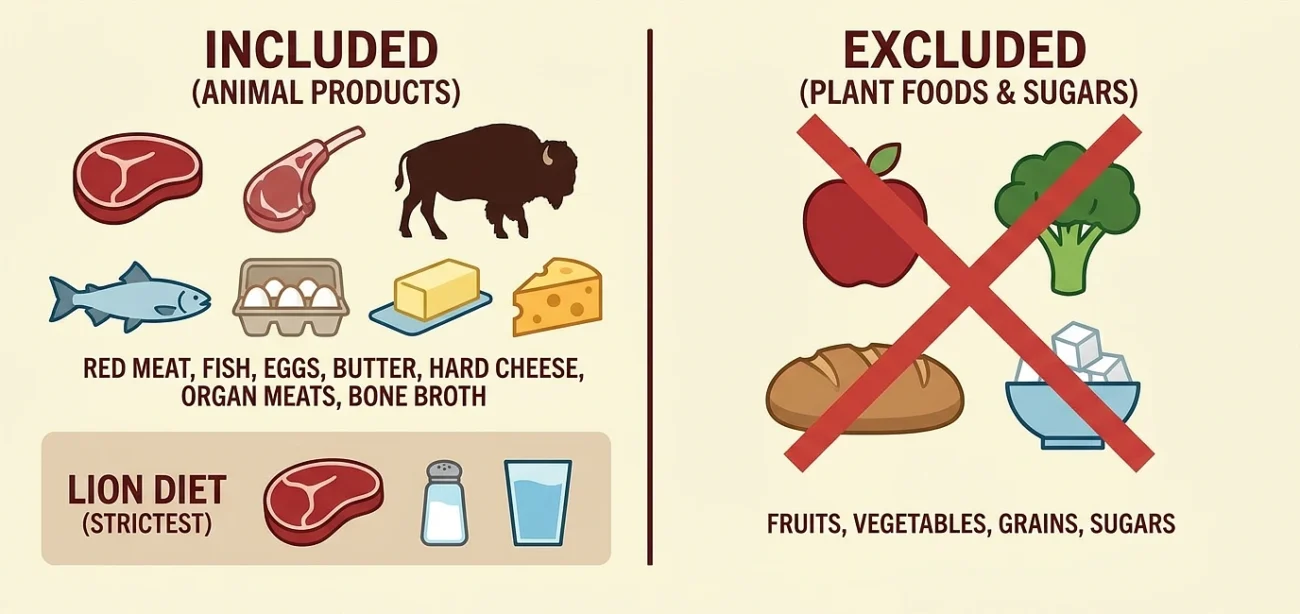
A carnivorous diet consists entirely of animal items, such as meat, fish, eggs, and, in most cases, butter and hard cheese, and excludes all plant foods. Only ruminant meat (beef, lamb, and bison), salt, and water are allowed in the strictest version of the Lion Diet. The majority of the dramatic before-and-after tales and headlines come from that version. Additionally, very few people persist with this version for longer than a few months.
Red meat as the mainstay, eggs and fatty fish on a regular basis, organ meats once a week or so, butter and aged cheese if dairy works for you, and bone broth almost every day are examples of a more sustainable version. No grains, no fruits, no veggies, and no sweets. On rare situations, some practitioners permit fruit or honey; depending on who you ask, the carnivorous community views this as either pragmatism or heresy.
2,029 individuals who had been on the diet for at least six months participated in the biggest descriptive study of eaters; 85% of them reported eating red meat every day or more often, and the majority said they were on the diet for health rather than weight reduction (Lennerz et al., 2021). It’s important to note that those who are willing to participate in a survey on a specialty diet they’ve been following for more than six months are not a representative sample of all. It remained with them.
How Does the Carnivore Diet Work?
A few different things happen at once when someone drops all plants and eats only animal foods.
The first is ketosis. Without carbohydrates as a fuel source, the body shifts to running on fat both dietary fat and stored body fat converted into ketones. This shift takes three to seven days and is responsible for most of the symptoms during the first two weeks: headaches, fatigue, irritability, the things the keto community has long called “keto flu.”
Satiety comes in second. Due to delayed stomach emptying and peptide YY signaling, protein improves feelings of fullness more than fat or carbohydrates (Leidy et al., 2010). After a few weeks on a meat-only diet, most individuals stop monitoring their caloric intake because they just aren’t as hungry in between meals as they formerly were. That is the primary cause of the weight reduction outcomes that individuals experience.
Elimination is the third. Eliminating all plant-based foods also eliminates any food sensitivities, troublesome FODMAPs, possible autoimmune flare-up triggers, and sources of gluten, lectins, and oxalates. This may provide significant relief in the first month for those with long-term inflammatory or digestive problems, which is why the diet is sometimes employed as a rigorous elimination procedure with scheduled reintroductions rather than a permanent eating regimen.
The impacts on metabolism throughout time are somewhat diverse. A scoping review of nine human studies conducted in 2026 revealed that while short-term outcomes such as weight loss, increased satiety, and decreased inflammatory markers in certain individuals are real, the same review also revealed deficiency risks and elevated LDL cholesterol in a significant portion of participants (Lietz et al., 2026). For many individuals, the diet is effective in the short term. It becomes more complex in the medium and long run.
How Do I Start the Carnivore Diet?
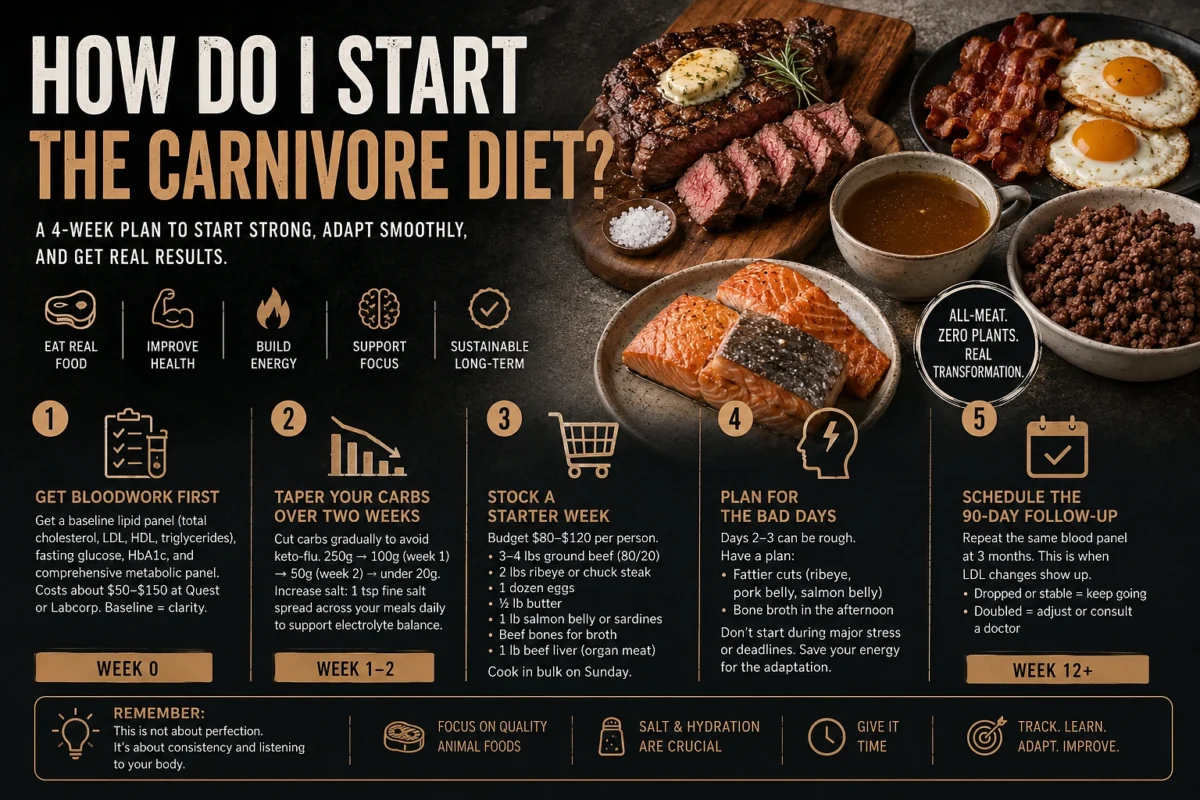
The version of this question most people ask is something like “what do I eat tomorrow” which is the wrong starting point. The version that gives you a sustainable result is “what do I do over the next four weeks to give this a real trial.”
- First, have a blood test. A direct-to-consumer lab like Quest or Labcorp will charge you between $50 and $150 for a baseline lipid panel (total cholesterol, LDL, HDL, triglycerides), fasting glucose, HbA1c, and a full metabolic panel. You cannot determine if your body is behaving well or badly at month three without baseline data. People regret skipping this step on a regular basis.
- Over the course of two weeks, reduce your carbohydrate intake. The worst of the keto-flu transition occurs when one goes from consuming 250g of carbohydrates per day to zero overnight. It is kinder and simpler to recover from cutting to 100g for a week, then 50g, and finally less than 20g. Increase salt during the transition a teaspoon of fine salt added across the day’s meals helps with the headaches and lightheadedness that come from rapid water loss in the first few days.
- Prepare for a first week. 3 to 4 pounds of ground beef (80/20), 2 pounds of ribeye or chuck steak, a dozen eggs, half a pound of butter, a pound of salmon belly or sardines, beef bones for broth, and a pound of beef liver for one organ-meat meal make up a practical first week’s grocery list that costs between $80 and $120 per person in the US. On Sunday, cook in volume by hard-boiling six eggs, pressure-cooking a chuck roast, and searing a couple steaks.
- Make plans for the difficult days. You will feel awful two or three days into the change. Plan your meals on such days. Typically, you should have a mug of bone broth in the afternoon along with fattier steaks like salmon belly, pig belly, or ribeye. The willpower needed to go through the adaption period is limited, so don’t attempt to start carnivorous the week before a big work deadline or a stressful family event. Instead, focus on the food.
- Set up the 90-day follow-up. After three months, have the same blood panel performed. Changes in LDL usually manifest at this time. It’s okay to continue if yours has decreased or remained steady. If it doubles, it’s a clear indication to either retreat or see a physician.
Pros and Cons of the Carnivore Diet
Surveys and case reports consistently reflect the following benefits: decreased joint pain and inflammatory symptoms, more constant energy throughout the day, easier grocery shopping, a significant reduction in food cravings after a few weeks, and substantial weight loss without calorie tracking. Despite the social conflict, many long-term eaters stick to their diet because they report unexpected increases in their mood and mental clarity (Lennerz et al., 2021).
The drawbacks are equally real. Nutrition gaps are the obvious one vitamins C and D, calcium, magnesium, iodine, and dietary fiber are all flagged as deficiency risks in clinical reviews of the diet (Lietz et al., 2026). Most long-term carnivore eaters either supplement or include specific organ meats and seafood to cover these gaps. Constipation in the first few weeks is common as the gut adjusts to zero fiber, and for some people the issue resolves on its own while for others it doesn’t.
The disadvantage that receives the most clinical attention is elevated LDL cholesterol. Within months, a fraction of active, lean eaters have sharp increases in LDL, often doubling from baseline. It’s still debatable if this increases cardiovascular risk in this particular metabolic setting, but you shouldn’t leave that issue unanswered for yourself. According to the Cleveland Clinic, the diet may result in temporary weight reduction but is not advised over the long term due to dietary deficiencies and a high saturated fat content (Cleveland Clinic, 2024).
The social tax comes next. It is possible to eat exclusively meat in restaurants. People underestimate how difficult it is to eat only meat at weddings, holidays, and friends’ dinner parties for years on end. They think their willpower will outlast their relationships, and sometimes it does, but sometimes the strict version of the diet starts to cost them in ways they didn’t budget for at first.
Simplified: the benefits include ease of use, fullness, quick outcomes, and symptom reduction for some individuals. Nutrient gaps, possible LDL elevation, social friction, and a learning curve during the first month that forces most individuals to return to their previous eating habits are the drawbacks.
For most healthy adults, a 60 to 90-day disciplined trial bloodwork on both ends, gradual transition, planned flexibility for life events is enough to know whether this works for your body. That’s the trial that’s actually worth running.
References
- Lennerz, B. S., Mey, J. T., Henn, O. H., & Ludwig, D. S. (2021). Behavioral Characteristics and Self-Reported Health Status among 2029 Adults Consuming a “Carnivore Diet.” Current Developments in Nutrition. https://pmc.ncbi.nlm.nih.gov/articles/PMC8684475/
- Leidy, H. J., Armstrong, C. L., Tang, M., Mattes, R. D., & Campbell, W. W. (2010). The Influence of Higher Protein Intake and Greater Eating Frequency on Appetite Control in Overweight and Obese Men. Obesity (Silver Spring). https://pmc.ncbi.nlm.nih.gov/articles/PMC4034047/
- Lietz, A., Dapprich, J., & Fischer, T. (2026). Carnivore Diet: A Scoping Review of the Current Evidence, Potential Benefits and Risks. Nutrients. https://www.ncbi.nlm.nih.gov/pmc/articles/PMC12845189/
- Shai, I., et al. (2008). Weight Loss with a Low-Carbohydrate, Mediterranean, or Low-Fat Diet. New England Journal of Medicine. https://www.nejm.org/doi/full/10.1056/NEJMoa0708681
- Cleveland Clinic. (2024). The Carnivore Diet: What Is It and Is It Healthy? https://health.clevelandclinic.org/the-carnivore-diet