
Mannacote: The Complete Guide to Perfect Plant Nutrition


Every gardener and farmer wants one thing healthy, thriving plants without constant effort. Mannacote makes that possible. This guide covers everything you need to know about this advanced fertilizer, from how it works to how to use it correctly.
What Is Mannacote?
Mannacote is a controlled-release fertilizer (CRF) designed to feed plants slowly and steadily over an entire growing season. Instead of flooding the soil with nutrients all at once, it uses a smart polymer coating to meter out nutrition based on what plants actually need.
It comes in small coated granules each one packed with a precise blend of nitrogen (N), phosphorus (P), and potassium (K), plus essential trace elements like magnesium, iron, and manganese.
The Science Behind the Coating
The real power of Mannacote lies in its semi-permeable polymer shell. Here is how it works step by step:
- Water Activation: Moisture enters the soil and seeps through tiny pores in the coating, dissolving the solid nutrient core inside.
- Temperature-Driven Release: As soil temperature rises, the coating expands slightly, allowing dissolved nutrients to diffuse outward into the root zone.
- Synchronized Feeding: When plants grow faster in warm conditions, nutrient release speeds up. In cooler periods, it naturally slows down.
This process keeps nutrient delivery perfectly aligned with the plant’s growth cycle not wasted, not rushed.
NPK Nutrient Profile
A typical Mannacote formulation contains a balanced blend:
- N Nitrogen (e.g., 18%): Drives lush, green, leafy growth.
- P Phosphorus (e.g., 8%): Builds strong root systems and supports flowering.
- K Potassium (e.g., 10%): Improves overall plant strength and stress resistance.
- Micronutrients: Iron, manganese, magnesium, and zinc for complete plant health.
Key Benefits of Mannacote
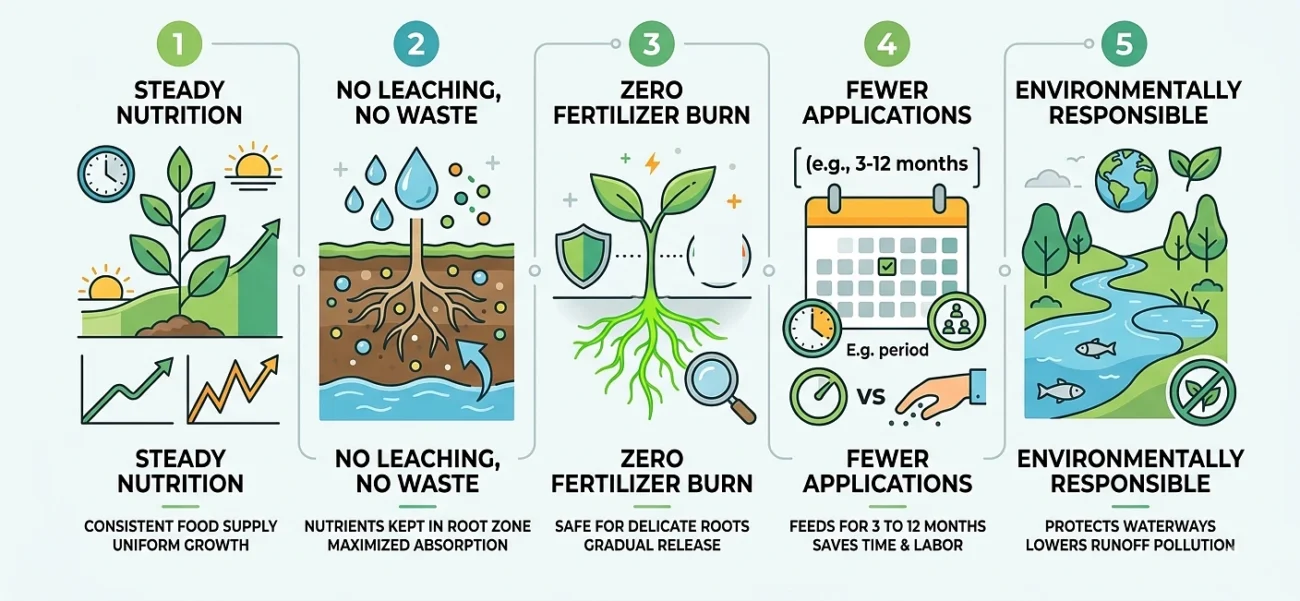
1.Steady, Reliable Nutrition
Plants fed with Mannacote never go through “feast and famine” cycles. They receive a consistent food supply from planting to harvest, which leads to uniform, strong growth.
2. No Leaching, No Waste
Traditional fertilizers wash away during rain or irrigation, polluting groundwater. Mannacote’s slow-release design keeps nutrients in the root zone, so almost every molecule is absorbed by the plant.
3. Zero Fertilizer Burn
High salt concentrations in conventional fertilizers can scorch delicate roots. Because Mannacote releases so gradually, the risk of root burn is virtually eliminated even for seedlings and sensitive ornamentals.
4. Fewer Applications
One application of Mannacote can feed plants for 3 to 12 months, depending on the formula and conditions. This saves time, reduces labor, and cuts reapplication costs significantly.
5. Environmentally Responsible
By reducing nutrient runoff, Mannacote protects rivers, lakes, and groundwater from agricultural pollution. Its low-leach profile aligns with tightening global regulations on nitrate contamination.
Who Should Use Mannacote?
Mannacote works across a wide range of settings:
- Home Gardeners – Supports vegetables, flowers, shrubs, and herbs without constant monitoring
- Professional Landscapers – A single spring application covers the entire growing season, cutting site visits dramatically
- Nursery Growers – Provides consistent nutrition so every plant leaving the facility is healthy and market-ready
- Commercial Farmers – Boosts crop yield for staple grains, citrus, mangoes, grapes, and more
- Indoor & Container Plant Owners – Prevents salt buildup in pots and removes the need for weekly liquid feeds
How to Apply Mannacote Correctly
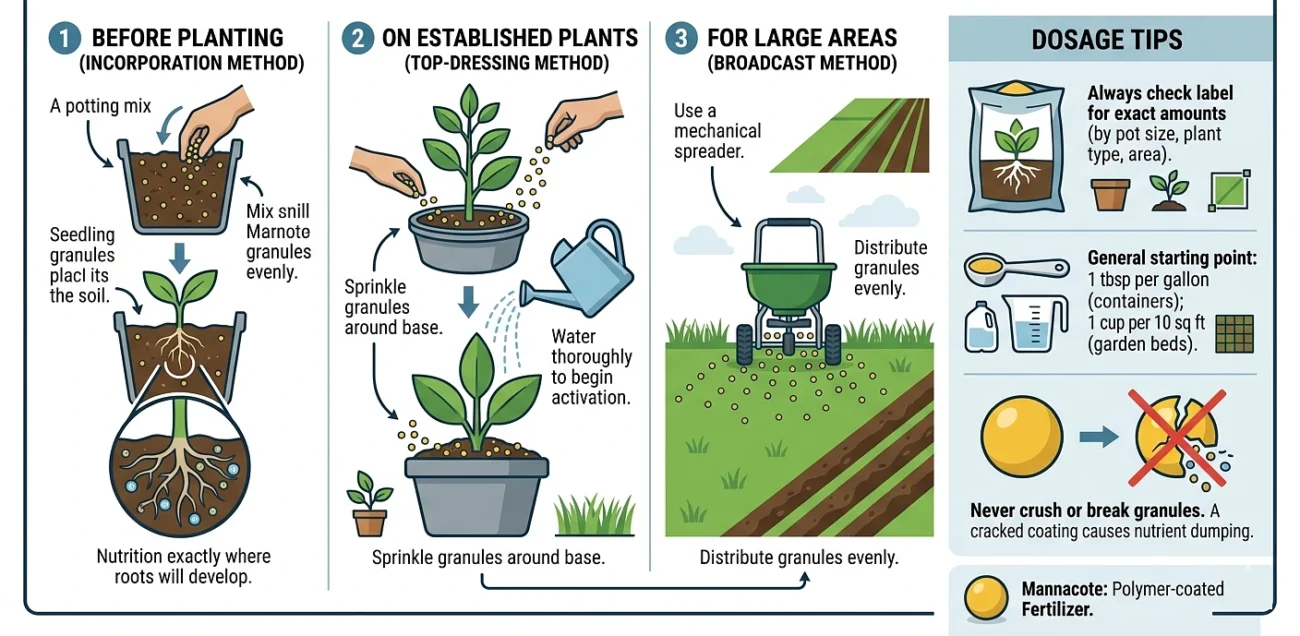
Proper application ensures the polymer coating functions as intended.
Before Planting (Incorporation Method): Mix Mannacote granules evenly into the potting mix or garden bed soil before placing seeds or transplants. This puts nutrition exactly where roots will develop.
On Established Plants (Top-Dressing Method): Sprinkle granules around the base of existing plants or trees. Water thoroughly afterward to begin moisture activation.
For Large Areas (Broadcast Method): Use a mechanical spreader to distribute granules evenly across turf, fields, or garden beds.
Dosage Tips:
- Always follow the package label amounts vary by pot size, plant type, and bed area.
- A general starting point: 1 tbsp per gallon of soil for containers; 1 cup per 10 sq ft for garden beds.
- Never crush or break the granules a cracked coating causes all nutrients to dump at once.
Choosing the Right Formula
Mannacote comes in different release durations. Match the formula to your crop cycle:
| Release Period | Best For |
|---|---|
| 3 months | Bedding plants, short-season vegetables |
| 5–6 months | Tomatoes, peppers, annuals |
| 8–9 months | Perennial shrubs, fruit trees |
| 12 months | Trees, long-season crops, turf |
Mannacote vs. Other Fertilizers
| Feature | Mannacote | Standard Granular | Organic Compost |
|---|---|---|---|
| Release Type | Controlled, temperature-driven | Quick, uncontrolled | Unpredictable, microbial |
| Burn Risk | Very low | High | Very low |
| Leaching Risk | Minimal | High | Low |
| Application Frequency | Once per season | Every 4–6 weeks | As needed |
| Nutrient Precision | High | Moderate | Low |
Storage and Handling Tips
Protect the polymer coating to maintain full effectiveness:
- Store in a cool, dry location away from direct sunlight.
- Keep bags sealed to prevent premature moisture activation.
- Avoid crushing or grinding granules during handling.
- Keep away from excessive heat, which can degrade the coating before use.
The Future of Mannacote
The technology continues to evolve. Current and upcoming innovations include:
- Biodegradable coatings to reduce plastic residue in soil.
- Smart formulations linked to soil moisture sensors for data-driven feeding.
- Micro-coated granules for targeted delivery in precision agriculture systems.
- AI-integrated farming applications that calculate exact nutrient inputs by temperature.