
80 Pounds Down With Pilates, After Four and a Half Months of Not Walking

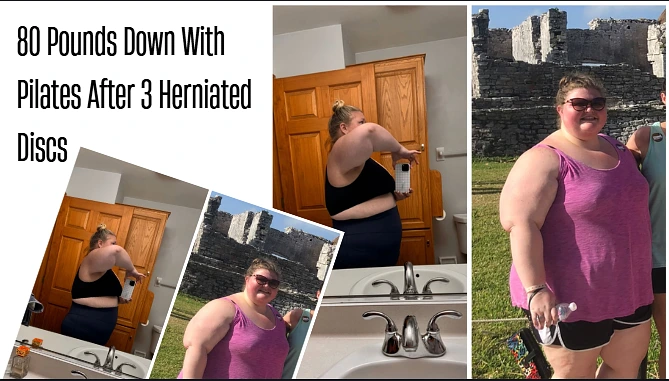
I didn’t walk for four and a half months this year.
Three herniated discs will do that. And I don’t think people who haven’t been through it understand that the worst part isn’t the pain, although the pain is bad. It’s what happens to your head. You stop trusting your own back. Somewhere around month two I noticed I’d started planning my day around not moving, and that felt less like being careful and more like giving up in slow motion.
I’m eighty pounds down now and doing Pilates six days a week. Still 135 to go, and I’m fine saying that out loud.
Left is the before. Right is somewhere in the middle of this.
The Months Of Not Moving Cost Me More Than I Expected
The weight was the obvious thing. The part I didn’t see coming was how fast everything else went.
My core was gone. Not weak, gone. Which is a particular kind of joke when the whole reason you’re lying down is that your spine needs support, and the muscles that are supposed to be providing that support are quietly disappearing because you’re lying down. I found out later there’s research on exactly this, that the deep trunk muscles already fire badly in people with back pain, and months of bed rest makes it considerably worse.
So I came out of it with the same injured discs and less of a system holding them.
Then there’s the weight and back pain thing, which goes in a circle. Being heavier puts more load on your spine, more load makes the pain worse, worse pain means less movement, less movement means more weight. I knew this. Knowing it didn’t help. What helped was finding a way to move that didn’t set my back off, and that took a while.
Why Pilates, And Not Something Else
Honestly? Because it was the only thing I could physically do at first.
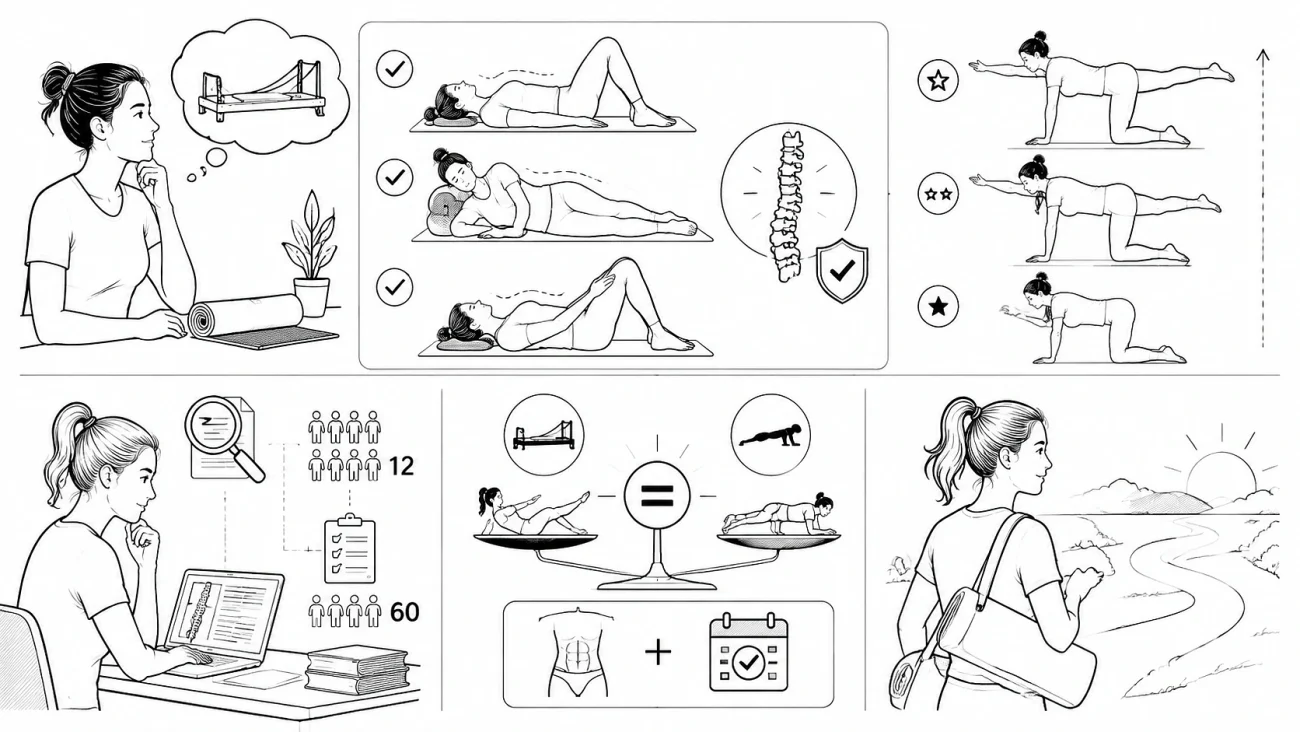
Most of it happens lying down or supported. Nothing is landing through your spine. You can make a movement smaller and smaller until it’s something you can manage, and there’s always a version of the exercise that’s easier, which matters enormously when you’re starting from a body that hasn’t done anything in four months.
I looked into it more later, once I’d been going a while, and the research is decent. There’s a systematic review that pulled together twelve randomised trials in people with lumbar disc herniation, looking at core stabilisation work, motor control exercise and clinical Pilates. A trial in sixty people with MRI-confirmed disc herniation compared Pilates directly against core stabilisation for pain and range of motion.
The thing I took from all of it is that nothing came out as obviously better than anything else. Core stabilisation works. Pilates works. What they have in common is the deep trunk stuff and turning up consistently, and the second part is the bit that’s actually hard.
So Pilates isn’t magic. It’s what I could do, and then keep doing.
Six Days a Week is The Whole Thing
If you take one thing from this, it’s this bit, not the eighty pounds.
There’s a trial I keep coming back to where women with chronic disc herniation did 45 to 60 minute sessions three times a week for eight weeks. Pain, range of motion, disability, trunk endurance, all four improved. The control group, who just carried on with light walking and stretching, improved on none of them.
Three sessions a week for eight weeks. That’s it. That’s the dose that moved everything.
I’m doing six a week and I’ve been at it a lot longer than eight weeks, so when people ask what the secret is, that’s genuinely the answer and it’s a boring one.
The weight loss came off the back of that rather than because Pilates burns a huge number of calories. It doesn’t. It just gave me something I could do every day without hurting myself, and doing something every day for months adds up in ways that a hard workout twice in a good week never did for me.
What I’d Tell Someone Starting Where I Started
A few things I got right, and one I got wrong.
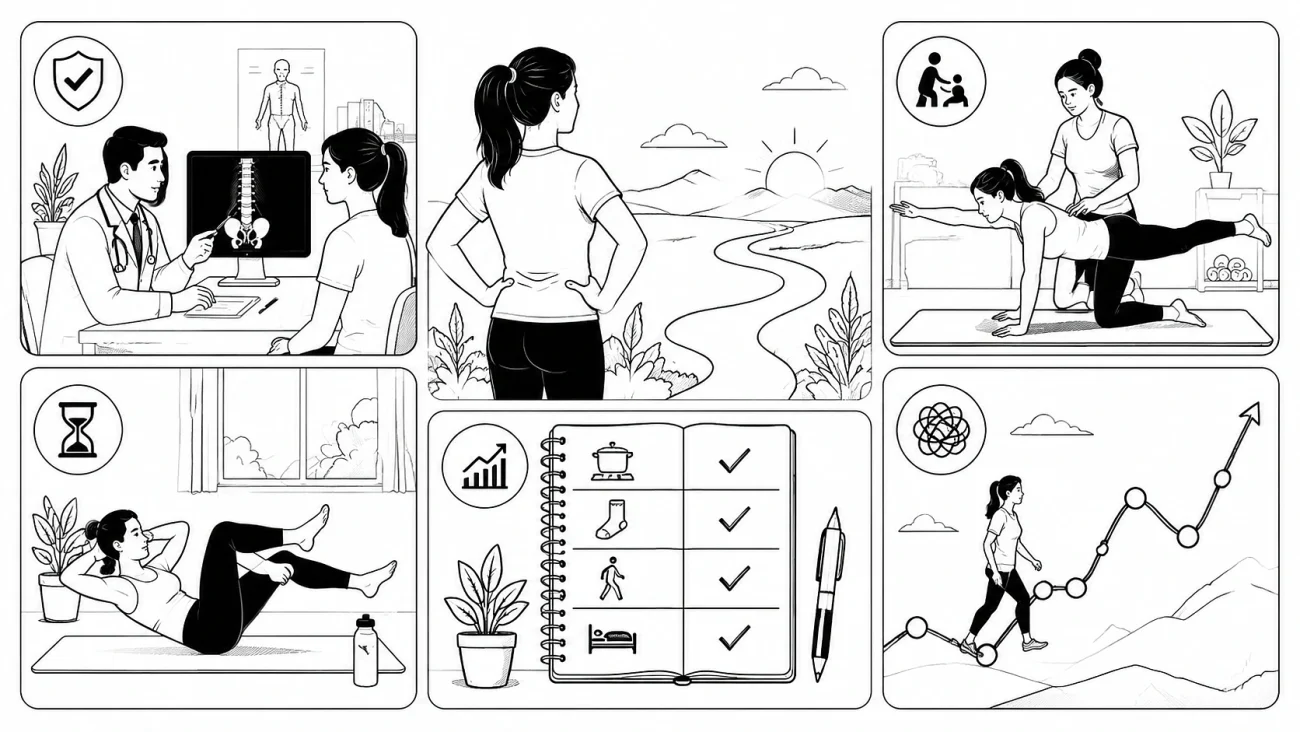
- Get properly cleared first, for your specific injury. Disc herniation isn’t one condition. Where it is, whether nerves are involved, whether there’s any neurological deficit, all of it changes what’s safe. Those trials I mentioned were all in people who’d been assessed as able to exercise, and that assessment is the thing.
- Find an instructor who has worked with backs. Not a general class. Someone who’ll modify around what you’ve actually got. Mine has been the difference between this working and this being another thing I tried.
- The first few weeks feel like nothing is happening. Deep core work is unimpressive to do and unimpressive to watch. I nearly stopped. Most people who stop, stop right about there.
- Track something other than the scale. Standing long enough to cook dinner. Putting socks on without a strategy. Those changed months before my weight did anything interesting, and on the bad weeks they’re what stopped me quitting.
The thing I got wrong was expecting it to be linear. It isn’t. I’ve had mornings this year where I woke up convinced the whole thing had gone backwards, and having a physio I can ring on those days turned out to be part of the plan rather than an admission of failure.
Still 135 To Go
People say congratulations and then look slightly uncertain, like they’re not sure whether eighty pounds with 135 left is a good news story.
It is, but not for the reason they think. The weight isn’t the achievement. Getting from not walking to six days a week is, and I did that part already. Whatever the scale does next, I’m not going back to lying on my bedroom floor at 2pm wondering if I’ll be able to stand up.
That’s the bit I’m proud of.