
Tibialis Raises: Perfect This Move For Stronger Knees

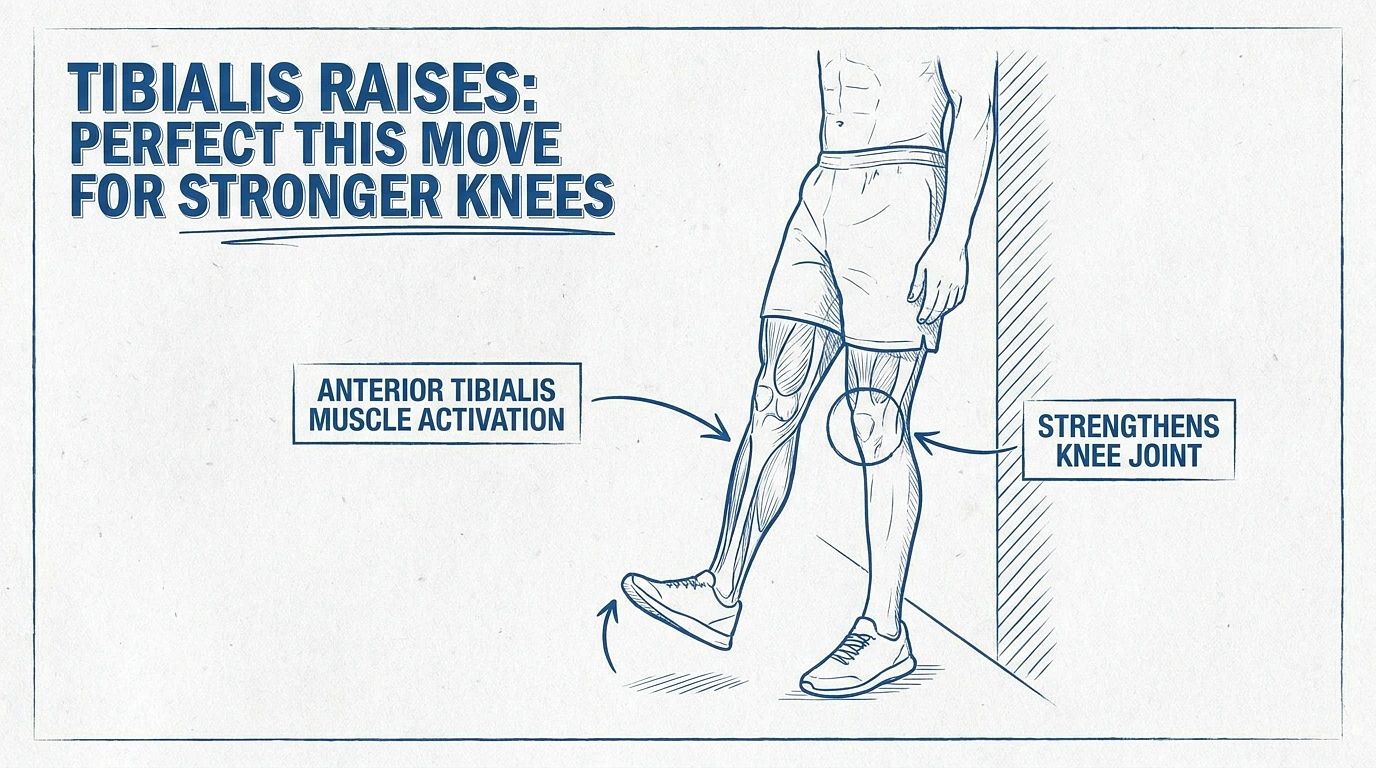
Tibialis raises train the muscle running down the front of your shin, called the anterior. It’s one of the most underrated shock absorbers your knees have. When it’s weak, every step sends impact straight up into your knee joint instead of getting soaked up in your lower leg.
The move is dead simple. Stand with your back against a wall. Walk your feet out about a foot or two. Heels glued to the floor, knees straight. Pull your toes up toward your shins. Slow up, slow down.
Aim for 20 to 25 reps. Two or three sets. A couple of times a week.
You’ll feel a burn the first session. Real strength and knee relief usually kick in somewhere between week 4 and week 8. Runners, desk workers, older adults, anyone with cranky knees. This one’s for you.
What is Tibialis Raises?
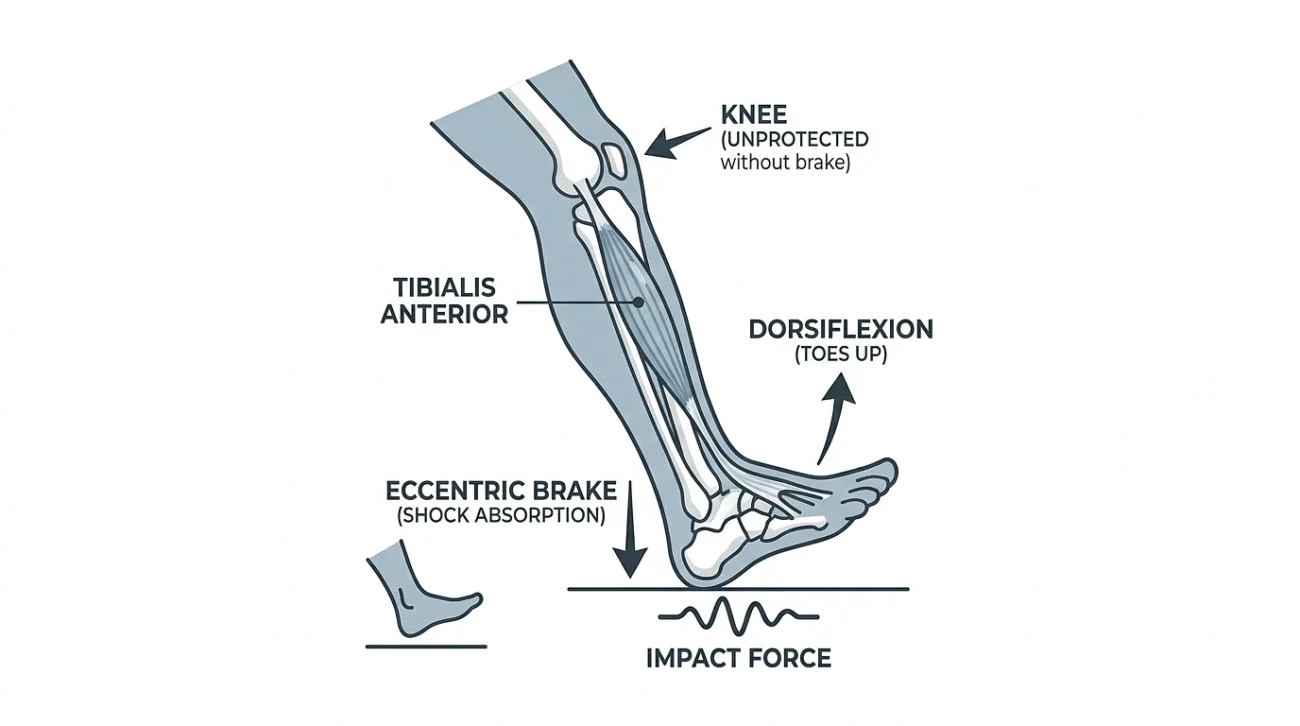
It’s a long, ropey muscle that runs from just below your knee, down the outer front of your shin, and tucks in near the base of your big toe.
Its main job is dorsiflexion. That’s the fancy word for pulling your toes up toward your shin. And it happens to be the strongest dorsiflexor in your foot (StatPearls, NCBI).
Here’s what dorsiflexion is doing for you all day, whether you notice or not:
- Lifting your toes when you walk so you don’t catch them and faceplant.
- Controlling how your foot lands when it hits the ground.
- Soaking up shock when you run, jump, or come down stairs.
- Helping hold up the arch of your foot.
When your foot hits the ground, this muscle eccentrically slows down how fast your forefoot slaps down. No brake, no shock absorption. The force has to go somewhere.
Where it goes is straight up your shin and into your knee.
How Does a Shin Muscle Help Your Knees?
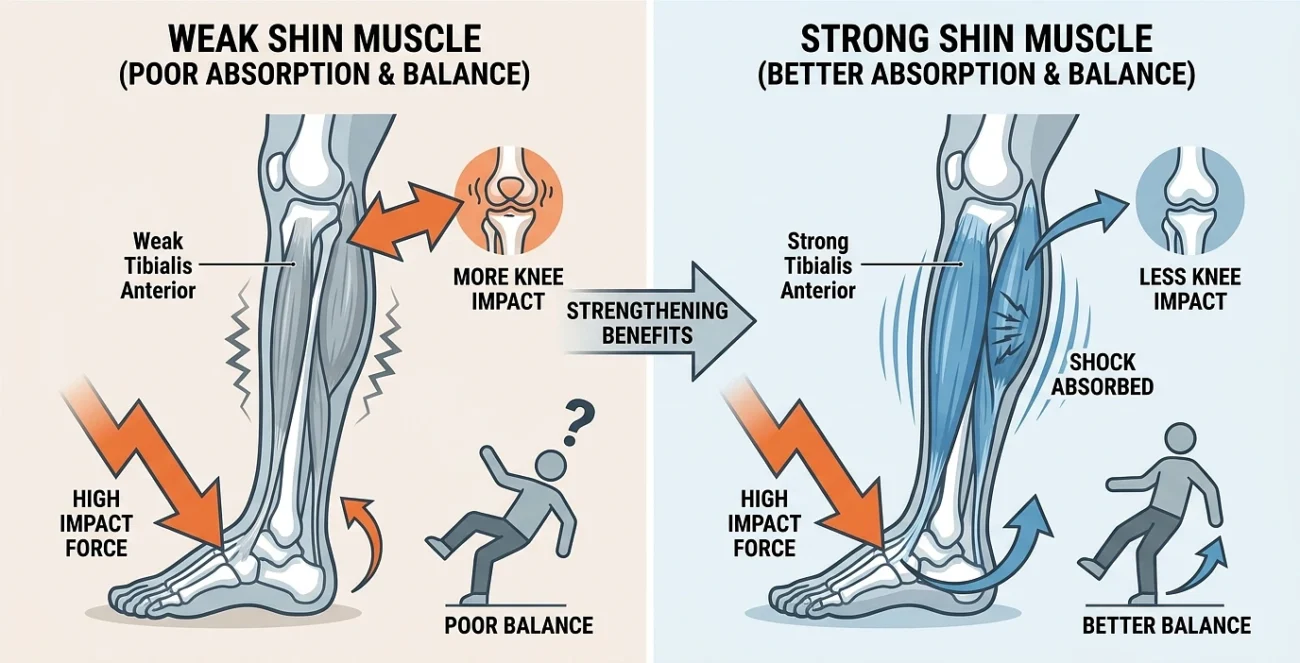
A 2021 study compared long-distance runners with chronic shin splints to runners with no pain at all. The shin-pain group had significantly weaker tibialis anterior, calf, and foot muscles. Their lower legs just weren’t doing their job during impact.
The researchers specifically called for anterior strengthening as part of rehab.
There’s also a long line of research on dorsiflexion and balance. Ankle dorsiflexor strength predicts how well someone can recover their balance after getting pushed backward. A delay in dorsiflexion is one of the strongest predictors of falls in older adults (Kemoun et al., Journal of Rehabilitation Medicine).
Other studies have shown that ankle muscle strength alone can tell you whether someone is a faller or a non-faller (Cattagni et al., Frontiers in Aging Neuroscience).
Strip the jargon away and it’s simple.
The “Knees Over Toes”
If you’ve spent any time on fitness Instagram, you’ve probably bumped into Ben Patrick, the “Knees Over Toes Guy.” Maybe you caught Andrew Huberman talking about “tib raises” on the Tim Ferriss Show.
Patrick calls training his “step one” for getting rid of knee pain. Huberman has credited the move with easing his knee, sciatica, back, and shoulder pain.
Are these guys onto something real? Honestly, yeah.
What they did was repackage a basic rehab principle physios have used forever. Graded exposure. Slowly building tissue capacity. Tibialis raises, sled work, and full-range calf work aren’t some new discovery. They’re just smart, boring, progressive strengthening that everyone skipped.
Good news? You don’t need a $200 tib bar or a fancy program. The bodyweight version against a wall is where almost everybody should start.
How To Do a Tibialis Raise (Bodyweight Version)
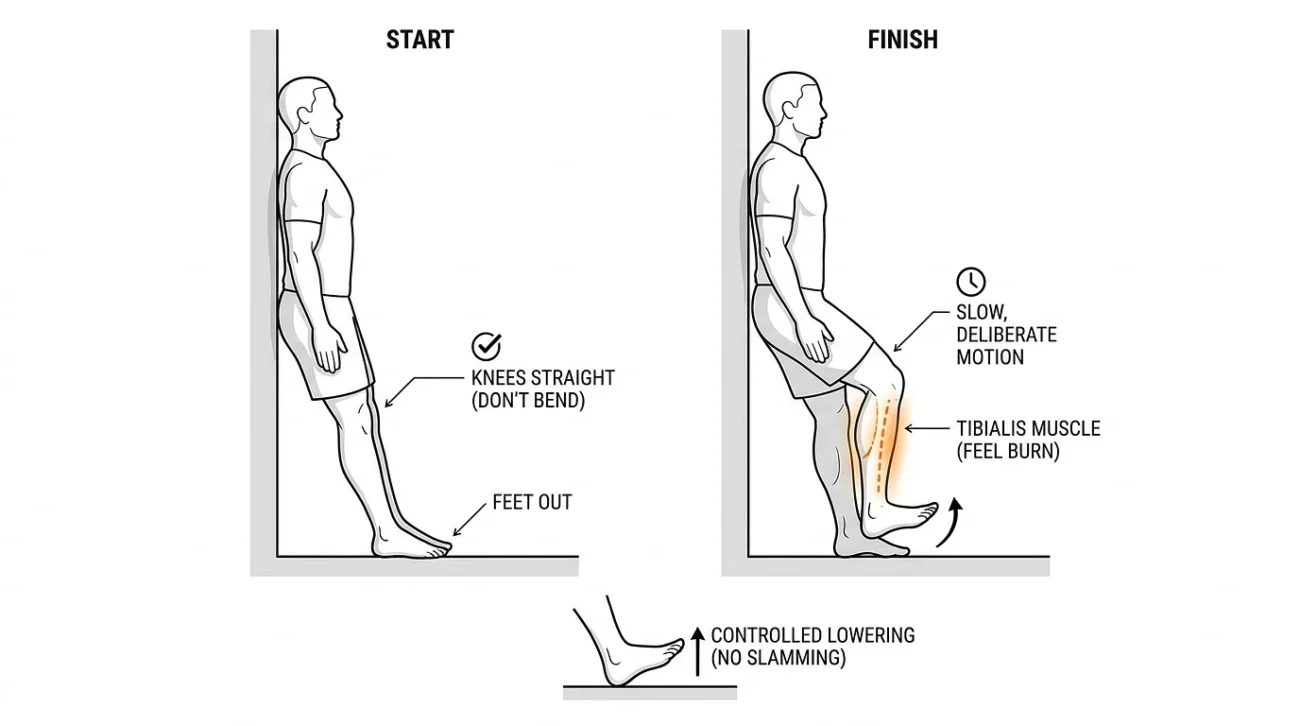
Here’s the no-equipment setup. This is what Patrick recommends as the entry point. It’s also what you’ll see in physical therapy clinics around the world.
- Stand with your back flat against a wall. Heels, butt, upper back, and head all touching.
- Walk your feet out about one to two foot-lengths from the wall. Further out means harder. Start close.
- Keep your knees straight, heels planted.
- Pull your toes up toward your shins as far as they’ll go. Slow. You should feel the front of your shin lighting up.
- Lower your toes back down with control. No slamming.
- Shoot for 20 to 25 reps. If your shins are screaming by rep 12, that’s totally fine. Stop. Breathe. Finish when you can.
Two to three sets, two to three times a week. That’s it.
A few cues that actually matter:
- Don’t bend your knees. The second you let them flex, your quads jump in and your tibialis takes a coffee break. Keep them straight, not locked-out hyperextended.
- Don’t rush. This is a slow, deliberate move. The tempo is what makes it work.
- Expect a serious burn. Most people have never trained this muscle directly, ever. Soreness in the front of the shin for a day or two after is normal.
How To Make It Harder Over Time
Once 25 clean reps stop being a challenge, you’ve got a few easy ways to push it.
Step further from the wall. Your first move. More distance equals a longer lever arm and more work. Simple as that.
Slow it down. Try a 3-second lower, 1-second pause at the top, 3-second raise. Time under tension turns a basic exercise into something brutal.
Add a band. Loop a light resistance band over the top of your foot. Anchor it to something solid in front of you. Dorsiflex against the tension. Classic rehab progression.
Move to weights or a tib bar. Sit on a bench, hook a dumbbell over your toes (or grab a tib bar), and do dorsiflexion under load. Patrick’s long-term standard is 25% of your bodyweight for 5 sets of 5. That’s a goal, not a starting point.
Heel walks. Lift your toes off the ground and walk forward on your heels for 30 to 40 seconds. Two or three rounds. Looks dumb. Feels brutal. Works.
References
- StatPearls (Juneja P, Hubbard JB) Anatomy, Bony Pelvis and Lower Limb: Tibialis Anterior Muscles. NCBI Bookshelf. https://www.ncbi.nlm.nih.gov/books/NBK513304/
- Nguyen U-S DT, Zhang Y, Zhu Y, et al. Increasing Prevalence of Knee Pain and Symptomatic Knee Osteoarthritis. PMC. https://pmc.ncbi.nlm.nih.gov/articles/PMC3408027/
- Reshef N, Guelich DR. Shin Splint: A Review. PubMed Central, NIH. https://pmc.ncbi.nlm.nih.gov/articles/PMC9937638/
- Fujimoto M, Hsu W-L, Woollacott MH, Chou L-S. Ankle dorsiflexor strength relates to the ability to restore balance during a backward support surface translation. Gait & Posture, 2013. https://pubmed.ncbi.nlm.nih.gov/23602447/
- Kemoun G, Thoumie P, Boisson D, Guieu JD. Ankle dorsiflexion delay can predict falls in the elderly. Journal of Rehabilitation Medicine. https://pubmed.ncbi.nlm.nih.gov/12092716/
- Cattagni T, Scaglioni G, Laroche D, Van Hoecke J, Gremeaux V, Martin A. Ankle muscle strength discriminates fallers from non-fallers. Frontiers in Aging Neuroscience. https://www.frontiersin.org/articles/10.3389/fnagi.2014.00336/full
- Tibialis Anterior Physiopedia. https://www.physio-pedia.com/Tibialis_Anterior
- Ben Patrick (Knees Over Toes Guy) on the Tim Ferriss Show, Episode #835. https://tim.blog/2025/11/11/ben-patrick-kneesovertoesguy/
- Patrick B. Building Bulletproof Knees Just Fly Sports Performance Podcast #148. https://www.just-fly-sports.com/podcast-148-ben-patrick/