
Bromelain in Pineapple: Why It Burns Your Tongue and What It Does in Your Body

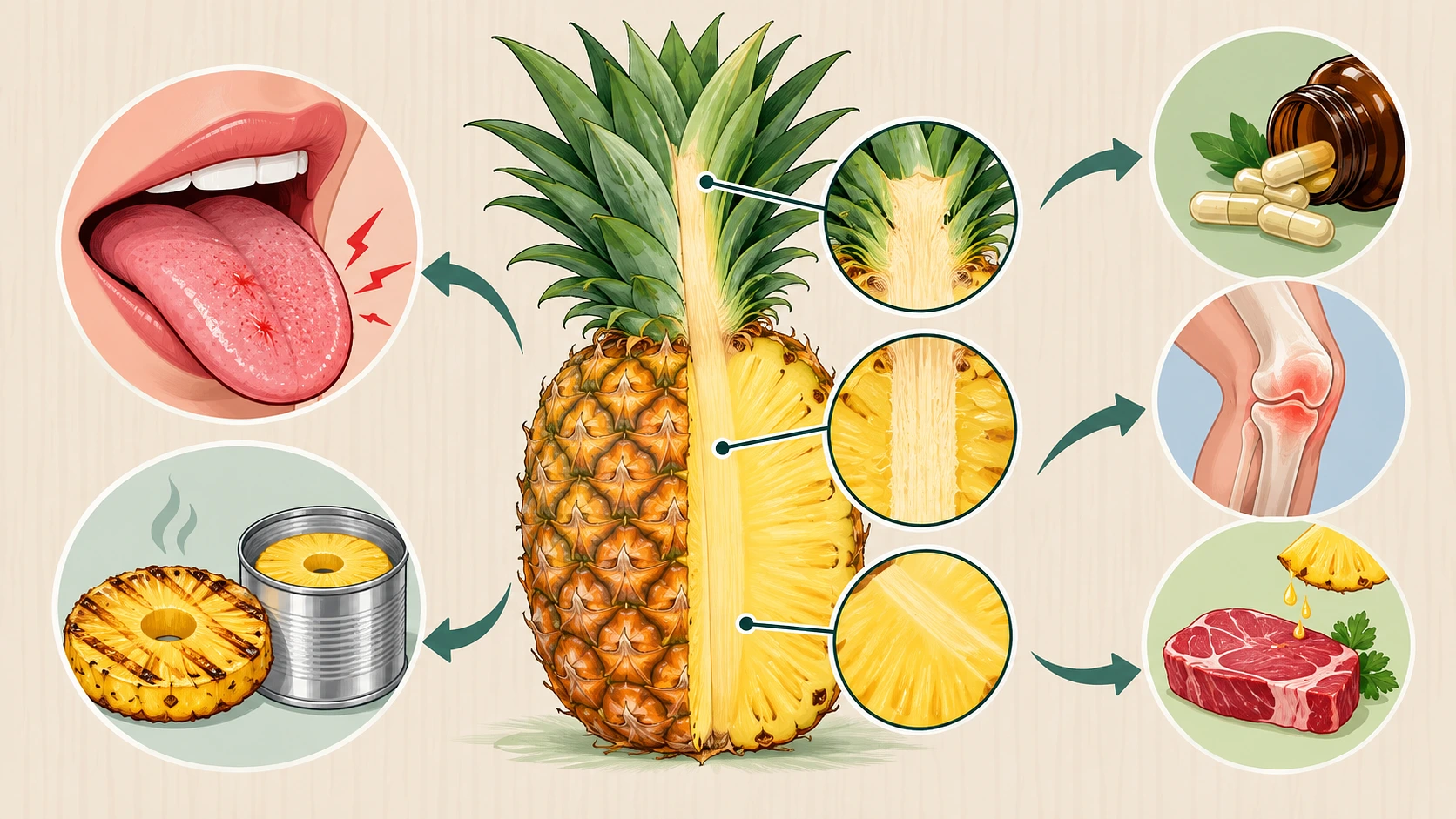
- Bromelain is a group of protein cutting enzymes in pineapple, and most of it is in the stem and core, not in the sweet flesh.
- The sting after fresh pineapple is that enzyme starting to digest the lining of your mouth. Heat destroys it, so canned and grilled pineapple do not sting.
- As a supplement it is taken for swelling after surgery and injury. The mechanism is well described, the big human trials are still missing.
Dole, the company that sells more pineapple than anyone, has a story on its own site titled “Why pineapples burn your tongue”, and the advice at the bottom is to grill it or buy it tinned. So a pineapple company is telling you the fresh product bites and the cooked one does not, and I think that is the most honest thing a fruit brand has published in years. The reason is one enzyme, it is worth 10 minutes because the same enzyme is behind the tongue, the ruined jello, the soft steak, and the capsules a dentist might suggest after a wisdom tooth comes out.
Mixture of enzymes and its job is to cut proteins apart. That is the whole mechanism. Everything below is that job being done in a place it was not meant for.
What Is Bromelain
An enzyme is a protein whose job is to speed up one chemical reaction. Bromelain is a protease, so the reaction it speeds up is chopping other proteins into smaller pieces, and it belongs to the cysteine protease family, which means it cuts wherever an amino acid called cysteine sits in the chain. Papaya has a cousin called papain that does the same thing. Papaya does not burn the mouth anywhere near as badly though, and when I looked into why, the answer is not the enzyme, it is the acid, pineapple is much more acidic than papaya and acid makes every little cut the protease leaves feel bigger than it is.
Which Part Of The Pineapple Has The Most Bromelain
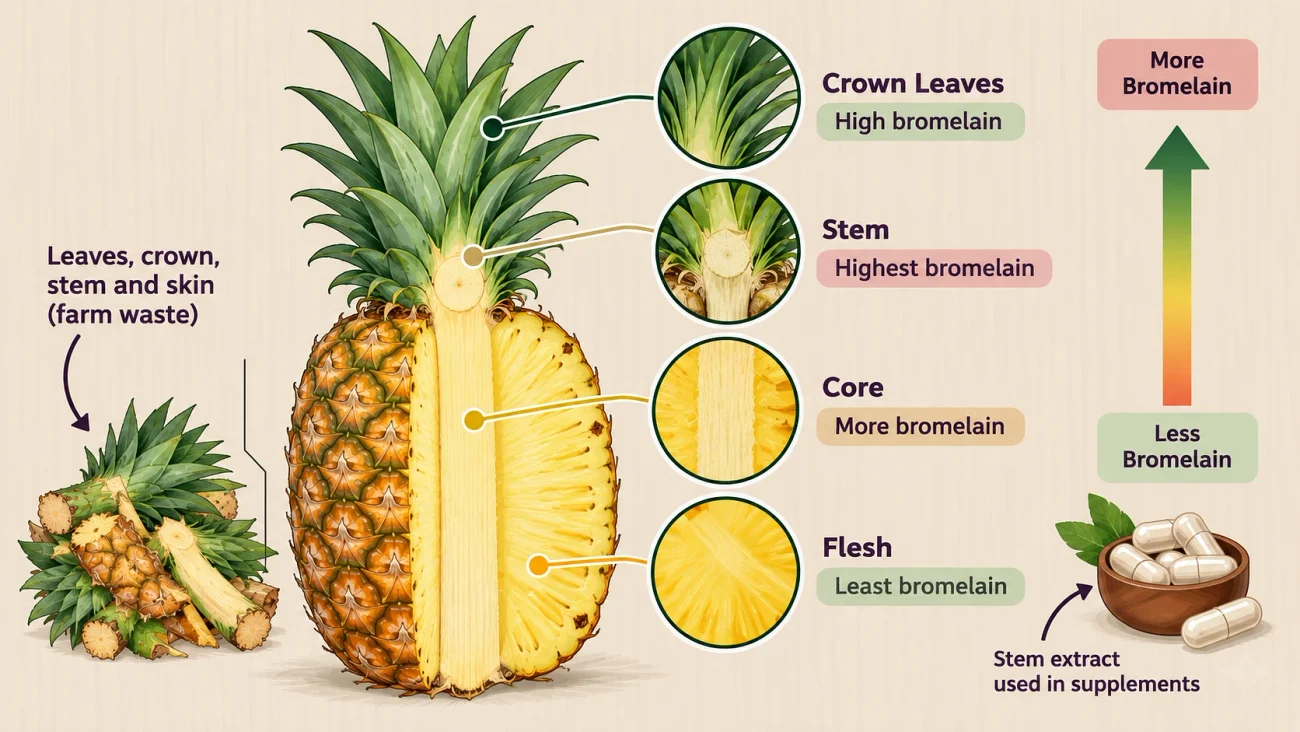
The flesh you eat has the least. The fibrous core has more and the stem has the most, which is why recipes say cut the core out if your mouth is sensitive and why the supplement makers do not bother with the fruit at all. A review in the journal Nutrients puts the sellable part of a pineapple at about 25%, and the other 75%, leaves, crown, stem and skin, is farm waste, and that waste heap is where nearly all in the world comes from. So the same pineapple gets sold to you twice. Once as rings in a tin, once as a bottle of pills made from the part they could not sell as fruit.
Two pineapples off the same shelf can sting differently as well. Enzyme strength changes with the soil and the weather the plant grew in, and the same goes for capsules, 2 of the same weight can be nothing like each other.
Why Fresh Pineapple Burns Your Tongue
Only fresh fruit does it. Half a pineapple at a barbecue and the next morning the tongue feels sandpapered, is that normal? Yes. Your tongue, your lips and the inside of your cheeks are covered in a thin protein powder lining, and given enough time bromelain treats that lining the way it treats a piece of steak. Inverse describes it as the enzyme eating away at the mucous lining while you chew. Fair description. You are chewing the pineapple, the pineapple is chewing you, and it started first. The cells grow back inside a day and the sting stays until they do.
Unripe fruit is worse because it carries more acid. A ripe one smells strongly at the base and has gone golden up most of the skin. A green one stood leaf end down on the counter for a few days will get there on its own, and yes that trick works, the sugar from the base drains up through the fruit.
How To Stop Pineapple From Stinging
Cook It Or Buy It Canned:
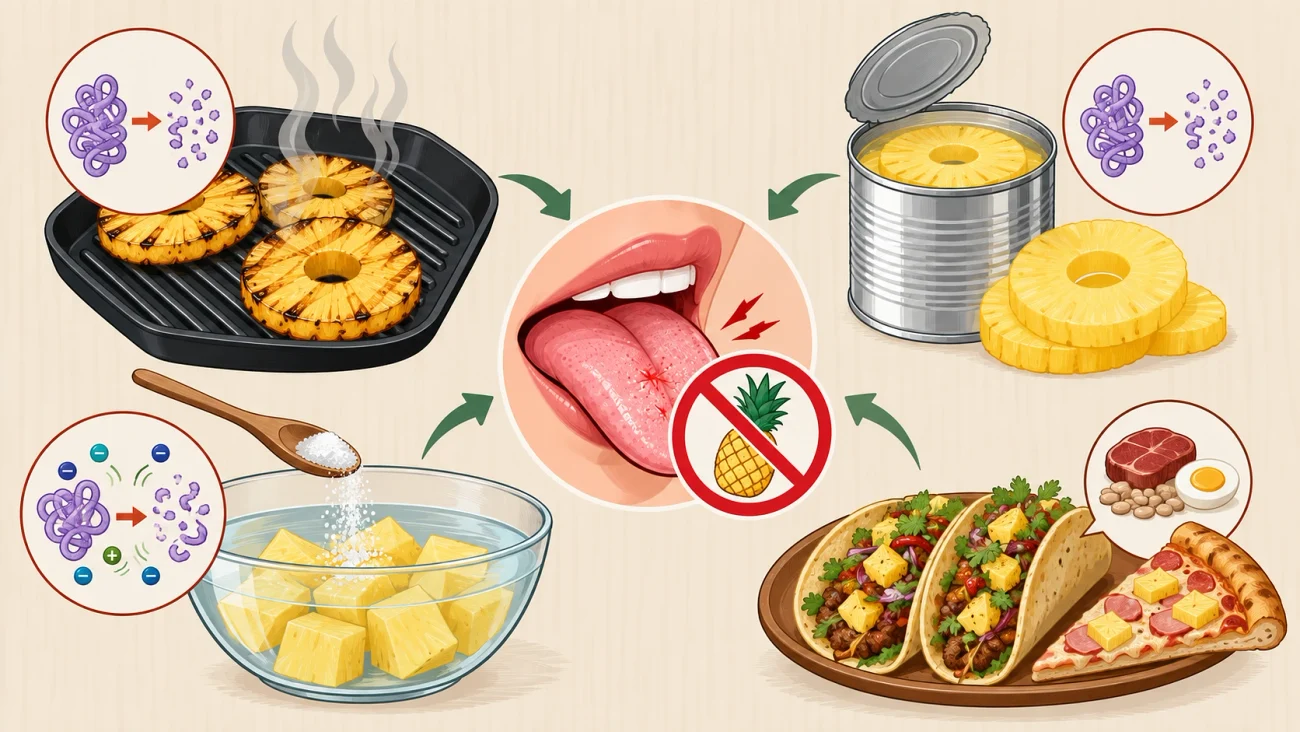
Enzymes are proteins and proteins fall apart at cooking temperatures. Somewhere between 160 and 175°F, about 70 to 80°C, bromelain unfolds and stops working, and it does not start again when the fruit cools. Canned pineapple was heated past that point to stop bacteria growing in the tin, so a ring out of a tin has been through a hotter afternoon than most steaks and you can eat them by the bowlful. Grilling does the same in a minute or 2 a side, with caramelised sugar on the outside. Blanching in hot water works if you want it soft and cold afterwards.
Soak It In Salt Water:
There is an older kitchen trick for people who want it raw and cold. Salt dissolved in water splits into charged sodium and chloride ions, those ions push in between the protease and the water molecules it needs to hold its shape, and it loses that shape the way it would under heat, only more gently. Science Meets Food walks through the chemistry if you want the amino acid level version. Soak the cut chunks in salted water for a few minutes, rinse, and the sting is either gone or well down. Less complete than the grill, but the fruit still tastes like fruit, which the grilled one does not, it tastes like dessert.
Eating pineapple with other food helps too, because then the enzyme has a plate of other proteins to chew through before it reaches your mouth. Tacos al pastor and the Hawaiian pizza both make sense on that logic. The pizza people can argue about the rest.
What Bromelain Supplements Are Used For
Swelling, mostly. The Restorative Medicine monograph lists the mechanisms as effects on cytokines, which are the signalling chemicals that switch inflammation on, on platelet clumping, and on fibrin, the protein mesh that forms inside a bruise or a clot. A bruise settles faster when the fibrin holding it together gets broken down sooner, and that is the whole pitch. People have taken it for years after nose and sinus operations, after dental work, and after sports injuries. Marathon runners, tooth extractions, sinus surgery, sprained ankles, the same modest drop in swelling and bruising turns up across the small studies, and it is the swelling that moves more than the pain.
The human evidence is the weak part, and I did read the latest critical review rather than the abstract. It is in Frontiers in Nutrition, it lists antioxidant, anti-inflammatory, immune, pain reducing, anti ulcer and cholesterol lowering effects, and then the dose table under all that is mostly rats. One line is 40 rats on 1,000 mg per kilo a day for 3 weeks. Scale that to an 80 kilo person and it is 80 grams a day, which no one is taking and no bottle is selling. Medical News Today says the same thing in plainer words, it can reduce inflammation and help wounds heal as a supplement, no large scale human studies back that up, side effects are few. The anticancer papers exist and they are cell culture and animal work, so read them as that.
Eating the fruit does not get you the supplement dose either. The swelling studies use hundreds of milligrams of concentrated stem enzyme several times a day, a slice of fresh flesh carries a small fraction of that, and stomach acid deals with most of what is left. Fresh juice has some. Canned has none, the heat already took it out. So pineapple after a sprain is a pleasant idea and not the thing the studies did.
Who Should Not Take Bromelain
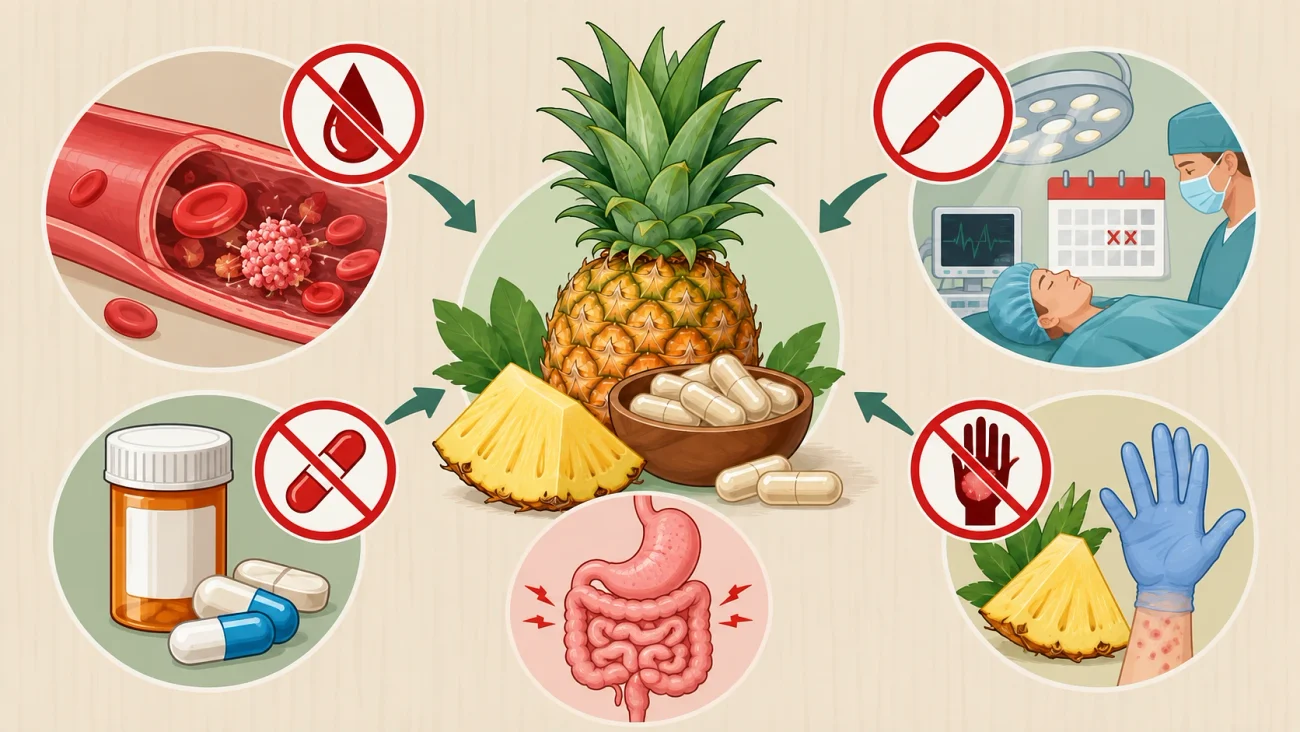
- Anyone on a blood thinner, because bromelain slows platelet clumping and the 2 together can mean easier bleeding.
- Anyone with surgery booked, for the same reason. Stop it 2 weeks out and tell the surgeon it was being taken.
- Anyone on antibiotics, since raises how much amoxicillin and a few other antibiotics the gut absorbs, and the dose was set without it.
- Anyone allergic to pineapple or latex, as the 2 cross react in some people.
Stomach upset and loose stools are the usual complaints at higher doses and they stop when the dose comes down.Using Pineapple As A Meat Tenderizer
Bromelain is sold as a meat tenderizer, made by the canning plants from the same peels and stems they would otherwise bin. Marinate a cheap cut in fresh pineapple juice and the protease breaks the tough connective proteins down, and if it is left too long the surface goes to mush, because unlike your tongue a steak cannot grow new cells. Twenty minutes is plenty, an hour is too long, and overnight is a mistake you make once.
Fresh pineapple in a gelatin dessert stays liquid for the same reason. Gelatin is a protein, bromelain cuts it into pieces too short to form a gel, and the bowl never sets. Use canned, or grill the fresh slices first.