
What Is the Role of Health in Human Capital Formation
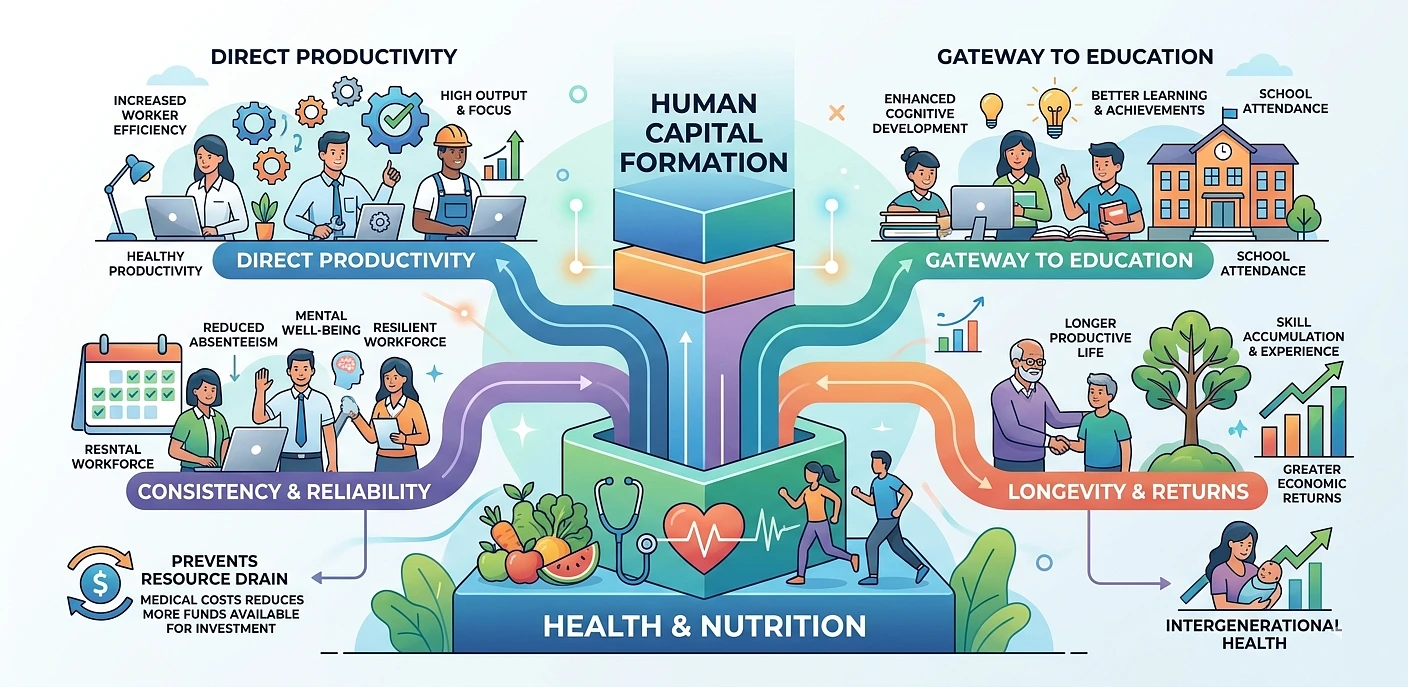
When economists talk about building a nation’s wealth, conversations usually revolve around technology, trade, or infrastructure. Health rarely takes center stage yet it should. Health is one of the most powerful drivers of human capital formation, and without it, every other investment in people falls short.
Human capital refers to the skills, knowledge, and productive capacity embedded in a population. Think of it as the human engine of economic growth. And just like any engine, it cannot run without fuel. That fuel is good health.
What Is Human Capital Formation?
Human capital formation is the process by which a society builds and improves the productive capabilities of its people. Economists like Gary Becker, Theodore Schultz, and Amartya Sen established that investing in people yields returns just as real as investing in machines or roads.
It is built through four main pillars:
- Education and training schooling, vocational skills, and lifelong learning.
- Health and nutrition physical and mental well-being.
- Work experience skills accumulated on the job over time.
- Supportive environments safety, legal protection, and access to opportunity.
Of all these pillars, health is the most foundational. A malnourished child cannot learn. A chronically ill worker cannot contribute. A mother in poor health cannot raise a thriving child. Health does not sit alongside the other pillars it holds them all up.
Health Directly Boosts Productivity
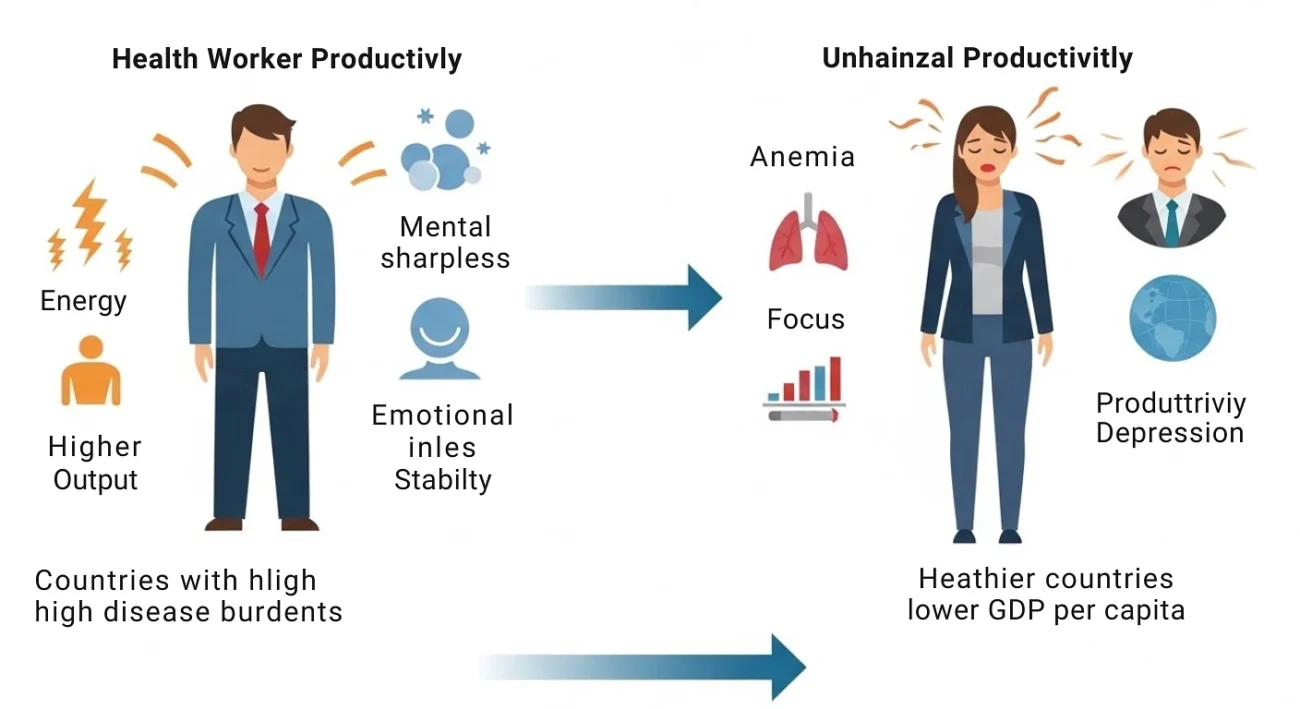
The most visible link between health and human capital is worker productivity. A healthy worker brings physical energy, mental sharpness, and emotional stability to the job all of which translate directly into output.
A worker battling chronic anemia a condition affecting over 1.6 billion people globally produces far less per hour than a healthy counterpart. The same applies to those suffering from untreated respiratory illness, pain disorders, or depression.
At the national level, countries with high disease burdens consistently underperform in GDP per capita compared to healthier nations at similar income levels. The Commission on Macroeconomics and Health (2001) estimated that improving health in low-income countries could generate economic returns many times greater than the cost of the investment itself.
Good Health Is the Gateway to Education
Health and education are deeply linked. But the health-to-education pathway deserves special attention because you cannot educate a sick child.
Early childhood is the most critical window. In the first 1,000 days of life, the brain forms up to one million neural connections per second. Disruptions during this period from malnutrition, infection, or chronic stress can cause lasting, often irreversible damage to cognitive capacity.
Children who grow up healthy are significantly more likely to:
- Enroll in school on time.
- Attend consistently and concentrate effectively.
- Score higher on cognitive assessments.
- Stay in school longer and earn higher qualifications.
- Command better wages as adults.
Even among school-age children, intestinal parasites, malaria, and untreated vision or hearing problems silently sabotage learning every day. A landmark study in Kenya found that a simple deworming program reduced school absenteeism by 25% with measurable wage benefits felt decades later.
Healthy People Show Up
Consistency is how human capital is built. Every sick day is a day of lost learning or lost output. Over time, these gaps accumulate into serious setbacks.
At work, absenteeism costs employers billions. The U.S. CDC estimates lost productivity from illness-related absence costs American businesses over $225 billion per year. In developing countries, where disease burden is heavier, the proportional cost is far greater.
In schools, missing even a few weeks per year can break the chain of sequential learning especially in subjects like mathematics or language, where each lesson builds on the last.
Mental health deserves particular emphasis here. Depression is the leading cause of disability worldwide. Workers with untreated mental illness don’t just miss more days they underperform even when present, a phenomenon economists call presenteeism. A workforce with access to mental health support is a more reliable, productive, and resilient one.
Longer, Healthier Lives Mean Greater Returns
There is a powerful economic logic behind health and longevity: investments in human capital only pay off if people live long enough to use them.
Economists David Bloom and David Canning demonstrated that a single additional year of life expectancy can increase long-run economic output by as much as 4%. When people expect to live longer, they and their governments invest more heavily in education, knowing the returns will be realized over a longer productive life.
This creates a virtuous cycle that compounds over generations:
- Better health longer life expectancy.
- Longer life greater returns on education investment.
- Higher education greater productivity.
- Greater productivity more resources for healthcare.
- Better healthcare better health and the cycle continues.
Older workers in good health also bring something irreplaceable: experience. The institutional knowledge, professional expertise, and mentorship capacity that comes with healthy aging is an enormous, often undervalued component of a nation’s human capital.
Poor Health Is a Drain on Resources
Poor health doesn’t just reduce output it actively diverts resources away from productive investment. The WHO estimates that around 100 million people are pushed below the poverty line every year due to out-of-pocket medical costs.
Households facing large medical bills have little left to invest in children’s schooling, nutrition, or skill development. A single serious illness can permanently derail the human capital trajectory of an entire family.
At the national level, governments in high-disease-burden countries spend disproportionate shares of their budgets on curative care treating illness after it strikes leaving fewer resources for the preventive health and education investments that build human capital over the long term.
Prevention is always more cost-effective than cure. Every dollar spent on measles vaccination, clean water, or prenatal care saves many more dollars in treatment costs and preserves the full productive potential of individuals who would otherwise be disabled or diminished.
Health Is Inherited
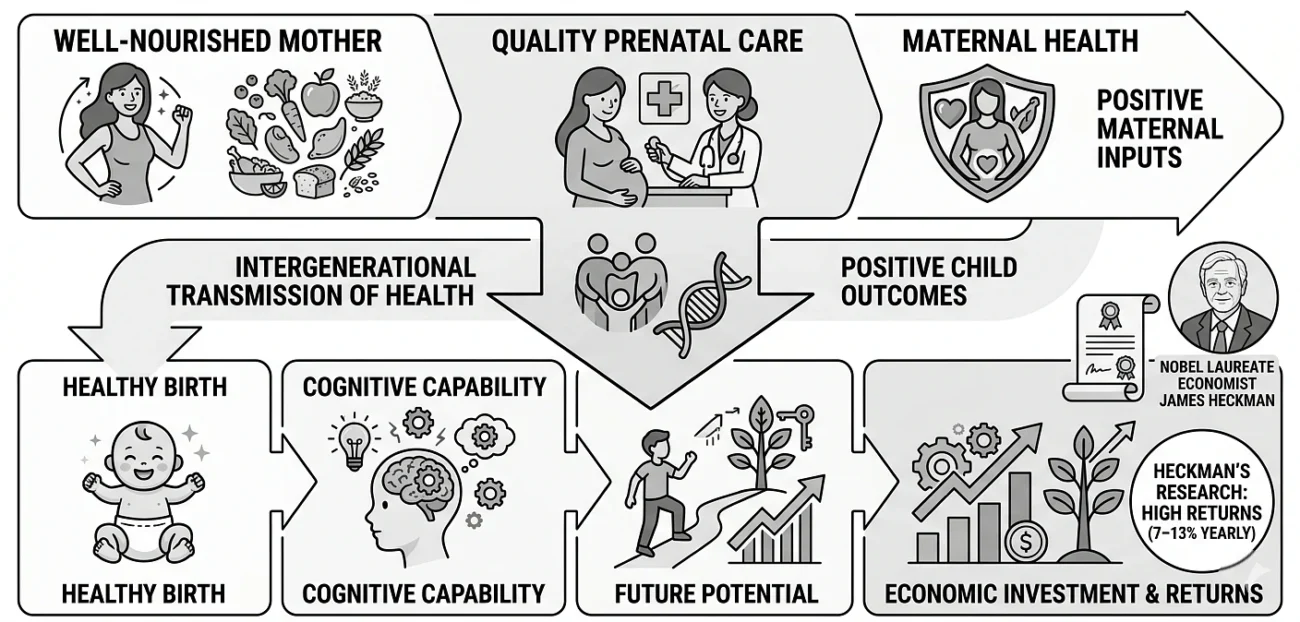
One of the most important and underappreciated dimensions of health in human capital formation is that it passes from one generation to the next.
A mother who is well-nourished and receives quality prenatal care is far more likely to deliver a healthy, cognitively capable child. Maternal malnutrition, anemia, and untreated infection, on the other hand, are directly linked to low birth weight, preterm birth, and impaired fetal brain development all of which reduce a child’s future human capital potential before they even take their first breath.
Nobel laureate economist James Heckman showed that interventions in the earliest years of life yield returns of 7–13% per year in increased productivity, reduced crime, and lower social expenditure. Investing in maternal and early childhood health is not charity. It is among the highest-return economic investments a society can make.
Health Capital: An Economic Asset, Not Just a Medical One
Economist Michael Grossman formalized the idea of health capital in his landmark 1972 model, treating health as a durable asset that depreciates over time and can be replenished through investment. In his framework, people invest in health not just to feel better, but because it determines how many healthy days they have available for productive activity.
This framing settles the debate: healthcare is not an expense. It is an investment. Societies that fund preventive care, early childhood nutrition, maternal health, and mental health services are not spending money. They are building the human capital base on which all future growth depends.